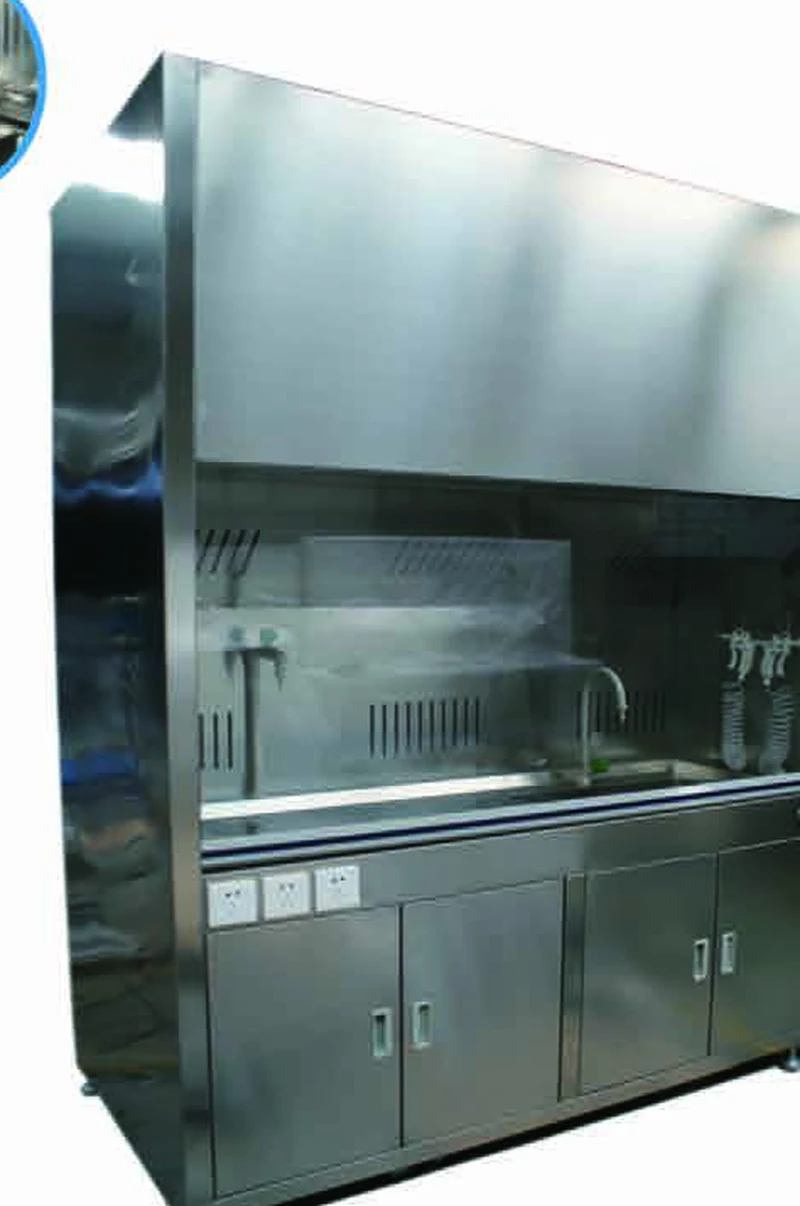
Cleanroom Equipment
Stainless Steel Fume Hood
Product Overview
The core function of a fume hood is extraction. Laboratory work generates harmful gases, odours, moisture and flammable or corrosive substances; the hood captures them close to the source before they can spread into the rest of the laboratory.
Note that it works in exactly the opposite direction to a clean bench: a clean bench supplies clean air to protect the sample, while a fume hood extracts contaminated air to protect the person. Hazardous material must be handled in a fume hood, never in a clean bench.
Key Specifications
- Rated Airflow
- 1,500~3,000 m³/h
- Face Velocity
- 0.3–0.6 m/s (adjustable)
- Noise Level
- ≤ 60 dB
- Power Supply
- AC 220V / 380V, 0.18–4 kW, 10–15 A outlets



Specifications
- Body Material
- Carcass: steel-and-wood, all-steel, all-stainless or PP engineering plastic. Worktop: stainless steel, solid epoxy resin, ceramic or natural marble
- Structure
- Sash opening height 0–750 mm
- Rated Airflow
- 1,500~3,000 m³/h
- Face Velocity
- 0.3–0.6 m/s (adjustable)
- Power Supply
- AC 220V / 380V, 0.18–4 kW, 10–15 A outlets
- Noise Level
- ≤ 60 dB
- Illuminance
- 200 LX
- Features & Accessories
- PP gooseneck faucet, PP tap, water and air guns, one-piece stainless steel sink, ABS five-hole power socket
- Weight
- 200~250 kg
Model Reference
| Model | Working Size (mm) | Overall Size (mm) | Users |
|---|---|---|---|
| VLC–1200 | 1000×650×1030 | 1200×800×2350 | 1 |
| VLV–1500 | 1300×650×1030 | 1500×800×2350 | 1 |
| VLV–1800 | 1600×650×1030 | 1800×800×2350 | 2 |
Detailed Description
Face velocity is the safety metric, not extract volume
Many buyers look only at extract volume, but what actually determines safety is the face velocity at the sash opening — the speed at which air draws contaminants inward. Two hoods with identical extract volume will have completely different face velocities if their sash openings differ. The larger the opening, the lower the face velocity, and the more easily contaminants escape. That is why sash opening height matters on the specification sheet: keeping the sash at or below the recommended height is what puts face velocity at its design value. Working with the sash fully open removes the safety margin.Material follows the chemistry
All stainless steel resists heat and mechanical damage and cleans well, which suits general chemical and biological work — but it does not tolerate strong acids or chloride-rich environments. PP engineering plastic resists strong acids and alkalis and is the only sensible choice around hydrofluoric, hydrochloric or nitric acid, where stainless steel corrodes through quickly. Steel-wood and all-steel cost less and suit teaching laboratories and general analytical rooms where reagents are not strongly corrosive. Choosing the wrong material does not merely shorten service life — the structure of the hood is weakened by corrosion while in use, which is considerably more dangerous than visible rust.Selection References
Before ordering, verify the efficiency grade, media type, and whether the operating environment fits your requirements.