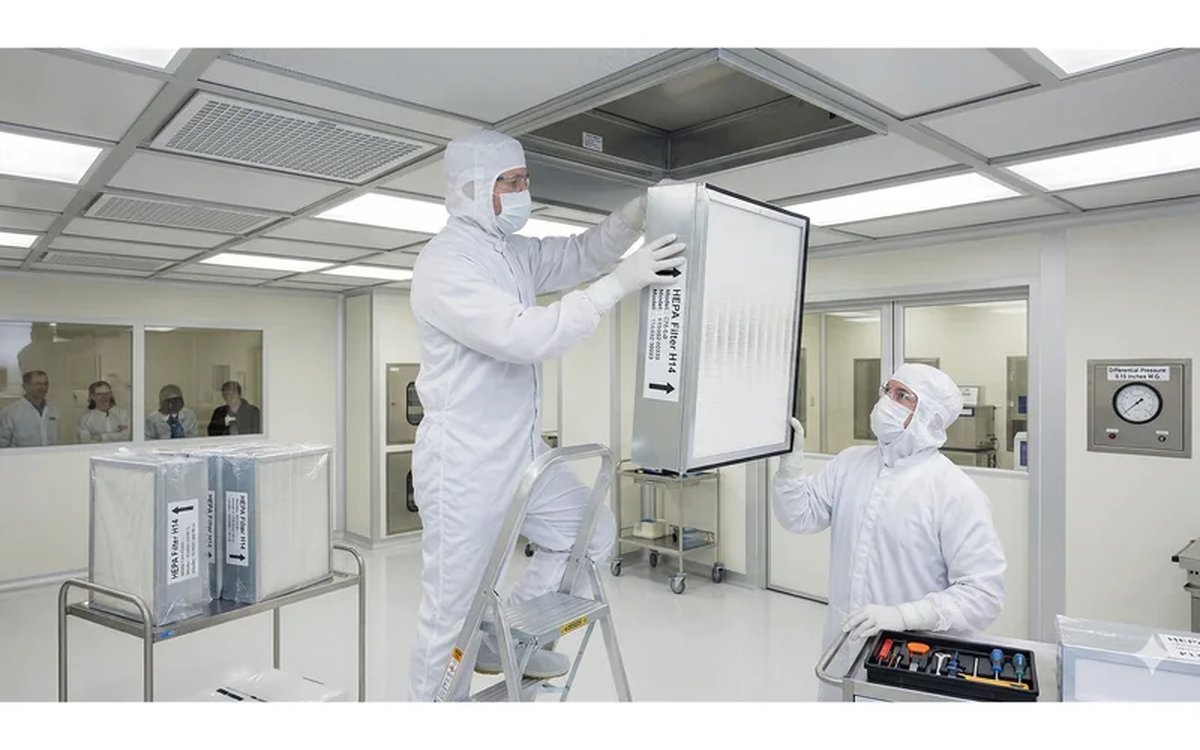
99.95 % and 99.995 % sound like they differ by only 0.045 %. But — 10× more particles slip through.
"One More 9" Costs an Order of Magnitude
Per EN 1822 / ISO 29463, high-efficiency filters come in five grades:
Chart 1: HEPA / ULPA Efficiency Ladder (EN 1822 / ISO 29463)
Each rung drops the penetration count by one order of magnitude — 10× stricter than the last
| Grade | Efficiency (@MPPS) | Penetration per million |
|---|---|---|
| H13 | 99.95 % | ≤ 500 particles / M |
| H14 | 99.995 % | ≤ 50 particles / M |
| U15 | 99.9995 % | ≤ 5 particles / M |
| U16 | 99.99995 % | ≤ 0.5 particles / M |
| U17 | 99.999995 % | ≤ 0.05 particles / M |
Efficiencies measured at the MPPS (Most Penetrating Particle Size, ~0.1–0.3 μm) per EN 1822 / ISO 29463. "Penetration" = particles passing through per 1,000,000 challenge particles.
Every rung drops the penetration count by one decade:
- ▸H13 (≥99.95 %) — up to 500 particles slip through per million challenge particles
- ▸H14 (≥99.995 %) — up to 50
- ▸U15 (≥99.9995 %) — up to 5
- ▸U16 (≥99.99995 %) — up to 0.5
- ▸U17 (≥99.999995 %) — up to 0.05
From H13 to U17 the efficiency gap is 10,000×. That's what "one more 9" actually buys.
MPPS: The Filter's Weakest Point
Intuition says a filter is worse at catching smaller particles. Wrong.
Filters capture via three overlapping mechanisms: inertial impaction (large particles), interception (mid), and Brownian diffusion (small). In the 0.1–0.3 μm window none of the three dominates — that's the MPPS (Most Penetrating Particle Size).
EN 1822 / ISO 29463 measure every efficiency rating at the MPPS. Not at a convenient size where the filter looks good — at the single worst point of the efficiency curve.
"H14 ≥ 99.995 %" really means: even at the hardest-to-catch particle size, no more than 50 ppm slip through.
What Does 27 % More Pressure Drop Buy You?
Same size (Baisheng 610 × 610 × 292 mm), same airflow (1,000 CMH):
Chart 2: Initial Pressure Drop — H14 HEPA vs U15 ULPA
Baisheng 610 × 610 × 292 mm filters, measured at rated airflow 1,000 CMH
Every 60 Pa increase in pressure drop raises fan power draw by ~10–15 %, adding 200–400 kWh per FFU per year. Over-specifying ULPA inflates both capex and long-run operating cost.
U15 runs 60 Pa higher than H14 — ~27 % more pressure drop.
That 60 Pa is not free. It means:
- ▸Fans pull 10–15 % more power to push air through
- ▸Each FFU burns an extra 200–400 kWh per year
- ▸A fab with 1,000 FFUs adds hundreds of thousands to its annual power bill
Every extra 9 costs pressure drop and energy. Pay where it matters, skip where it doesn't.
HEPA or ULPA? Start From Your ISO Class
Filter selection isn't "higher is better" — it's driven by the ISO 14644-1 cleanliness requirement:
Chart 3: ISO Class vs Filter Grade Mapping
Recommended filter grade and airflow pattern for each ISO 14644-1 cleanliness class
| ISO Class | Recommended filter | Typical application | Airflow |
|---|---|---|---|
| Class 3 (↓) | U15 / U16 ULPA | Advanced semi lithography, EUV optics | Laminar |
| Class 4–5 | H14 HEPA | General semi, OLED, aseptic pharma fill | Laminar |
| Class 6–7 | H13 HEPA | Electronic assembly, optics inspection, pharma C/D | Turbulent OK |
| Class 8–9 | Medium / high-eff | Food packaging, OR perimeter, general cleanroom | Turbulent OK |
General engineering guidance. Final selection depends on the process, target particle size, fallout limits, and qualification state. ISO Class 1–2 is outside this table.
Quick mapping:
- ▸Advanced semi lithography / EUV (ISO Class 3 and below) — must use U15 or U16 ULPA
- ▸General semi, OLED, aseptic pharma fill (ISO Class 4–5) — H14 HEPA is enough
- ▸Electronic assembly, optics inspection, pharma grade C/D (ISO Class 6–7) — H13 HEPA suffices
- ▸Food packaging, OR perimeter (ISO Class 8–9) — medium or high-efficiency filters are fine
Forcing U16 into an ISO Class 5 aseptic fill line just burns cash for no engineering benefit. Conversely, saving money with H14 in an EUV optics bay can scrap a single million-dollar reticle.
Three Real-World Selection Traps
Trap 1: Blindly Chasing the Highest Grade
Over-spec drives up both upfront cost and long-term operating cost (higher ΔP → more electricity). Pin the ISO Class first, then pick the filter — not the other way round.
Trap 2: Looking Only at Average Efficiency, Not Per-Unit Scan Test
"This filter averages H14 efficiency" does not mean no local pinhole leaks. EN 1822-4 requires a per-unit scan test for H14 / U15 and above: a mobile probe scans the entire filter face, confirming no local point exceeds the penetration limit.
Always demand the per-unit Scan Test report on delivery. Without it, an average-efficiency certificate can't catch local leaks.
Trap 3: Forgetting to Set a Terminal ΔP = Replacement Trigger
Initial pressure drop is not forever. As dust accumulates, ΔP climbs. The engineering rule of thumb: set terminal ΔP at 2–2.5× initial ΔP and replace at that point.
Example for H14 HEPA: 220 Pa initial → terminal at 440–550 Pa. Hit that, swap it out. Running fans against perpetually high ΔP burns energy and shortens motor life.
Bottom Line: Higher Grade Isn't Better — The Right Grade Is
When picking HEPA / ULPA, the real questions are not "which is strongest" but:
- 1What ISO Class does my process need?
- 2Has MPPS efficiency been verified? (Scan test)
- 3Does the pressure/energy profile match my fan curve?
- 4When does terminal ΔP arrive? Budget for how many replacements?
The right grade matters more than the expensive grade.