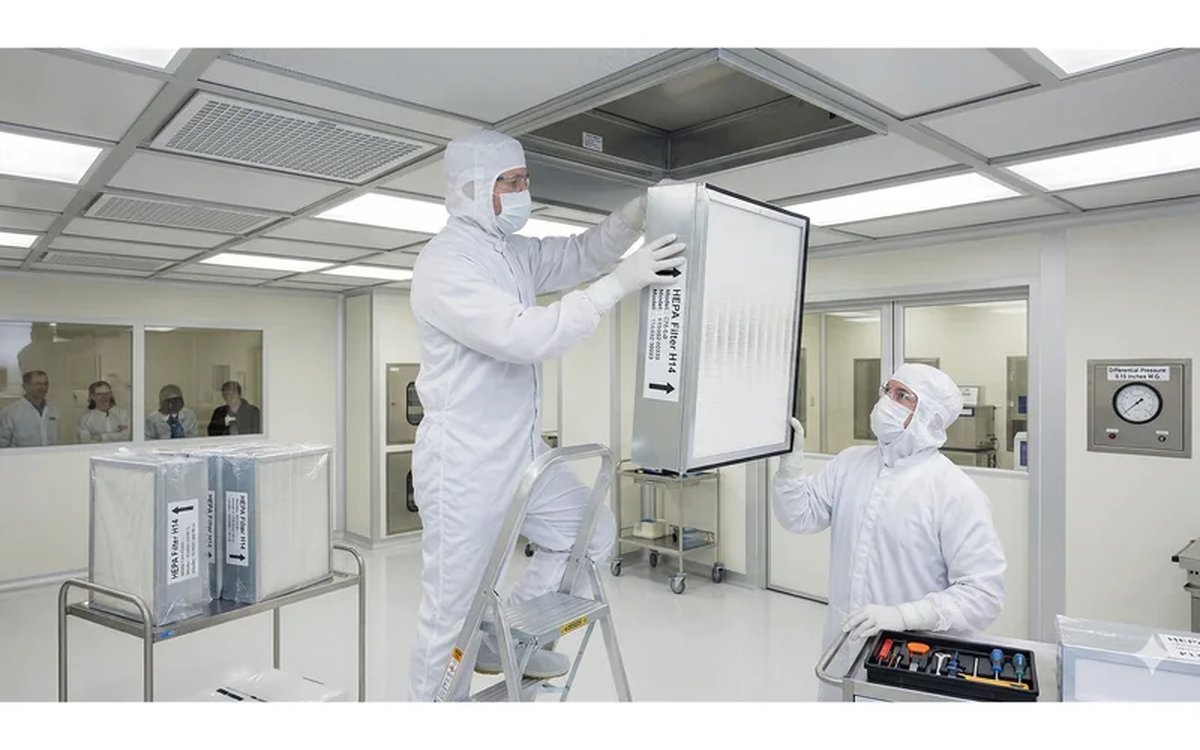
If the pre-filter is a "screen door," the medium filter is the "bodyguard" — it intercepts 90% of threats so HEPA only handles the final 10%. The stronger the bodyguard, the longer the VIP lives.
Where Medium Filters Sit in the Filtration Chain
A complete air filtration system typically has three stages:
- 1Pre-filter (G1–F7) → blocks ≥5μm coarse dust
- 2Medium filter (F7–F9) → blocks 0.3–5μm fine dust ← you are here
- 3HEPA / ULPA (H13–U17) → blocks ≥0.12μm ultra-fine particles
The medium filter's purpose is simple: HEPA is too expensive to face all the dust directly. A single HEPA H14 costs hundreds to thousands, lasting 2–3 years. Without a medium "bodyguard," 1–5μm particles hammer the HEPA directly, potentially cutting its life to 6–12 months.
Conversely, a medium filter costs tens to low hundreds and lasts 6–12 months. Spending a few hundred on a medium filter to block an extra 6 months of dust saves you half a HEPA replacement.
What Separates F7, F8 and F9
These three grades follow EN 779. Since 2018, ISO 16890 uses ePM1 (capture efficiency for 0.3–1μm particles) for finer differentiation.
Medium Filter F7 / F8 / F9 Grade Comparison
Higher ISO 16890 ePM1 = stronger HEPA protection, but more pressure drop
| Grade | ePM1 Eff. | ePM2.5 Eff. | Target particles | HEPA life gain | Initial ΔP |
|---|---|---|---|---|---|
| F7 | ≥ 50 % | ≥ 65 % | 1–5 μm dust, bacteria carriers | HEPA life ×1.5–2 | 80–120 Pa |
| F8 | ≥ 70 % | ≥ 80 % | 0.5–3 μm fine dust, fumes | HEPA life ×2–2.5 | 100–150 Pa |
| F9 | ≥ 85 % | ≥ 90 % | 0.3–1 μm sub-micron | HEPA life ×2.5–3 | 120–180 Pa |
ΔP values are typical initials for 592×592 mm standard frames at rated airflow. ePM1 captures 0.3–1μm particles — the key metric for HEPA protection.
The key metric is ePM1:
- ▸F7 (ePM1 ≥50%): Captures half of sub-micron particles. Suitable when there's no HEPA downstream (office buildings), or when downstream is HEPA H13 with moderate cleanliness requirements.
- ▸F8 (ePM1 ≥70%): Captures 70%. The industry's go-to "universal grade" — pharmaceutical GMP zones, hospital isolation rooms, and electronics secondary filtration mostly use F8. Balanced ΔP and protection.
- ▸F9 (ePM1 ≥85%): Captures 85%. Used in semiconductor fab dry-coil sections, EUV litho pre-stages — wherever HEPA unit cost is extreme. Highest ΔP, increased fan energy.
Selection rule of thumb: Downstream HEPA H13 → use F7–F8; downstream HEPA H14 → use F8–F9; no HEPA → medium filter is the final stage, F7 balances IAQ and energy.
Three Structures: V-Bag, Mini-Pleat, Rigid Cell
Grade determines "how much to capture"; structure determines "how to install, how often to change." Same F8, but three structures have completely different ΔP, dust capacity, and depth profiles.
Three Medium Filter Structures: V-Bag vs Mini-Pleat vs Rigid Cell
Choosing structure = balancing ΔP curve, dust capacity & install space
AHU return, VAV systems, long replacement cycles
Depth-limited, low-ΔP need, energy retrofit
High-clean secondary, vibration env, HEPA pre
Values are typical for F8 grade at rated airflow. V-Bag has highest capacity but deepest; Mini-Pleat has lowest ΔP but mid capacity.
V-Bag: The Dust Capacity Champion
V-Bag is the most traditional and common medium filter structure. Filter bags hang on a frame like a row of "pockets," expanding when air flows through — unfolded area is 3–5× the frame face area.
- ▸Strength: Highest dust capacity (600–900 g), longest replacement cycle (6–12 months)
- ▸Weakness: Deepest installation depth (300–600 mm), AHU must have enough space
- ▸Best for: AHU return-air sections, semiconductor MAU secondary stages, hospital central HVAC
Mini-Pleat: The Energy-Saving Favorite
Mini-Pleat uses dense pleating to pack large amounts of media into a thin frame — like folding an A0 sheet into A4 size.
- ▸Strength: Lowest initial ΔP (80–110 Pa), shallowest depth (150–300 mm), significant energy savings
- ▸Weakness: Mid-range dust capacity, shorter cycle than V-Bag
- ▸Best for: AHU retrofits with limited depth, new buildings requiring low-ΔP per energy codes, FFU pre-stages
Why "low ΔP" = energy savings? The AHU fan pushes air through the filter. Every 50 Pa reduction in filter ΔP cuts fan energy consumption by ~8–15%. For a 24/7 commercial building, the annual electricity difference can be tens of thousands.
Rigid Cell: The Stability Champion
Rigid Cell uses hard plastic or metal frames to fix the media in a rigid structure — unlike bags that sway with airflow.
- ▸Strength: Rock-solid structure, no wobble, no leakage, stable ΔP curve
- ▸Weakness: Higher ΔP (110–150 Pa), costlier than V-Bag
- ▸Best for: Vibration environments (near equipment), high-cleanliness secondary filtration, HEPA pre-stages requiring stable airflow
Selection in Practice: Downstream Decides
The medium filter doesn't exist in isolation — its grade and structure depend on "what comes after."
Medium Filter Application Scenarios & Grade Pairing
The more expensive/sensitive the downstream → the higher the medium filter grade
| Scenario | Pre-filter | Medium grade | Downstream | Why this grade |
|---|---|---|---|---|
| Semicon fab dry coil | G4 | F8–F9 | HEPA H14 | HEPA cost is extreme; F9 maximizes life |
| Pharma GMP clean zone | G4 | F8 | HEPA H13 | cGMP demands stable cleanliness; F8 balances ΔP & protection |
| Hospital neg-pressure room | G3–G4 | F7–F8 | HEPA H13 | Exhaust HEPA protection + cross-infection control |
| Office building central HVAC | G4 | F7 | — | No HEPA downstream; F7 is final stage, balancing IAQ & energy |
| Electronics SMT line | G4 | F7–F8 | HEPA H13 | Prevent solder particles from contaminating PCBs |
Pairings reflect common industry practice, not mandatory rules. Special processes (EUV, BSL-3) may have stricter requirements.
Common selection mistakes:
- ▸Mistake 1: "F9 is best, use F9 everywhere" — F9 has the highest ΔP. If downstream is only HEPA H13, F8 is sufficient; F9 just wastes electricity.
- ▸Mistake 2: "Office buildings don't need medium filters" — Without a medium filter, the AHU's F7 is the terminal filter. On high-PM2.5 days, indoor air quality suffers badly.
- ▸Mistake 3: "Structure doesn't matter, only grade" — Same F8: V-Bag can last 9 months, Mini-Pleat may hit terminal ΔP in 6. Replacement cost and downtime differ significantly.
Pressure Drop Management: The Medium Filter's Life Metric
Like pre-filters, medium filter replacement timing is based on ΔP, not the calendar:
| Grade | Initial ΔP (typical) | Recommended terminal ΔP | Consequence of exceeding |
|---|---|---|---|
| F7 | 80–120 Pa | 200–250 Pa | Insufficient airflow, premature HEPA loading |
| F8 | 100–150 Pa | 250–300 Pa | AHU fan overload, increased noise |
| F9 | 120–180 Pa | 300–350 Pa | Energy spike, system pressure imbalance |
Advanced practice: Install a DP transmitter on the AHU, connected to BMS (Building Management System). Auto-alert when ΔP exceeds threshold — no human memory required. Standard in semiconductor fabs and hospitals.
ISO 16890 vs EN 779: Cross-Reference for Purchasing
| EN 779 | ISO 16890 | Correspondence |
|---|---|---|
| F7 | ePM1 ≥ 50% | F7 ≈ ePM1 50% + ePM2.5 65% |
| F8 | ePM1 ≥ 70% | F8 ≈ ePM1 70% + ePM2.5 80% |
| F9 | ePM1 ≥ 85% | F9 ≈ ePM1 85% + ePM2.5 90% |
ISO 16890 adds the ePM2.5 dimension, enabling more granular assessment of PM2.5 capture. Recommend requesting test reports under both standards when purchasing.
FAQ
Q: Is there a big price gap between F7 and F8?
A: Typically F8 costs 20–40% more than F7 (same structure, same size). But F8 extends HEPA life by 6–12 months, and HEPA costs hundreds to thousands. On a TCO basis, F8 almost always wins. The exception: if there's no HEPA downstream (e.g., office terminal filtration), F7 is sufficient.
Q: Can medium filters be washed and reused?
A: Almost never. Medium filters use fiberglass or synthetic fiber media — washing destroys the fiber structure and electrostatic effect, causing significant efficiency loss. A few "washable" medium filters exist (metal mesh, special PE), but their efficiency is typically only G4–F5, not true medium-efficiency. Conclusion: medium filters are consumables — replace at end of life.
Q: V-Bag or Mini-Pleat — how to choose?
A: Two conditions: (1) Does the AHU have enough depth? V-Bag needs 300–600 mm, Mini-Pleat only 150–300 mm. (2) Do you prioritize "fewer changes" or "lower ΔP"? For fewer changes → V-Bag (high dust capacity); for energy savings → Mini-Pleat (low ΔP). Semiconductor MAUs typically choose V-Bag (minimize shutdowns); office energy retrofits choose Mini-Pleat.
Q: Why do some specs say "MERV 13" instead of F7/F8?
A: MERV is the ASHRAE 52.2 grading system, mainly used in North America and the Middle East. MERV 13 ≈ F7–F8, MERV 14 ≈ F8–F9. Asian markets use EN 779 / ISO 16890, but if the client spec says MERV, you need a cross-reference table.
Q: Must there always be a pre-filter before the medium filter?
A: Strongly recommended. Without a pre-filter, ≥5μm coarse dust hits the medium filter directly, cutting its life by 50–70%. A pre-filter costs a few dollars; a medium filter costs tens to hundreds — skipping the pre-filter is burning money.
Related Standards & References
- ▸EN 779 — Particulate Air Filters for General Ventilation (F7–F9)
- ▸ISO 16890 — Particulate Air Filters for General Ventilation (ePM1/ePM2.5/ePM10)
- ▸ASHRAE 52.2 — Method of Testing (MERV 1–16)