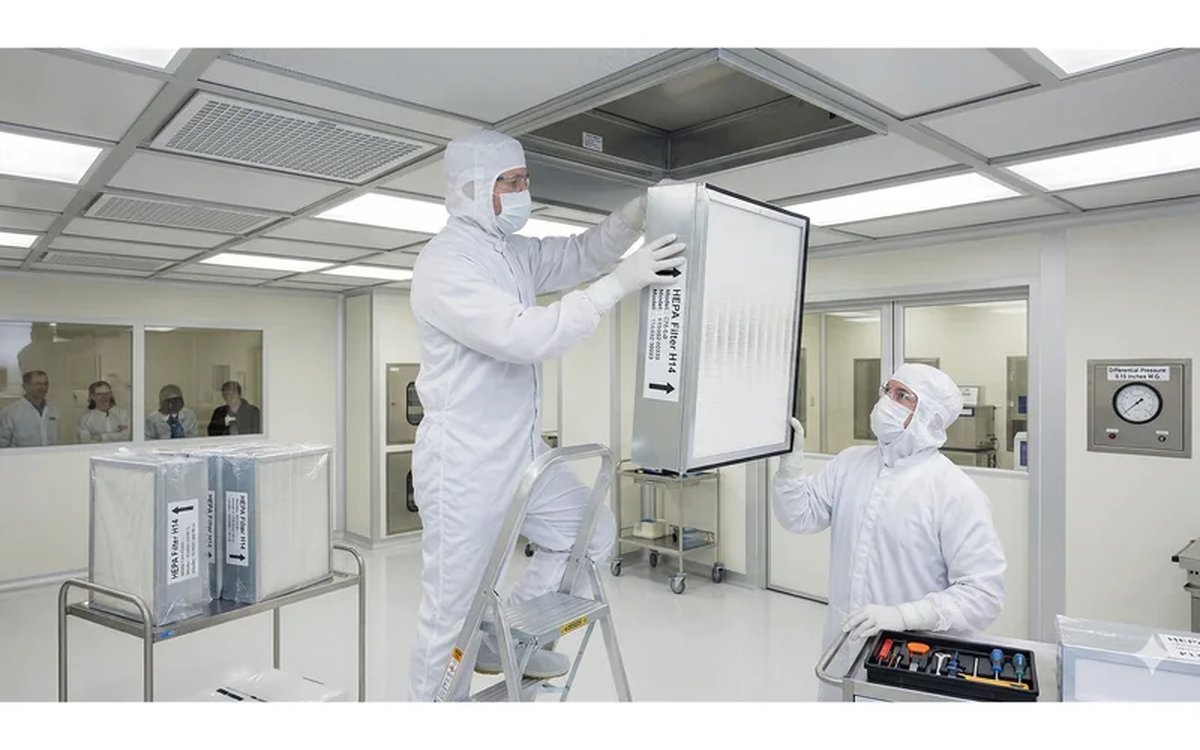
A $6 pre-filter that isn't changed on time will cut the life of the $250 HEPA behind it in half. Penny wise, pound foolish — the most common mistake in air filtration systems.
What Is a Pre-Filter: The "Screen Door" of HVAC
Think of the screen on your window — it blocks mosquitoes and leaves but lets fine dust pass through. A pre-filter plays the same role in an HVAC system: the first line of defense, capturing particles ≥5μm including construction dust, pollen, hair, and fiber debris.
How big is 5μm? About 1/15 the diameter of a human hair. Anything smaller needs the downstream medium-efficiency filter and HEPA filter.
The core value of a pre-filter isn't "how clean it filters" — it's taking bullets for the expensive filters behind it. Regularly changing a cheap pre-filter can extend HEPA life by 40% or more — the highest-ROI action in filter management.
Grade Classification: EN 779 G1 Through F7
Pre-filter efficiency grades follow EN 779, from low to high: G1, G2, G3, G4 (coarse) and F5, F6, F7 (fine). Since 2018, ISO 16890 has been gaining adoption, classifying by ePM10 (efficiency against ≥10μm particles) — but purchase specs still commonly use the EN 779 G3/G4/F5 designations.
Pre-Filter Grade Comparison: G1 → F7
EN 779 / ISO 16890 mapping — higher grade = more pressure drop
| Grade | Arrestance | Target particles | Typical use | Initial ΔP |
|---|---|---|---|---|
| G1 | 50–65 % | Coarse sand, large fibers | Exhaust vents, louvers | 20–30 Pa |
| G2 | 65–80 % | Dust, pollen | Factory intake, parking | 25–40 Pa |
| G3 | 80–90 % | Building dust, hair | Office AHU first stage | 30–50 Pa |
| G4 | 90–95 % | Fine dust, spores | Semicon OA, hospital gen. | 40–60 Pa |
| F5 | 40–60 %* | ≥1μm suspended dust | Lab, electronics pre-stage | 50–80 Pa |
| F6 | 60–80 %* | Bacteria carriers, soot | Pharma buffer, food plant | 60–100 Pa |
| F7 | 80–90 %* | Fine particles, fumes | Cleanroom pre, HEPA pre | 80–120 Pa |
* F5–F7 efficiency is EN 779 colorimetric, not gravimetric。Efficiency is EN 779 Arrestance (gravimetric). G1–G4 target ≥10μm coarse dust; F5–F7 begin capturing ≥1μm fine particles. ISO 16890 uses ePM10 efficiency.
How to read this chart:
- ▸G3 / G4 are the most common choices. Office buildings, factory HVAC, and hospital general areas almost always use G4 as the first stage.
- ▸G1 / G2 are for extreme dust loads — cement plant intakes, parking garage ventilation, exhaust pre-screening.
- ▸F5 / F6 / F7 border on medium-efficiency. If your downstream is HEPA H13/H14, F5 or F6 as a second-stage pre-filter is usually sufficient.
Purchasing tip: Suppliers may list "G4 / ePM10 ≥50%", meaning the filter meets both EN 779 G4 and ISO 16890 ePM10 50%. Both standards coexist during the transition period — confirm which standard the quoted efficiency refers to.
This article covers pre-filters G1–F7 only. For the downstream HEPA stage — full H10–H14 / U15 grade specifications, the MPPS test principle, and ISO 14644 cleanliness class mapping — see the HEPA filter grade comparison table.
Three Structural Types: Panel, Bag & Pleated
Same G4 grade, completely different form factors. Structure determines dust-holding capacity, installation depth, pressure curve, and replacement frequency.
Three Pre-Filter Structures: Panel vs Bag vs Pleated
Same G4 grade, different structure → very different dust capacity, life & depth
High airflow, low ΔP, ample space
Long life, fewer changes, AHU return
Depth-limited, FFU pre-stage
Dust capacity and ΔP are typical values at G4 grade and rated airflow. Actual figures vary with media density and face velocity.
Quick rule of thumb:
- ▸Panel: Cheapest, thinnest, most frequent changes (1–2 months) — suited for high-airflow, low-cost environments like factory intake louvers
- ▸Bag: Highest dust capacity, longest life (3–6 months) — suited for AHU return-air sections, especially in semiconductor fabs and hospitals that minimize downtime
- ▸Pleated: Shallowest depth (50–100mm) — suited for FFU pre-stages and retrofit applications with limited frame depth
Real-world example: A 12-inch semiconductor fab MAU (make-up air unit) with 6 m² intake area and 120,000 CMH airflow. With panel G4 at the front, the dusty outdoor air fills the 150 g capacity in ~6 weeks, requiring shutdown for each change. Switching to bag G4 boosted capacity to 500 g and extended the cycle to 4 months — 4 fewer shutdowns per year, saving significant maintenance labor.
Frame Material Selection: Cardboard, Aluminum, Galvanized & Stainless Steel
The media is the "heart"; the frame is the "skeleton." Many people focus only on efficiency grade and overlook the frame — then find the cardboard frame has softened and warped in humid conditions, seals have failed, and dust is bypassing the media entirely.
Pre-Filter Frame Material Selection
The frame sets the life ceiling — will the media or the frame fail first?
| Frame | Temp range | Moisture | Fire rating | Frame life | Cost |
|---|---|---|---|---|---|
| Cardboard | < 70 °C | Poor (softens) | None | 1–3 months | ★☆☆☆ |
| Aluminum | < 200 °C | Good | Non-combustible | Reusable | ★★☆☆ |
| Galv. steel | < 350 °C | Good | Non-combustible | Reusable | ★★★☆ |
| Stainless (SUS) | < 500 °C | Excellent | Non-combustible | 10 yr+ | ★★★★ |
Temp and humidity are frame material limits, excluding media constraints. Paper frames soften in 2–4 weeks under high humidity.
Rules of thumb:
- ▸Cardboard: Cheap, light, fine for dry environments (offices, malls). A humid factory during monsoon season? Not recommended — the frame softens in 2 weeks.
- ▸Aluminum: Moisture-resistant, reusable (swap media, keep frame), lower long-term TCO than cardboard. Standard for most AHU installations.
- ▸Galvanized steel / Stainless steel: Heat-resistant, corrosion-resistant, used in chemical exhaust zones and as pre-stages for high-temperature filters. Stainless has the highest cost but lasts 10+ years in acid/alkali environments.
Real case: A display panel factory used cardboard G4 as the MAU first stage. Being near the coast, salt-laden air warped the frames in 3 weeks. Switching to aluminum frames extended the effective life of the same media from 3 weeks to 8 weeks — not because the media improved, but because the frame stopped failing first.
Application Scenarios: Who Uses Which Grade
A pre-filter isn't "just buy the best" — higher grade means higher pressure drop, and the AHU fan burns more electricity pushing air through. The core logic: What's downstream? How expensive is it?
| Scenario | Downstream filter | Recommended pre-filter | Structure |
|---|---|---|---|
| Semiconductor fab MAU | F7 + HEPA H14 | G4 | Bag (high capacity, long life) |
| Hospital general ward | F7 | G3–G4 | Panel or Pleated |
| Office building central HVAC | F7 | G4 | Bag (3–4 month cycle) |
| Factory exhaust system | None downstream | G2–G3 | Panel (lowest cost) |
| FFU pre-stage | HEPA H13/H14 | G4–F5 | Pleated (depth-limited) |
| Food plant GMP zone | F8 + HEPA | G4 | Bag (moisture-resistant Al frame) |
| Parking garage ventilation | None downstream | G1–G2 | Panel (low cost) |
When to Replace: Pressure Drop Is the Only Metric
"Change every 3 months" is a rough guess at best. The correct method is measuring pressure drop:
- 1Record initial ΔP (measure when newly installed — G4 panel typically 40–50 Pa)
- 2Set terminal ΔP (usually 2–2.5× initial, e.g., 100–120 Pa)
- 3Replace when ΔP is reached, regardless of calendar time
Why? Because a filter near a highway may hit terminal ΔP in 3 weeks, while one in a rural area may last 4 months. A fixed calendar schedule either wastes money (too early) or kills the HEPA (too late).
Money-saving formula: Install a differential pressure gauge (or ΔP switch, costs a few dollars) across the pre-filter. When the differential exceeds the threshold, it lights up or sends a signal. This small investment saves thousands annually in HEPA replacement costs — because you'll never forget to change the pre-filter, and HEPA life consistently extends by 40%+.
FAQ
Q: Is there a big difference between G4 and F5? Should I just go with F5?
A: G4 Arrestance (gravimetric) is ~90–95%; F5 Efficiency (colorimetric) is ~40–60% — different test methods, can't compare numbers directly. In simple terms, F5 is noticeably better at catching 1–5μm fine dust. But F5 initial ΔP is also 20–30 Pa higher. If you already have an F7 medium filter downstream, G4 is sufficient; if the pre-filter feeds directly into HEPA with no medium stage, F5 is safer.
Q: Can pre-filters be washed and reused?
A: Depends on the media. Metal mesh (aluminum, stainless) can be washed, dried, and reinstalled — common in kitchen exhaust pre-filtration. Non-woven and synthetic fiber media should not be washed — water destroys the fiber structure, causing efficiency loss and uneven ΔP. Disposable G4 panels cost a few dollars each; not worth the risk.
Q: How much does a pre-filter affect HEPA life?
A: Field data shows that diligent pre-filter + medium-filter replacement extends HEPA life by 40–60%. An HEPA H14 costs hundreds to thousands; a G4 pre-filter costs a few dollars. Every $1 spent on pre-filters saves $50–100 in HEPA replacement. This is why semiconductor fabs are fanatical about pre-filter schedules — their HEPA units cost thousands each.
Q: ISO 16890 or EN 779 — which should I follow?
A: Both standards coexist. ISO 16890 (introduced 2016) classifies by ePM1/ePM2.5/ePM10, which is more granular than EN 779's G/F system. However, after decades of EN 779 usage, industry specs, drawings, and acceptance criteria still mostly reference G3/G4/F5. In practice, know both and be able to cross-reference.
Q: What if the pre-filter pressure drop is too high?
A: Three approaches: (1) Use a larger filter (2× area ≈ –40% ΔP); (2) Switch from panel to bag or pleated (larger media area, lower ΔP); (3) Drop one grade (G4 → G3), but assess whether downstream filters can handle the extra dust load. High ΔP = insufficient airflow = the entire system is underperforming.
Related Standards & References
- ▸EN 779 — Particulate Air Filters for General Ventilation (G1–F9 grading)
- ▸ISO 16890 — Particulate Air Filters for General Ventilation (ePM1/ePM2.5/ePM10)
- ▸ASHRAE 52.2 — Method of Testing General Ventilation Air-Cleaning Devices (MERV 1–16)