The Role of HVAC Filters: The "Lungs" of an Air Conditioning System
An HVAC (Heating, Ventilation and Air Conditioning) system is essentially a building's respiratory system. Outdoor air enters, passes through temperature and humidity conditioning, and is supplied indoors. Filters are the system's "lungs" — they determine how clean the delivered air actually is.
A typical HVAC system has at least two filtration stages:
- ▸Pre-filter stage: Captures large particles (dust, hair, pollen) to protect downstream equipment from clogging.
- ▸Main filter stage: Captures fine particles (PM10, PM2.5) — this is the stage that truly determines indoor air quality.
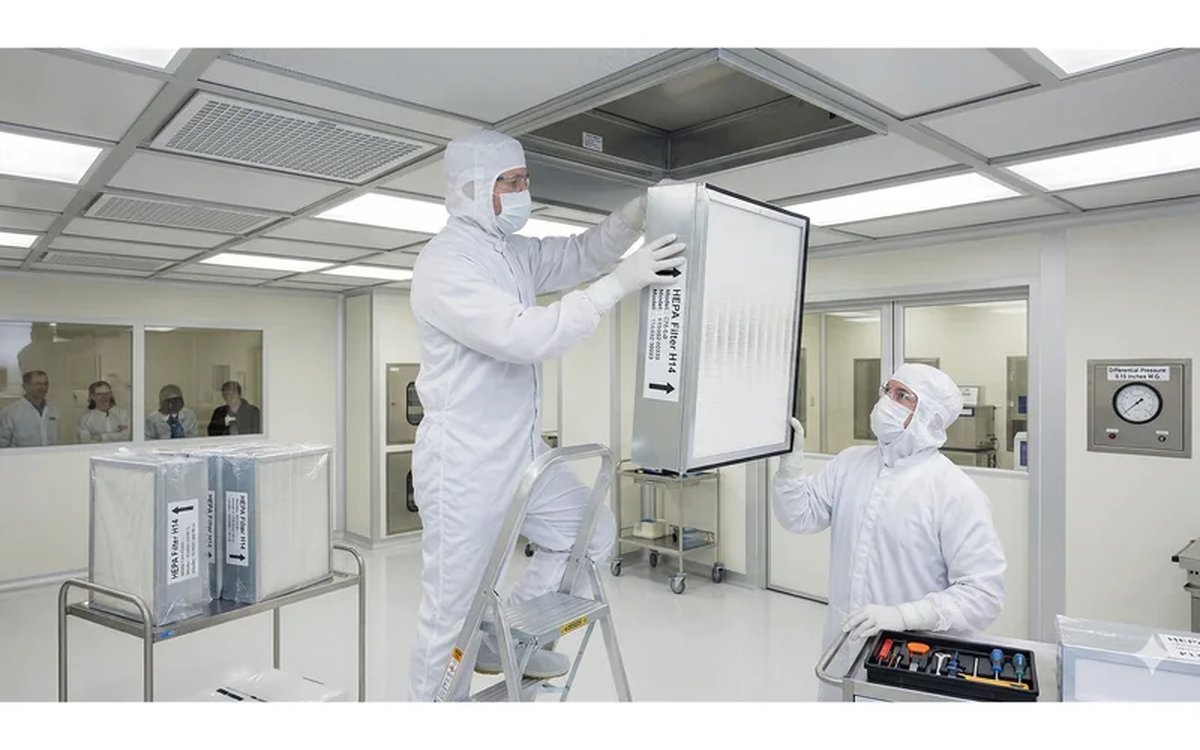
Certain high-demand environments (hospital operating rooms, cleanrooms) add a third or even fourth stage of high-efficiency / HEPA filtration to intercept the finest particles.
Common HVAC Filter Grades
From basic G1 to medical-grade H14, HVAC filter grades span a wide range. The following table summarizes efficiency, pressure drop, and typical applications for each grade.
Common HVAC Filter Grades at a Glance
From pre-filter to high-efficiency, mapped to ISO 16890 / EN 779
| Grade | Standard | Efficiency | Init. ΔP | Typical Use |
|---|---|---|---|---|
| G1–G4 | ISO Coarse | < 50% (ePM10) | 30–60 Pa | OA intake pre-filtration, protect downstream |
| M5–M6 | ISO ePM10 ≥50% | 50–80% (ePM10) | 60–120 Pa | General office AHU, shopping malls |
| F7 | ISO ePM2.5 ≥65% | ≥65% (ePM2.5) | 100–180 Pa | Schools, offices, data centers |
| F8 | ISO ePM2.5 ≥75% | ≥75% (ePM2.5) | 120–200 Pa | Hospital general areas, premium offices |
| F9 | ISO ePM1 ≥80% | ≥80% (ePM1) | 150–250 Pa | Hospital OR pre-filter, semiconductor MAU |
| H13–H14 | EN 1822 HEPA | ≥99.95–99.995% | 200–350 Pa | OR terminal, cleanroom ceiling |
Pressure drop values are initial; actual varies by media and construction. ePM efficiency per ISO 16890.
Is Higher Always Better? Not Necessarily
Many people assume "just install the best grade." But higher filter grades mean:
- ▸Higher pressure drop → fan needs more energy → higher electricity bills
- ▸Potentially faster clogging → high-efficiency filters have shorter life in dirty air
- ▸Possible airflow deficit → existing fans may not overcome the added resistance, starving the room of air
The right approach is to select the grade that is just sufficient for your scenario, not to chase the highest number.
Filter Configurations for Three Scenarios
Office buildings, hospitals, and semiconductor fabs all use HVAC systems, but their air quality requirements are worlds apart.
Office vs Hospital vs Factory: Three HVAC Filter Configs
Same HVAC system, very different filter grades and stages
| Scenario | Pre-filter | Main filter | Final filter | ACH |
|---|---|---|---|---|
| General office building | G4 | F7 | — | 6–10 |
| Premium office / data center | G4 | F8–F9 | — | 8–15 |
| Hospital general ward | G4 | F7–F8 | — | 6–12 |
| Hospital operating room | G4 | F9 | H13–H14 | 20–25 |
| Semiconductor / FPD fab | G4 + M6 | F9 | H14 / ULPA | 30–60+ |
General office building: Two-stage enough, F7 handles PM2.5 Premium office / data center: F9 protects sensitive equipment, tight temp control Hospital general ward: Infection control requires at least F7 Hospital operating room: Three-stage, terminal HEPA laminar Semiconductor / FPD fab: Four-stage, MAU→AHU→FFU, 60–100% coverage | ||||
Configurations are common design recommendations. Actual design depends on regulations, owner requirements, and outdoor air quality. Hospital OR per FGI / ASHRAE 170.
Scenario 1: General Office Building
The goal is simple: keep occupants comfortable and reduce PM2.5 exposure. In most cases, G4 pre-filter + F7 main filter is sufficient.
F7 filters capture over 65% of PM2.5 particles. Under normal outdoor air conditions (AQI < 100), indoor PM2.5 can be controlled below 15 µg/m³, meeting WHO recommended guidelines.
If the building is in a heavily polluted area (frequent AQI > 150), consider upgrading to F8 or F9, but verify the fan can handle the extra pressure drop.
Scenario 2: Hospital
Hospital filter configurations vary by zone:
- ▸General wards: G4 + F7–F8, 6–12 ACH. Focus is cross-infection control.
- ▸Operating rooms: G4 + F9 + H13–H14 terminal HEPA, 20–25 ACH. Terminal HEPA is typically installed in ceiling laminar flow diffusers for sterile airflow above the surgical field.
- ▸Negative-pressure isolation rooms: F9 + H14, and exhaust air must also pass through HEPA to prevent pathogen release.
Hospital design follows ASHRAE Standard 170 and FGI Guidelines, which specify minimum ACH and filtration grades for each zone.
Scenario 3: Semiconductor / High-Tech Fab
This is the most complex scenario. Air handling in a semiconductor fab typically has four stages:
- 1MAU outdoor air handling: G4 coarse + M6 medium-coarse — removes outdoor dust of all sizes.
- 2AHU return air handling: F9 medium-high — reduces particle counts in return air to acceptable levels.
- 3FFU terminal filtration: H14 HEPA or ULPA U15, mounted in the cleanroom ceiling, providing final high-efficiency filtration.
- 4Chemical filter (optional): Activated carbon or chemical media to remove AMC (Airborne Molecular Contamination).
Each stage has a different mission: front stages catch the big stuff, rear stages catch the small stuff. Working together, they reduce particle concentration from hundreds of thousands per m³ outdoors to below 3,520 per m³ (ISO 5).
Grade Upgrade vs Energy Cost: Is It Worth It?
Many facility managers want to upgrade filter grades to improve air quality but worry about skyrocketing electricity bills. Here are the actual numbers.
Filter Grade Upgrade vs Energy Cost Increase
Higher grade → higher pressure drop → more fan energy — but benefits are not linear
G4: Basic protection, mandatory
F7: Sweet spot: blocks 65% PM2.5
F9: Worth it only for high-demand (hospital, semi MAU)
H14: Terminal HEPA, pressure borne by FFU
Estimated for a single AHU at 10,000 CMH rated airflow, 8,760 hours/year, TWD 3.5/kWh. Actual varies by system resistance and fan efficiency.
Key Takeaways
- ▸G4 → F7: +100 Pa pressure drop, ~TWD 10,000/year extra electricity. PM2.5 filtration jumps from near-zero to 65%. Absolutely worth it.
- ▸F7 → F9: Another +100 Pa, ~TWD 10,000/year more. PM2.5 filtration goes from 65% to 80%. Unless you have specific requirements (medical, precision manufacturing), the cost-benefit is marginal.
- ▸F9 → H14: +100+ Pa jump, plus HEPA requires special housings and higher fan static pressure. Usually only at terminal points (FFU or ceiling HEPA box), never in the main AHU loop.
How Outdoor Air Quality Affects Selection
The same building in a clean-air city versus a polluted industrial zone may need different filter configurations. Worse outdoor air means heavier burden on pre-filters.
| Outdoor Condition | AQI Range | Suggested Pre | Suggested Main | Notes |
|---|---|---|---|---|
| Good | 0–50 | G4 | F7 | Standard config sufficient |
| Moderate | 51–100 | G4 | F7–F8 | F7 is fine, F8 for extra margin |
| Unhealthy for sensitive | 101–150 | G4 + M5 | F8 | Add pre-filter stage to relieve main filter |
| Unhealthy | 151–200 | G4 + M6 | F8–F9 | Dual pre-filter + high main |
| Very unhealthy | >200 | G4 + M6 | F9 | Consider standalone air purifiers too |
Replacement Frequency and Cost Considerations
Beyond grade and pressure drop, factor in Life Cycle Cost (LCC): purchase price + energy + replacement cost.
| Filter Grade | Suggested Interval | Unit Price (TWD) | Replacement Trigger |
|---|---|---|---|
| G4 | 1–3 months | 200–800 | ΔP reaches 2× initial or visibly dirty |
| F7 | 6–12 months | 1,500–4,000 | ΔP increase > 100 Pa |
| F9 | 6–12 months | 3,000–8,000 | ΔP increase > 120 Pa |
| H14 | 3–5 years | 8,000–25,000 | ΔP reaches 2× initial or PAO leak test fails |
Pro tip: Pre-filters are the cheapest consumable. Replacing them frequently extends the life of main and HEPA filters significantly — saving money overall.
Selection Workflow Summary
- 1Identify scenario requirements: Office? Hospital? Manufacturing? Each has different regulations and standards.
- 2Assess outdoor air quality: Check local annual average AQI to determine pre-filter configuration.
- 3Choose main filter grade: F7 is the sweet spot for most scenarios. Medical and high-tech consider F8–F9.
- 4Determine terminal needs: Do you need HEPA? Depends on scenario (OR, cleanroom = yes).
- 5Verify fan margin: Sum all filter pressure drops (initial + terminal), confirm fan static pressure is sufficient.
- 6Estimate LCC: Don't just look at purchase price — calculate 3–5 year electricity + replacement costs.
FAQ
Q1: Do office buildings really need HEPA? Unless there are special needs (heavy pollution area or immunocompromised occupants), general offices do not need HEPA. F7–F8 already controls PM2.5 to comfortable levels. Installing HEPA in the main AHU loop creates too much pressure drop for standard fans.
Q2: Pre-filters are cheap — can I skip them? Absolutely not. Pre-filters may only catch large particles, but they protect everything downstream — coils, main filters, and fans. Without them, main filters clog within weeks and coils accumulate dust that degrades heat exchange efficiency.
Q3: How do I measure pressure drop and know when to replace? Install a differential pressure gauge (or switch) before and after each filter bank. When the reading exceeds the manufacturer's recommended terminal pressure drop (typically 1.5–2× initial), it is time to replace. Some systems wire differential pressure switches to trigger alarms automatically.
Q4: Is the difference between F7 and F8 significant? F7 ePM2.5 efficiency is ≥65%; F8 is ≥75% — a 10-percentage-point gap. For general offices, the impact is modest. But F8 adds 20–40 Pa pressure drop, costing roughly TWD 2,000–3,000/year more. If budget allows and the fan has headroom, F8 is a reasonable upgrade.
Q5: How do I know if my fan can handle the upgrade? Add up the pressure drops of every component in the system (coils + pre-filter terminal ΔP + main filter terminal ΔP + ductwork + diffusers). This total must not exceed the fan's rated static pressure. If upgrading filters pushes the total past the limit, either install a larger fan or stay at the current grade.