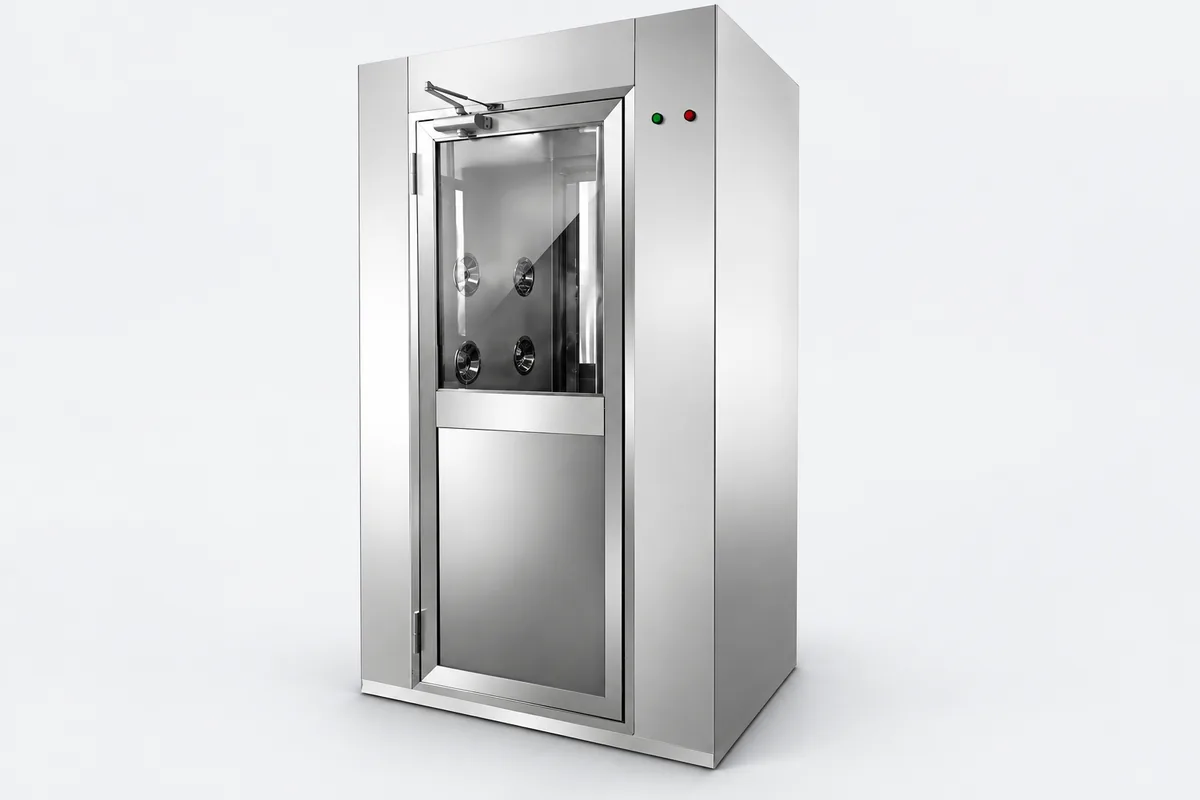
Automatic Door Air Shower
Product Overview
Features & Specifications



Detailed Description
Touch-free matters because of gloves
After people finish gowning in the changing room and put on gloves, their hands are the cleanest part of the body and the part that most needs to stay clean. EU GMP Annex 1 (2022) §7.10 requires gowning and hand washing according to written procedures; once the procedure is done, if the next step is to push open by hand a door that everyone has touched, the preceding steps are undermined. The automatic door type hands the door-opening action over to a button or sensor; the button can be pressed with an elbow or the back of the hand, and the sensor type requires no contact at all. For pharmaceutical, biotech and food entrances with high hand-hygiene requirements, this is the most direct reason to choose automatic doors.The passage rhythm is set by the program
With a manual-door air shower, when people open the door and how long it stays open depend on each person's habits; the automatic door type fixes the whole sequence: entrance opens, enter, close, shower, exit opens, leave, close. Every cycle takes the same time, so peak throughput can be calculated in advance. Assuming a 15-second shower and about 5 seconds each for opening and closing each door, each person takes about 25 seconds, so about 2 people can pass per minute. If the result is not enough, what needs to be reconsidered is the number of units or switching to a tunnel, not shortening the shower time. Automation also solves a common problem: people forgetting to close the door when leaving. With manual doors, if a door is not properly closed, the interlock keeps the next person from entering, or worse, the interlock gets bypassed and the two doors end up open straight through; automatic doors close by themselves after the person leaves.Button or sensor activation
Sensor activation is completely contact-free, but if the sensing range covers the corridor, passers-by will also trigger the door, causing unnecessary door openings and possibly disrupting the interlock rhythm. Button activation requires a deliberate action and can be pressed with an elbow or the back of the hand, with fewer false triggers. If the area in front of the entrance is a busy corridor, choose a button or reduce the sensing range; if it is a dedicated changing area that only people about to enter will approach, the sensor type is more convenient. On the exit side, the door is usually opened automatically by the program when the shower ends, so no separate trigger is needed.Swing doors still need swing clearance
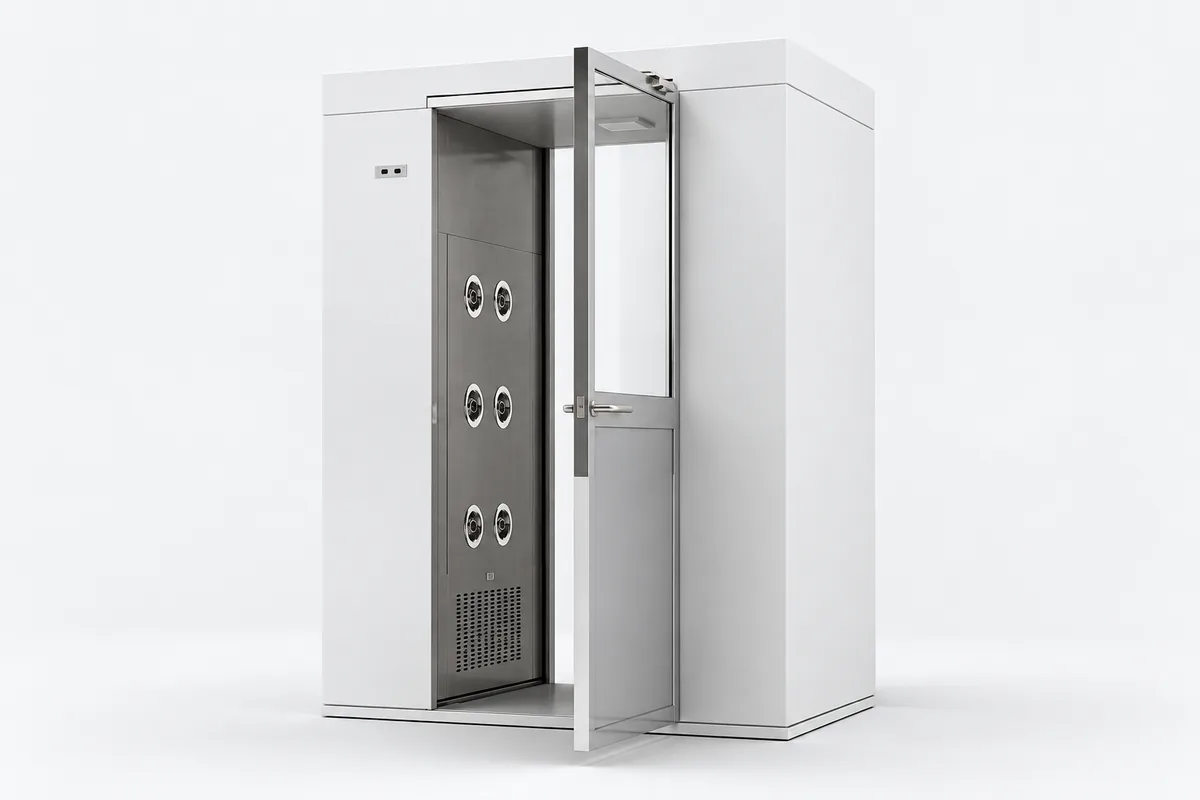
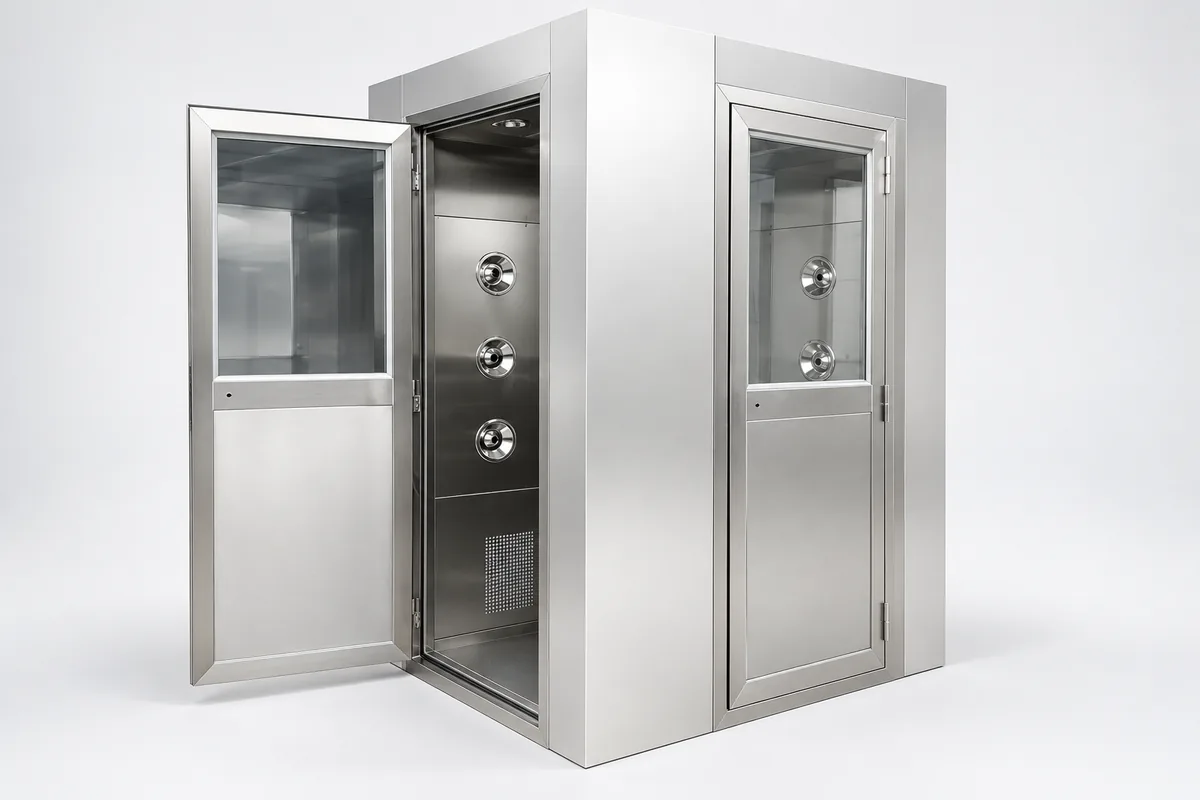
The door leaves of the automatic door type are still swing doors, so fan-shaped clearance is needed in front of and behind the doors, and the door operator itself is mounted near the door head, requiring installation height above the door opening. Where the corridor is narrow and swing clearance cannot be provided, choose the automatic sliding door type or the roll-up door type instead. Presence detection in the door-closing path is standard equipment, stopping the door from closing when a person or object is detected; when trolleys pass through, the detection range should cover the height of the trolley body, not just a person's waist.Power failures and emergencies
What most needs to be defined in advance for power-operated doors is the failure state: whether the doors stay locked or can be pushed open manually during a power failure. Both doors are locked during the shower, and if a power failure or fire occurs at that moment, people must be able to get out. This must be decided together with the plant's fire escape plan, written into the requirements when ordering, and included in operating procedures and training. The emergency door-release button inside the enclosure should be placed within reach but where it will not be pressed by accident.Swing doors or sliding doors
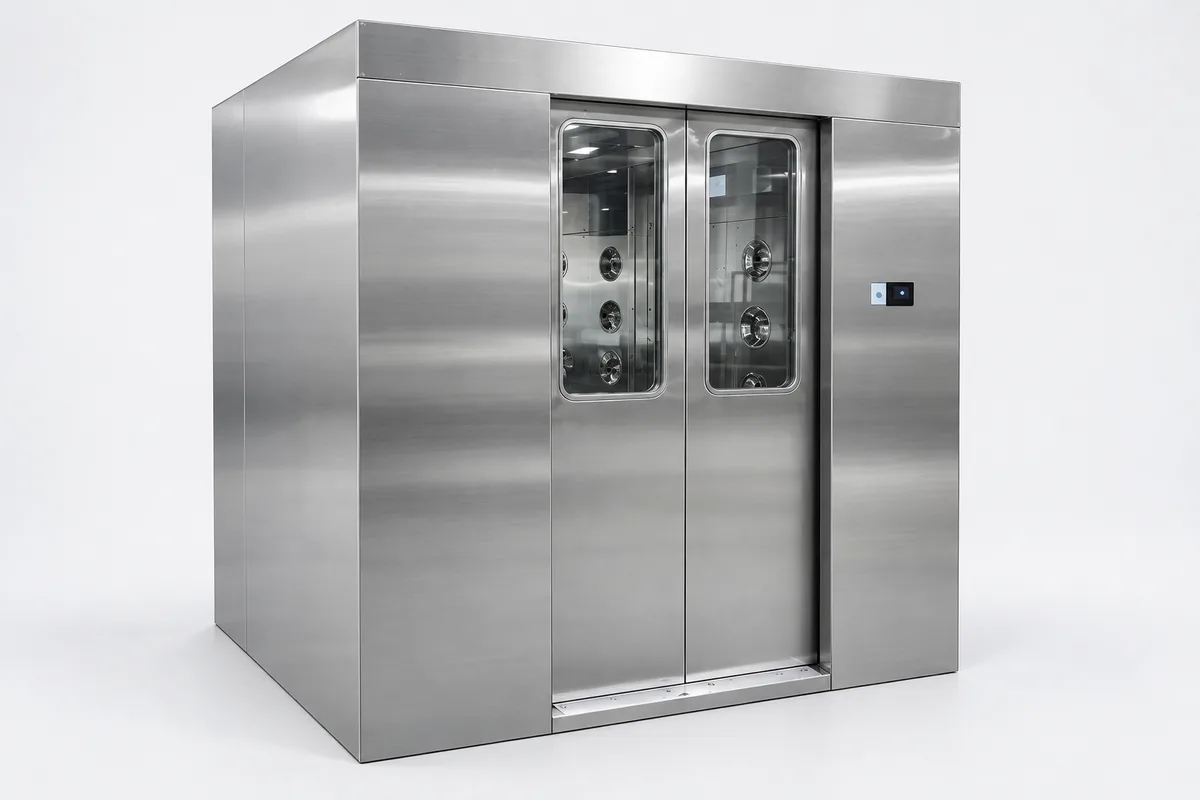
Automatic swing doors are simple in structure, with a complete sealing surface between door leaf and frame; automatic sliding doors need no swing clearance, but the enclosure must be widened to house the door leaves. Both can be touch-free; the difference lies in site space and sealing requirements, which can be compared using the description of the automatic sliding door type.Frequently Asked Questions
Can the automatic door type let people out before the shower is complete?
No. During the shower both doors are locked by the electronic interlock, and the exit door opens automatically only after the shower time ends; the shower time can be set between 0–99 s. What needs attention is emergencies: in a power failure or fire, the door locks must be releasable or openable by hand, otherwise people will be trapped inside; this failure state must be decided together with fire protection planning when ordering.
How many people per minute can pass through the automatic door type?
Assuming a 15-second shower and about 5 seconds each for opening and closing each door, each person takes about 25 seconds, or about 2 people per minute; a two-person enclosure (depth approx. 1500 mm) taking two people at a time doubles this. The advantage of automatic doors is that each cycle takes a fixed time, so peak throughput can be calculated in advance. When the result is insufficient, add enclosures or switch to a multi-person tunnel rather than shortening the shower time.
How much installation space does the automatic door type need?
A typical single-person enclosure measures approx. 1300–1400 × 1000 × 2050–2100 mm externally, and the two-person depth is approx. 1500 mm. Two more things must be added: the swing clearance in front of and behind the swing doors, and the height near the door head for mounting the door operator. Where the corridor is narrow and swing clearance cannot be provided, choose the automatic sliding door type or the roll-up door type.
Selection References
Before ordering, verify the efficiency grade, media type, and whether the operating environment fits your requirements.