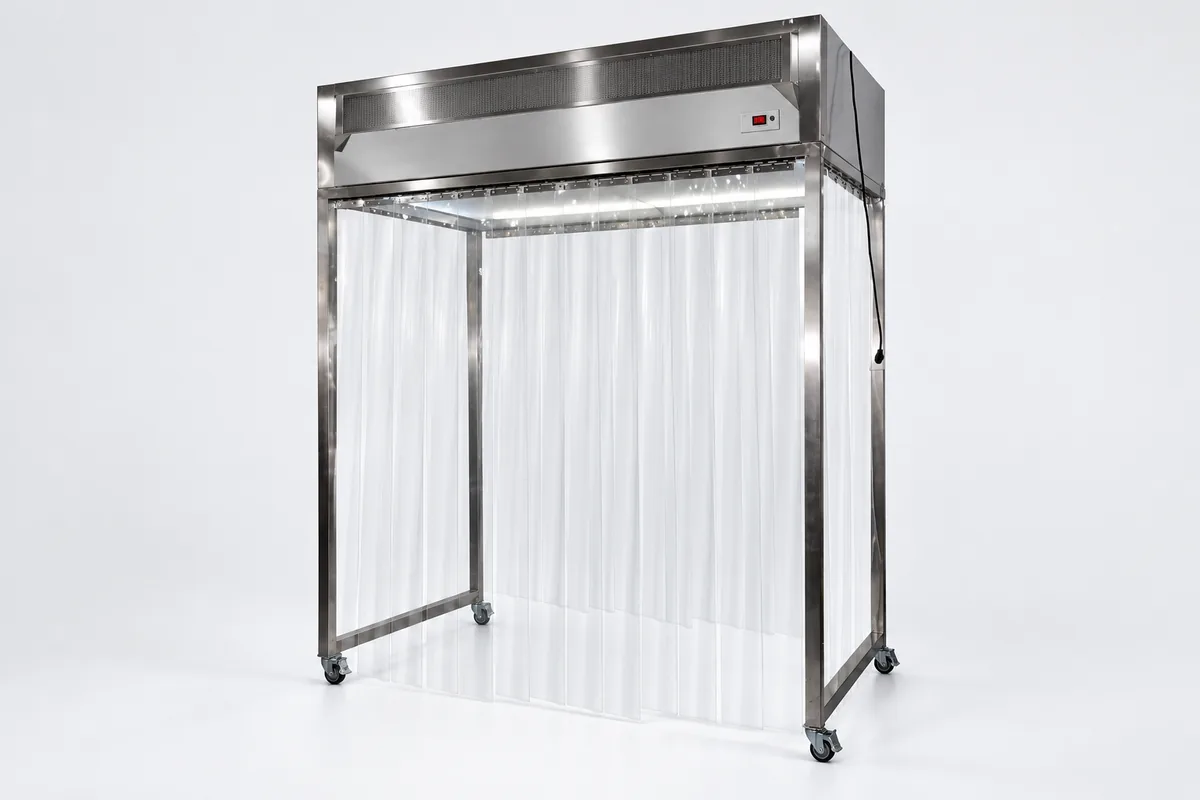
Clean Booth
Product Overview
Features & Specifications



Detailed Description
The economics of local purification
The cost of purifying a whole plant is not just construction: air handling units, ducts, filters, air change rates, floors and partitions all have to be planned for the highest class, and every kilowatt-hour afterwards goes into maintaining that class. An actual review of a production line often finds that only a handful of workstations need ISO 5, while ISO 7, ISO 8 or even ordinary air conditioning is enough elsewhere. Enclosing those points with a booth gives local high cleanliness at the critical operations while the surroundings remain a lower-grade background environment. A booth needs no building partitions and can be dismantled, moved and reassembled when the line changes; this is the biggest difference from a fixed cleanroom.Where 0.45 m/s ±20% comes from
There is no dedicated product standard for clean booths. The design value of 0.45 m/s ±20% follows the US FDA 2004 aseptic processing guidance recommendation for unidirectional flow in ISO 5 critical areas; the EU GMP Annex 1 (2022) §4.30 guidance value for Grade A unidirectional flow is 0.36–0.54 m/s at the working position. Both are velocities measured at the working position. An FFU outlet face velocity of 0.45 m/s does not mean the velocity at working height inside the booth is the same; the taller the booth, the shorter the curtains and the larger the equipment, the more easily velocity and uniformity at the work surface deviate. At acceptance, measure at working height rather than relying on the FFU specification; measuring points should cover the four corners and the centre of the booth. Uniformity matters as much as the average: the corners are often where velocity is lowest and surrounding air is most easily entrained.Curtain tightness determines the actual class
A booth's class is not determined by the FFUs alone but by "supply airflow" and "curtain leakage" together. However clean the supply from the top, if there are large gaps all around and surrounding air is constantly entrained, the measured class will still fall short of the design value. Trade-offs among the three curtain types: Anti-static strip curtains: overlapping strips that people and carts can pass straight through, the most convenient for access; insufficient overlap, or strips that do not fall back into place after being pushed aside, become leak points. Anti-static grid curtains: one-piece, with better enclosure than strips, and see-through; entering and leaving requires pushing them aside or a separate doorway. Acrylic: the tightest enclosure and the easiest to clean, and can be made as fixed walls; the trade-off is weight and difficulty of adjustment, and entrances must be planned separately. Two more points: the gap between the curtains and the floor is the outlet for air in the booth. If it is too large, positive pressure cannot build up inside and surrounding air is easily entrained; if the curtains touch the floor completely, the air has no outlet and escapes erratically through the curtain joints, and passage is inconvenient. The booth must maintain positive pressure relative to its surroundings, and the optional differential pressure gauge shows this directly.Moving, modification and acceptance
The class must be determined by particle count measurement in accordance with ISO 14644-1; equivalence with the old Class system follows FDA 2004: ISO 5 = Class 100, ISO 6 = Class 1,000, ISO 7 = Class 10,000, ISO 8 = Class 100,000. The frame material depends on the cleaning method: stainless steel withstands repeated disinfection and is the easiest to wipe; powder-coated cold-rolled steel costs less and suits electronics assembly where dust removal is the main concern; aluminium profile is the lightest and the easiest to assemble and modify, suiting lines whose layout changes often. EU GMP Annex 1 (2022) §4.6 also points out that clean areas should not have recesses that are hard to clean, and projecting shelves and equipment should be kept to a minimum; on a booth, the frame joints and curtain hangers are where dust most readily collects. The top cover can be cold-rolled steel panel, stainless steel or grid curtain; the top surface outside the FFUs must be closed off to prevent unfiltered air from above being drawn in. When a booth on swivel castors is moved, the surrounding airflow, the return air path and nearby particle sources all change, so the original acceptance results no longer apply and measurements must be repeated. Likewise, adding or removing FFUs, changing the curtain material or opening a new entrance are all changes that require reconfirmation.Frequently Asked Questions
Can a clean booth achieve ISO 5?
It can be planned for, but only measurement counts. The design assumes vertical unidirectional flow from FFUs at the top at 0.45 m/s ±20%, FFUs covering the entire booth top, and enclosing curtains that maintain positive pressure inside. The actual class is affected by booth height, curtain gaps, equipment inside the booth and personnel movement, and must be confirmed by particle counting at working height in accordance with ISO 14644-1. Booths where FFUs cover only part of the top, or with very short curtains, usually measure worse than the design value, and both points must be factored in at the planning stage.
Should a booth use strip curtains, grid curtains or acrylic?
It depends on traffic frequency and how tight the enclosure needs to be. Strip curtains are the most convenient for access, with people and carts passing straight through, but they leak if overlap is insufficient or strips do not fall back; grid curtains are one-piece with better enclosure, but must be pushed aside or a separate doorway provided; acrylic gives the tightest enclosure and is the easiest to wipe, but is heavy and hard to adjust. A common arrangement is acrylic or grid curtains on three sides and anti-static strip curtains on the access side.
Does a booth fitted with swivel castors need revalidation after being moved?
Yes. The actual class of a booth depends on the surrounding airflow, the return air path and nearby particle sources; when it moves, all of these change and the original particle count results no longer represent the new location. After moving, at least re-measure air velocity and particle counts at working height and confirm that the booth still maintains positive pressure relative to its surroundings; the same applies when FFUs are added or removed or the curtains are replaced.
Selection References
Before ordering, verify the efficiency grade, media type, and whether the operating environment fits your requirements.