Silicon Wafer Etching and Cleaning Machine
Product Overview
Features & Specifications



Detailed Description
Two process steps in one machine
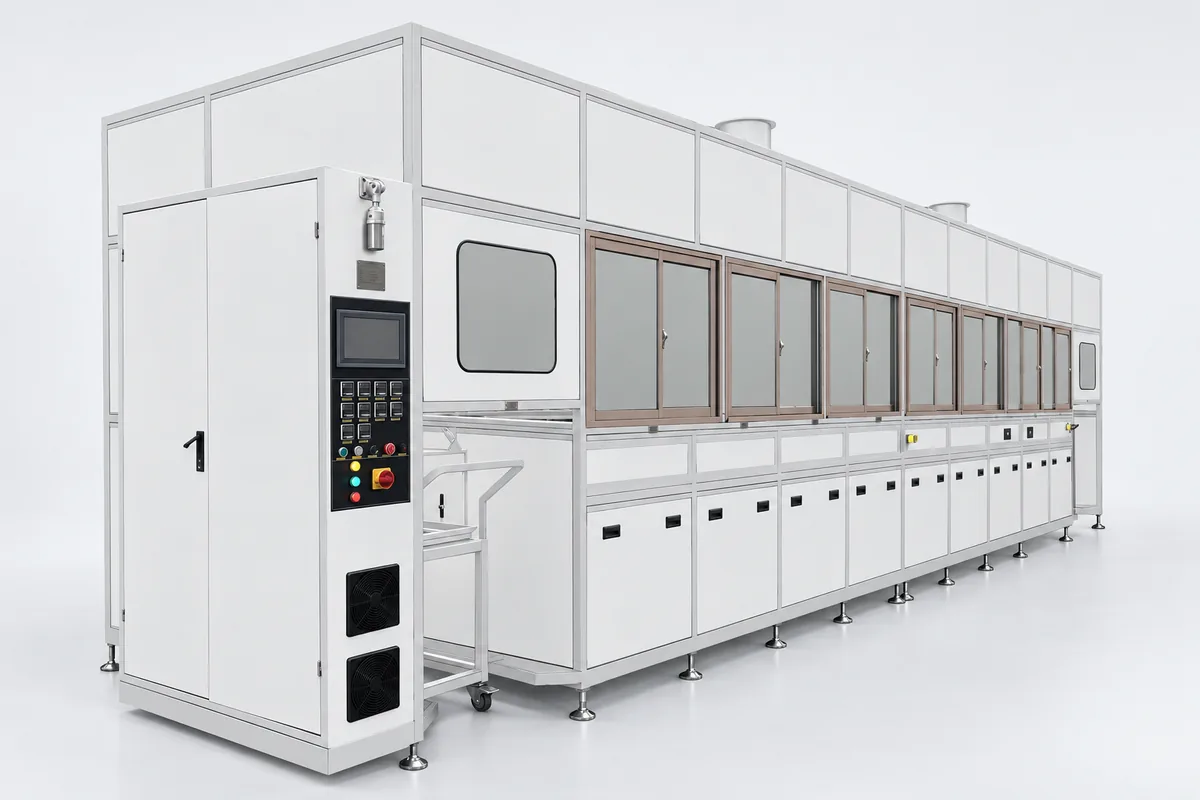
The conventional solar cell approach splits post-diffusion polishing and wet etching across two machines and two process steps. This machine integrates both, with no additional equipment investment and no extra process step. The process does not use NaOH, HNO₃ or H₂SO₄ chemistries but a dedicated polishing solution instead, so chemical consumption costs are lower, waste water pollution is lighter and treatment costs fall accordingly. Rear-side polishing can be combined with SE, rear passivation (Al₂O₃), back contact, double printing, MWT and other technologies; it is highly compatible and easy to integrate into a system or modularise. The advantage of immersion transport is that the whole wafer is submerged in the solution, unlike water-floating or roller-carried chemistry where only one side touches the liquid surface, so no etch lines appear and there is less breakage from roller gripping.Relationship to semiconductor RCA cleaning
The classic wet cleaning method for semiconductor wafers is RCA cleaning, published by Kern and Puotinen in 1970; the HF dip conditions are taken from Kern's 1990 review:| Step | Formulation (by volume) | Conditions | Source |
|---|---|---|---|
| SC-1 | H₂O : H₂O₂ : NH₄OH, 5:1:1 to 7:2:1 | 75–85°C, 10–20 minutes | Kern & Puotinen 1970 |
| SC-2 | H₂O : H₂O₂ : HCl, 6:1:1 to 8:2:1 | 75–85°C, 10–20 minutes | Kern & Puotinen 1970 |
| HF dip | 1% HF | 15 seconds | Kern 1990 |
Safety interlocks for heated tanks
PP tanks themselves burn, which makes the protective design of heated tanks especially important. FM Global Data Sheet DS 7-7 recommendations for wet process equipment include: Low-level interlock: heating is cut automatically when the liquid level falls below the heater. Independent over-temperature cutout: a separate over-temperature protection in addition to the temperature controller, which can still cut power if the controller fails. Quarterly interlock testing: interlocks must be tested regularly, not installed and forgotten. Containment capacity: containment must be able to hold the entire liquid volume of the tool. Flammable liquid exhaust: when flammable liquids are used, exhaust must keep concentrations below 25% of the lower flammable limit (LFL). Related industry documents include SEMI S3-1211 (process liquid heating systems) and S8-0218 (ergonomics); at acceptance, the supplier can be asked to explain the corresponding design.Manual cleaning machines: output needs three numbers together
Output is not the reciprocal of the cycle per piece. The catalogue output is the result of the cycle per piece, the load/unload cycle and the number of lines together: for graphite boats, a cycle per piece of 4–12 hours, 3 hours of load/unload and 2 lines give a stated output of 16–30 pieces per day; for quartz tubes, a cycle per piece of 10 minutes, 5 minutes of load/unload and 2 lines give a stated output of 12 tubes per hour. For graphite boats most of the time goes into the cleaning itself, while for quartz tubes load/unload takes up half the cycle per piece, so the bottlenecks differ: to raise output, the former needs more lines or tanks, while the latter first needs a look at load/unload staffing and handling routes. The most common purchasing mistake is to look only at the cycle per piece, ignoring load/unload time and the number of lines, and finding after the equipment arrives that manual loading and unloading has become the bottleneck.Manual, semi-automatic or fully automatic
The value of manual cleaning machines lies in flexibility: for small batches, many part types and frequently changing cleaning conditions, the changeover cost of automatic equipment is actually higher than manual labour. When batches are stable, part types fixed and labour costly, consider semi-automatic or fully automatic machines, as well as single-door or double-door configurations (loading on one side and unloading on the other, separating dirty and clean routes).Frequently Asked Questions
The specification states a cell efficiency gain of 0.2%–0.3%. How can it be verified?
This figure varies with the baseline process and is not a guaranteed value. Verify it by trial production: split one batch of wafers into two groups, one through the original process and one through this machine's rear-side polishing plus etching, with all other steps identical, and compare the distribution of conversion efficiency rather than just the average, while also recording breakage rate and chemical consumption. If the original process already uses another rear-side treatment, the gain may be smaller; when combining with SE, rear passivation or other technologies, verify compatibility at the same time.
Can this machine run semiconductor RCA cleaning?
It would need a separate design. This machine's process is post-diffusion polishing plus wet etching for solar cells, using a dedicated polishing solution; according to Kern's papers, RCA SC-1 and SC-2 are processed at about 75–85°C for 10–20 minutes, which needs heated tanks, temperature control, and the low-level interlock and independent over-temperature cutout recommended by FM Global DS 7-7. For an RCA process, provide the formulations, temperatures and number of tanks so it can be re-planned as a heated cleaning machine or a manual cleaning machine with multiple tanks in series, and confirm that the tank temperature is within the service range of PP.
How many pieces can the graphite boat cleaning machine clean per day?
The catalogue states about 16–30 pieces, based on a cycle per piece of 4–12 hours, a load/unload cycle of 3 hours and 2 lines running in parallel. The range is wide because the cycle per piece varies between 4 and 12 hours with how dirty the graphite boats are and the cleaning formulation; the longer the cycle, the fewer batches can be completed each day. If the actual requirement is higher than this, first check whether the bottleneck is cleaning time or load/unload: if it is cleaning time, add lines or tanks; if it is load/unload, adding staff or switching to automatic loading and unloading is most effective.
Selection References
Before ordering, verify the efficiency grade, media type, and whether the operating environment fits your requirements.