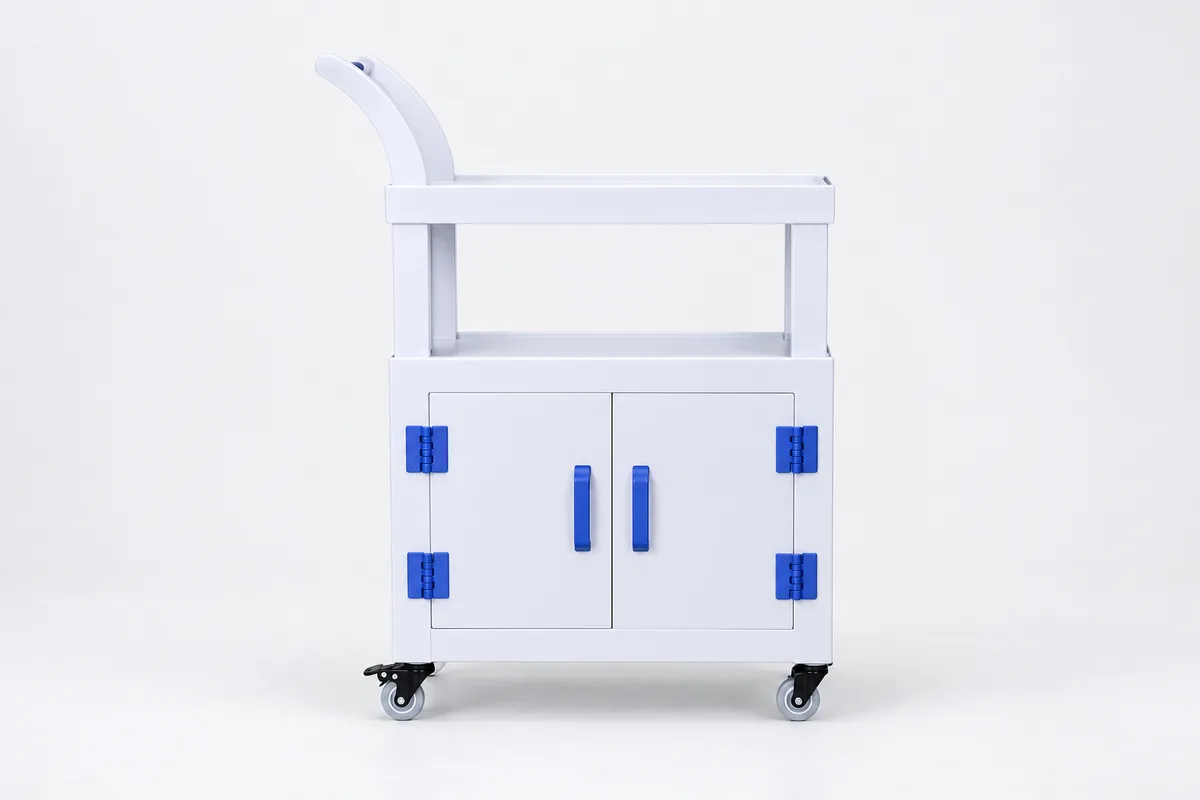
PP Acid-resistant Cart
Product Overview
Features & Specifications



Detailed Description
Two enemies of carts in wet process areas: rust and drips
Dry-area carts fear particle generation most; wet-process carts fear corrosion and drips, and the two problems amplify each other: corroding metal parts shed rust flakes that fall into chemical baths and contaminate the process; chemicals dripping on the floor speed up the next round of corrosion. An all-PP construction eliminates metal entirely and breaks this cycle at the source. The most easily overlooked part is the castors. A PP body on ordinary metal bearings will seize within a few months; when purchasing, include the material of the wheels and bearings in the specification.Moving chemicals: the cart itself is containment
Prudent Practices in the Laboratory §6.C.4 requires chemicals to be moved only in break-resistant secondary containment. The upstands and base of a cart are a form of containment: if a bottle tips over or cracks during transport, the liquid must stay on the cart rather than run onto the floor. US university safety guides are more specific on the details: UC Berkeley states that incompatible chemicals should not be placed in the same secondary containment; Boston University recommends that carts have edges at least 2 inches (about 5 cm) high on all four sides. Applied to cart design, these mean upstands of sufficient height and compartments or separate trays to keep acids apart from bases, and oxidising acids apart from organics. Solution carts and soaking carts also need attention to the centre of gravity: containers full of chemicals have a high centre of gravity and the liquid sloshes, so the inertia while pushing is far greater than with dry loads. Put heavy items at the bottom and light ones on top, and avoid sudden stops while pushing.Furnace quartz tube carts: curved cradles spread the stress
Furnace tubes and quartz parts are long, heavy and brittle; moved on an ordinary cart, the vibration of pushing alone is enough to cause hidden cracks. A quartz tube lying on a flat deck touches it along only two lines, so the weight of the entire tube is concentrated on those two lines; add vibration on top and you have the source of hidden cracks. Hidden cracks are invisible from outside and only break when the tube heats up in the furnace, losing not just the quartz tube but the whole furnace load of product. The deck of a PP furnace quartz tube cart has curved cradles made to the furnace tube outside diameter, so the tube body sits along the curved surface and the contact changes from lines to a surface, spreading the stress; the cradles are also PP, avoiding hard contact points that cause local pressure damage. Even the best cradle cannot absorb the inertia of a sudden stop, so pushing speed should also be written into the work instructions. Photoresist carts and two-tier worktables are used for material turnover between the lithography (yellow-light) area and the wet process area.PP racking, worktables and cleaning baskets
PP racking is used to hold cleaned wafer parts and fixtures; it is seamlessly welded throughout and has rubber levelling feet at the base to take up unevenness in the floor. For cleaning baskets the key issue is metal ions: one purpose of semiconductor cleaning is to remove metal ions, so using a metal basket contaminates while it cleans. Cylindrical: for cylindrical parts or small items. Box: for cleaning loose parts together, with holes in the base and sides to let the chemicals flow through. Frame: for plate-shaped or large workpieces, supported by the frame with minimal contact. Silicon ingot: supports made to the ingot outside diameter to prevent rolling and knocks. The limit of a PP basket is temperature: when the bath temperature approaches the service limit of PP, the basket softens and deforms, so for high-temperature processes first confirm that the bath temperature is within the service range of PP (see the PP laboratory bench page for the temperature resistance of PP).Routine checks for PP carts and cleaning baskets
PP carts and cleaning baskets are held together by welds, and weld quality determines how long they last. Rinse with pure water after contact with chemicals to keep residual acid from concentrating in corners; check regularly for fine cracks in the welds and for discolouration or deformation at corners; on cleaning baskets, look especially at the welds at the base and the handle, which carry the weight of a full basket of workpieces. If a crack is found, take the item out of service for repair rather than waiting for it to break apart in the acid bath.Frequently Asked Questions
How high should the upstands be on a PP cart for moving chemicals?
At least high enough that liquid does not spill off the cart when a bottle falls over. Boston University's safety guidance recommends edges at least 2 inches (about 5 cm) high on all four sides of a cart, which can be taken as the minimum; the actual height should be adjusted to the size of the containers carried, and for large bottles or drums a higher upstand or a full tray-type solution cart is recommended. The upstands and base must be continuously welded with no gaps so that spilled liquid stays on the cart; compartments inside the cart then separate the containers so bottles do not knock each other over.
Can acids and bases be moved on the same PP cart?
Not in the same containment space. UC Berkeley's guidance states that incompatible chemicals should not be placed in the same secondary containment, because if one bottle breaks, the spilled liquid will come into contact with the other. Prudent Practices also lists nitric acid and perchloric acid as oxidisers and acetic acid as an organic acid, and these should not be mixed either. Separate them with compartments or individual trays on the cart, or simply make two trips with two carts.
To what dimensions should the curved cradles of a furnace quartz tube cart be made?
To the outside diameter and length of the furnace tube or quartz tube. The cradle curvature must fit the tube body so that contact changes from two lines to a surface and the weight is spread; if the curvature is too large the tube rolls in the cradle, and if too small only the edges touch, which concentrates the stress instead. For long tubes, the number and spacing of cradles must be set by the length so that no long section of the tube is left unsupported. When ordering, provide the outside diameter, length and weight of the tubes, and whether the same cart must carry tubes of different sizes.
Selection References
Before ordering, verify the efficiency grade, media type, and whether the operating environment fits your requirements.