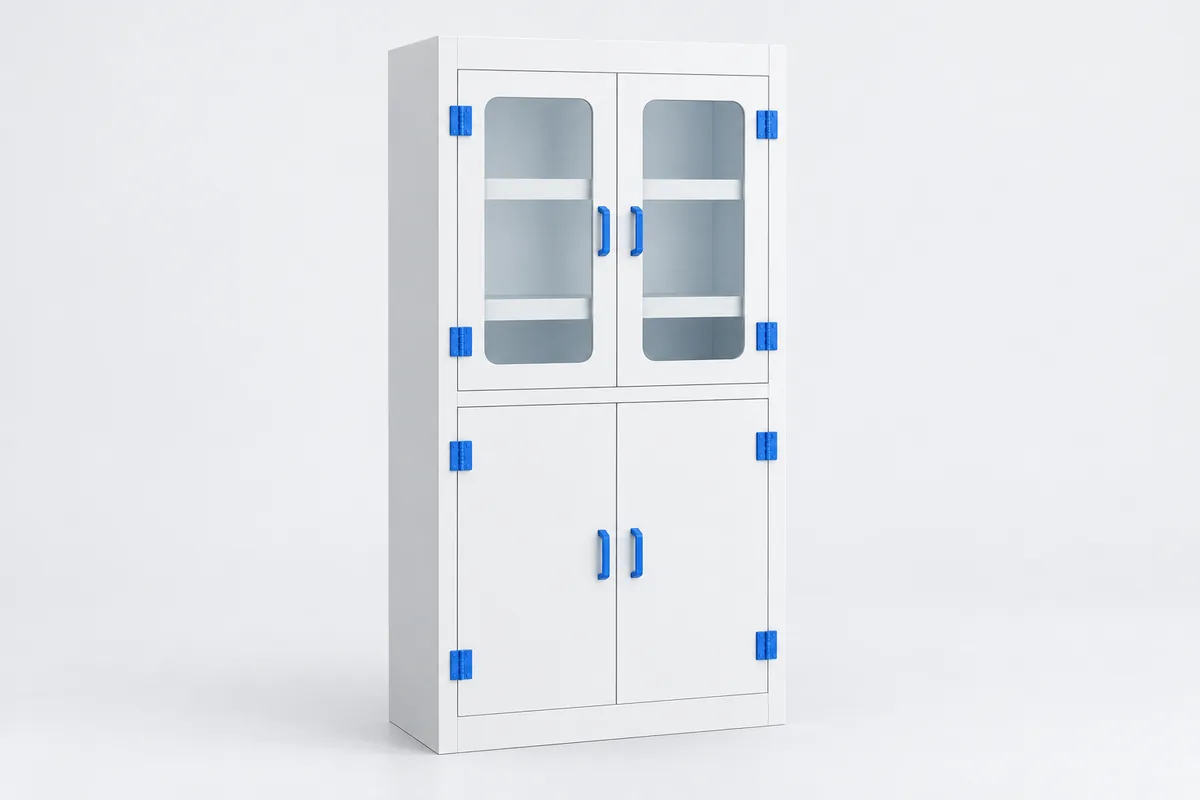
PP Corrosive Chemical Storage Cabinet
Product Overview
Features & Specifications



Detailed Description
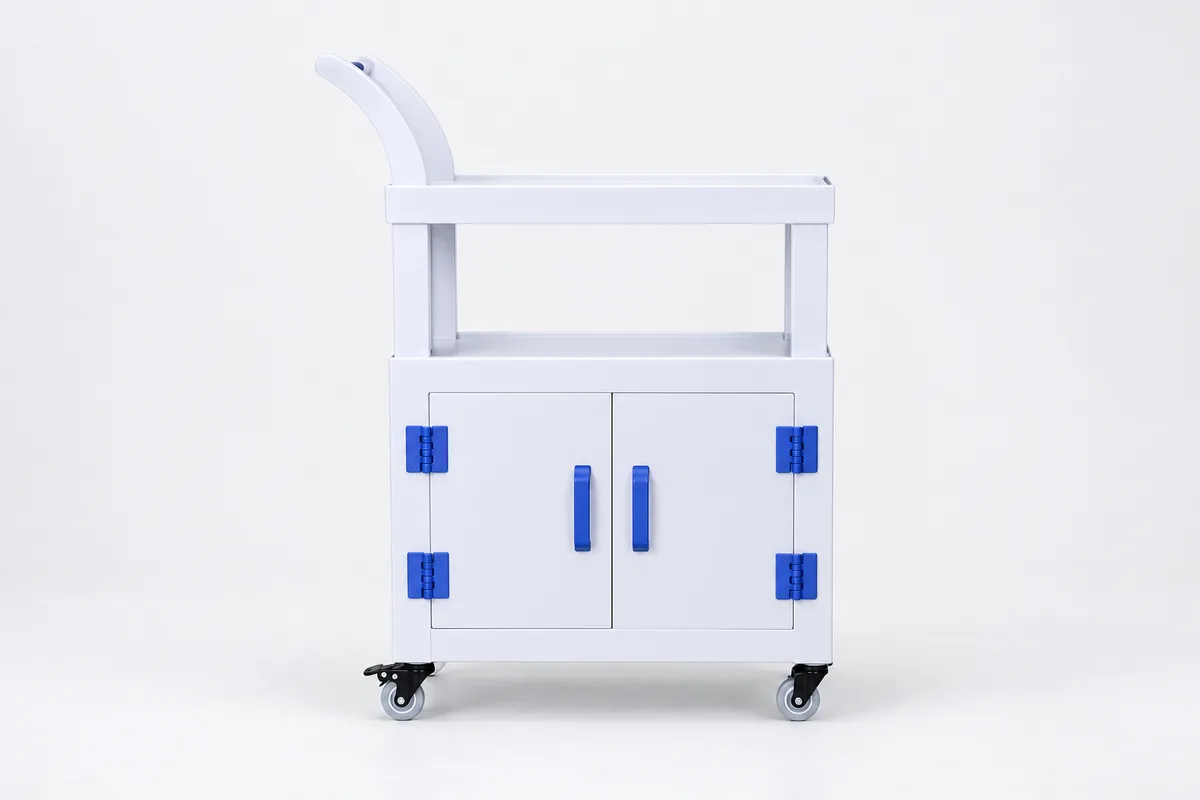
This is an acid and alkali cabinet, not a flammable storage cabinet
This is the point most often confused. Flammable liquid storage cabinets have clear construction and test requirements: US OSHA 1910.106(d)(3) requires the cabinet to pass a 10-minute fire test with the interior temperature not exceeding 325°F (about 163°C), and a steel cabinet is double-walled 18-gauge sheet with a 1½-inch air space between the walls; the European equivalent is EN 14470-1:2023. PP acid cabinets, and metal acid cabinets coated with epoxy, are not within the scope of NFPA 30 or OSHA 1910.106 (according to the UT Austin environmental health and safety office). PP also burns, and Prudent Practices in the Laboratory (2011) notes that PP burns readily and melts quickly. So flammable solvents such as IPA, acetone and ethanol, even in small quantities, must go in a flammable storage cabinet; a PP cabinet holds only corrosive acids and alkalis.Even acids must be kept apart
"Acids go in the acid cabinet" is only the first step. Prudent Practices Table 5.1 and §5.E.2 list nitric acid and perchloric acid as oxidisers and acetic acid as an organic acid, and require incompatible chemicals to be stored separately. If an oxidising acid and an organic acid sit on the same shelf in the same tray and both leak, they can react. In practice, zone storage by the table below, using separate cabinets, or separate compartments and trays within one cabinet:| Class | Examples | Storage principle |
|---|---|---|
| Oxidising acids | Nitric acid, perchloric acid | Keep apart from organics and organic acids |
| Organic acids | Acetic acid | Keep apart from oxidising acids |
| Other inorganic acids | Hydrochloric acid, sulfuric acid, hydrofluoric acid | Keep apart from bases; no glass containers for hydrofluoric acid |
| Bases | Sodium hydroxide, ammonia solution | Keep apart from acids |
| Flammable solvents | IPA, acetone, ethanol | Not in a PP cabinet; use a flammable storage cabinet |
The spill tray is the last line of defence
The real value of a chemical cabinet is not in everyday storage but in the moment a container breaks: when a bottle tips over or cracks, whether the tray can catch all the liquid decides whether this is a cleaning job or an incident. At a minimum, plan for the tray to hold the largest bottle in the cabinet. The tray is designed to be removable because sooner or later it will catch something. A fixed tray has to be cleaned inside the cabinet, which means handling corrosive liquid in a semi-enclosed space; a removable tray can be taken to a fume hood for handling. The corrosive warning label on the front is not decoration either: it tells the first person to arrive what is inside.Whether to connect exhaust
Even tightly capped acid containers release small amounts of acid vapour over time, which builds up in the cabinet, corrodes metal parts and labels, and rushes out as an acid smell when the door is opened. An acid-resistant ventilated cabinet with an exhaust connection draws these vapours away continuously; when exhaust is connected, the duct itself must also be acid resistant, otherwise the corrosion just moves into the duct.Furnace quartz tube storage cabinets and nitrogen cabinets
Furnace tubes and quartz parts are among the most expensive and most fragile consumables in semiconductor processing. The PP furnace quartz tube storage cabinet uses compartments to separate each piece so they do not knock together when taken out or put back. After acid cleaning, quartz parts have an extremely clean surface, which is exactly why they readily adsorb moisture and organics from the air, and the effect of fresh cleaning fades with storage time. The PP nitrogen cabinet is continuously purged with nitrogen during storage to displace moisture and oxygen, keeping quartz parts in their as-cleaned state until they go on the tool. The cabinet is PP rather than stainless steel because quartz parts coming out of the acid bath may still carry residual acid. The three are often planned together: quartz parts cleaned in the PP single-tank manual cleaning machine go straight into the nitrogen cabinet to await use on the tool; for the specifications and output of the manual cleaning machines, see the silicon wafer etching and cleaning machine page.Frequently Asked Questions
Can a PP chemical cabinet hold solvents such as IPA and acetone?
No. IPA and acetone are flammable liquids and must go in a flammable storage cabinet: US OSHA 1910.106(d)(3) requires flammable liquid storage cabinets to pass a 10-minute fire test with the interior not exceeding 325°F, and a steel cabinet is double-walled 18-gauge sheet with a 1½-inch air space; in Europe the standard is EN 14470-1:2023. PP acid cabinets are outside the scope of these rules, and PP itself burns. The same laboratory usually needs both kinds of cabinet: a PP cabinet for acids and alkalis and a flammable storage cabinet for solvents.
Nitric acid and acetic acid are both acids. Can they go on the same shelf of the same PP cabinet?
Not recommended. Prudent Practices Table 5.1 lists nitric acid as an oxidiser and acetic acid as an organic acid, an incompatible combination that can react if both leak. Put them in different PP cabinets, or separate them within one cabinet with independent compartments and their own spill trays, so that if one bottle breaks the liquid cannot reach the tray holding the other. The same principle applies to acids and bases.
Once quartz parts are cleaned, should they go in a PP storage cabinet or a PP nitrogen cabinet?
It depends on how long it will be between cleaning and use on the tool, and on how demanding the process is about surface cleanliness. After acid cleaning, quartz parts readily adsorb moisture and organics; if they will go on the tool the same day or soon afterwards, a PP furnace quartz tube storage cabinet with proper compartments to prevent knocks is enough; if they will be stored longer, or the process is sensitive to surface condition, use a PP nitrogen cabinet with continuous nitrogen purge to keep them in their as-cleaned state. Both cabinets are PP because quartz parts fresh out of the acid bath may still carry residual acid.
Selection References
Before ordering, verify the efficiency grade, media type, and whether the operating environment fits your requirements.