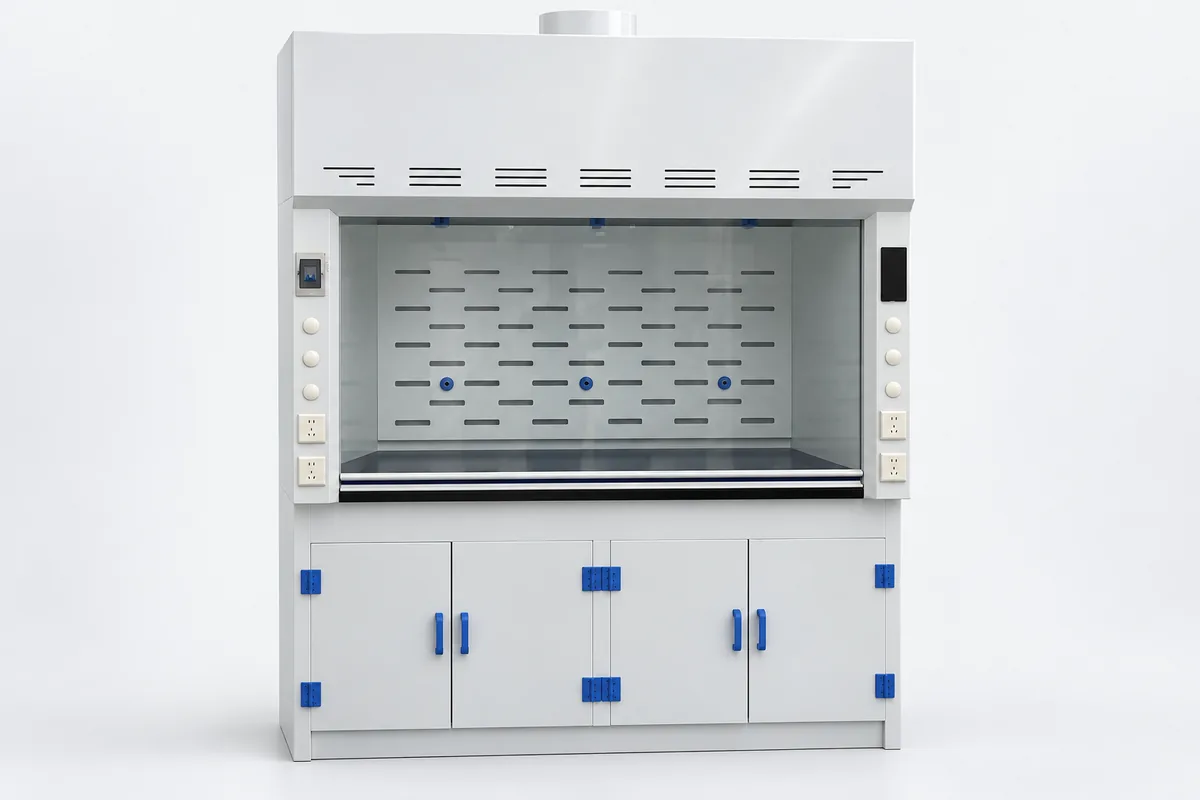
PP Fume Hood
Product Overview
Features & Specifications



Detailed Description
Where a PP fume hood fits: acid resistant, not fire resistant
PP is chosen for acid resistance, especially for hydrofluoric acid and wet processes that generate acid mist, which stainless steel and ordinary coated steel hoods cannot handle. But PP has a weakness that has to be faced: it burns. The US National Research Council's Prudent Practices in the Laboratory (2011) §9.C.2.10.7 points out that PP fume hoods burn readily and melt quickly. Flame-retardant PP cannot be taken on the manufacturer's word alone either. FM Global's FM 4910 is a flammability test for cleanroom materials, with pass criteria of a fire propagation index FPI ≤ 6 and a smoke damage index SDI ≤ 0.4; FM Global Data Sheet DS 7-7 recommends that PP that has not passed FM 4910 be replaced with materials such as Halar, PVDF or Teflon. Ordinary PP sheet is not an FM 4910 material; where flame retardancy is needed, specify FM 4910 listed sheet in the specification and require the corresponding certification documents. So when handling flammable solvents, or where there is heating equipment in the hood, fire risk must be assessed together with corrosion resistance, not corrosion resistance alone.Face velocity and performance testing
There is no single legal figure for face velocity worldwide. Prudent Practices §9.C.2.1 notes that no regulation specifies an acceptable face velocity; 80–100 fpm (about 0.4–0.5 m/s) is generally recommended, and it should not approach or exceed 150 fpm, because excessive velocity creates eddies in front of the operator that actually carry contaminants out of the hood. The current Appendix A of US OSHA 1910.1450 gives no face velocity figure either. Face velocity is only a surrogate indicator; real containment performance has to be confirmed by testing: ANSI/ASHRAE 110-2016: tests with SF₆ tracer gas in three states, as manufactured (AM), as installed (AI) and as used (AU); the standard specifies only the test method and sets no pass threshold, which is set by the user. EN 14175 series: -2 covers safety and performance requirements, -3:2019 type tests, -4 on-site tests, and -7:2012 hoods for high heat and acidic loads (including perchloric acid and hydrofluoric acid hoods). JB/T 6412-2025 (Fume hoods): Chinese industry standard, in force from 2026-07-01, replacing JB/T 6412-1999. At acceptance, an on-site test to one of the above can be required, with the pass threshold written into the contract.Hydrofluoric and perchloric acid: two special cases
Hydrofluoric acid: hydrofluoric acid attacks glass. Guidance from US university health and safety offices recommends that fume hoods for hydrofluoric acid use PE, PP or PC sashes rather than glass. The standard sash on this unit is 5 mm tempered glass; for hydrofluoric acid use, state when requesting a quote that a plastic sash is required. Perchloric acid: Prudent Practices §9.C.2.10.5 requires perchloric acid work to use a dedicated hood: a welded stainless steel liner with a washdown system; EN 14175-7:2012 also lists perchloric acid hoods as a special category. A PP fume hood is not a perchloric acid hood and must not be used for perchloric acid work.Hardware and ductwork must match the hood
Many acid-resistant fume hoods have PP bodies but stainless steel handles, hinges and screws. Acid mist condenses on the metal parts and corrosion starts within a few months; hinges loosen, sashes sag and containment deteriorates. On this unit the handles and hinges are also PP, so the corrosion resistance of the whole unit is consistent. The ductwork connected to the φ250 mm exhaust outlet must be equally acid resistant: however corrosion resistant the hood, connecting it to ordinary galvanised or stainless steel duct still leads to corrosion through the duct.Floor-standing PP fume hood
The floor-standing type omits the base storage cabinet, so the working space extends from worktop level all the way to the floor: Room for large items: quartz boats, large carriers and tanks that will not fit on a worktop need the vertical space that only a floor-standing hood provides. Easy piping from the floor: acid supply, drain and nitrogen lines entering and leaving from the floor do not have to route around a base cabinet. Washing and drainage: rinse waste can be directed straight to a floor drain, with no need for a separate drip tray under the worktop. With no base cabinet, the PP frame alone takes the weight and support of the unit, so frame thickness and the arrangement of levelling feet matter more than on a bench-mounted hood. The trade-off is the loss of base cabinet storage, so chemicals and spares need a storage location planned elsewhere, preferably decided at the planning stage rather than discovering after delivery that there is nowhere to put the reagent bottles.Frequently Asked Questions
Can this PP fume hood be used for hydrofluoric acid work?
The hood body can; the sash needs to change. PP has good resistance to hydrofluoric acid, which is the main purpose of a PP fume hood; but the standard sash is 5 mm tempered glass, and hydrofluoric acid attacks glass, so guidance from US university health and safety offices recommends PE, PP or PC sashes for hydrofluoric acid hoods. When requesting a quote, state the hydrofluoric acid use so the sash can be changed to plastic sheet; the sink, taps, drain and exhaust duct in the hood should also be in hydrofluoric-acid-resistant materials.
Is a φ250 mm exhaust outlet enough? How is the exhaust volume estimated?
Exhaust volume is roughly "sash opening area × face velocity". For example, if the internal opening is about 1.6 m wide and the sash is raised to 0.5 m, the opening area is 0.8 m²; at the 0.5 m/s recommended in Prudent Practices, the exhaust volume is about 0.4 m³/s, or about 1,440 m³/h, which corresponds to an air velocity of about 8 m/s in a φ250 mm duct. Recalculate the actual figures from the internal width, the sash working height and the target face velocity, and hand them to the exhaust system designer together with the pressure losses of the duct length and bends.
Can perchloric acid be heated in a PP fume hood?
No. Prudent Practices §9.C.2.10.5 requires perchloric acid work to use a dedicated perchloric acid hood: a welded stainless steel liner with a washdown system to rinse the hood interior and exhaust duct; EN 14175-7:2012 also places perchloric acid hoods and hydrofluoric acid hoods together in the special category for high heat and acidic loads. A PP fume hood has neither of these features, and PP itself burns and melts quickly. Laboratories that need to use perchloric acid should plan a separate dedicated hood and follow the safety rules of their organisation.
Selection References
Before ordering, verify the efficiency grade, media type, and whether the operating environment fits your requirements.