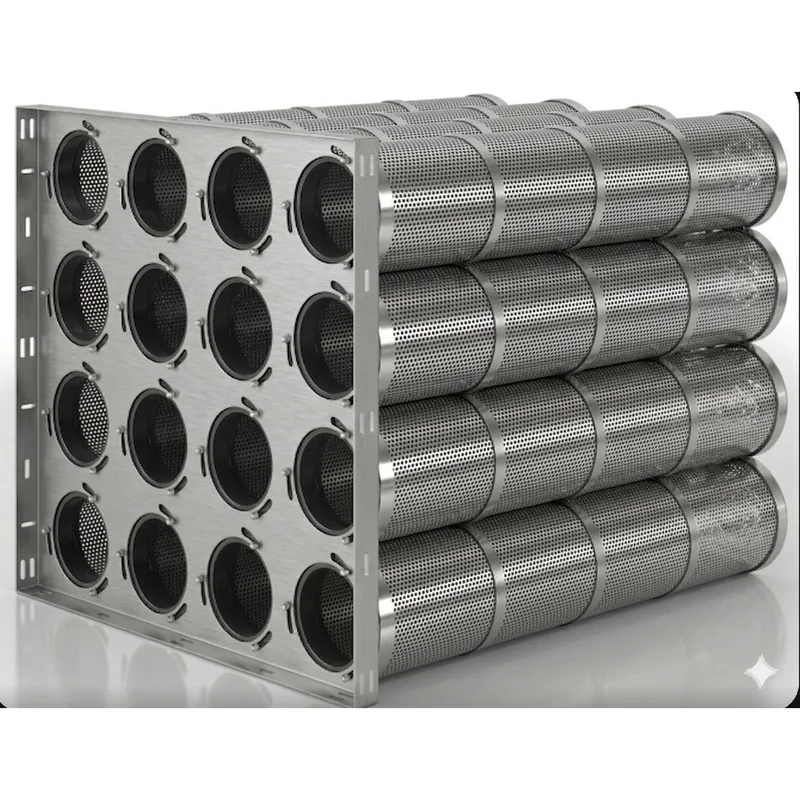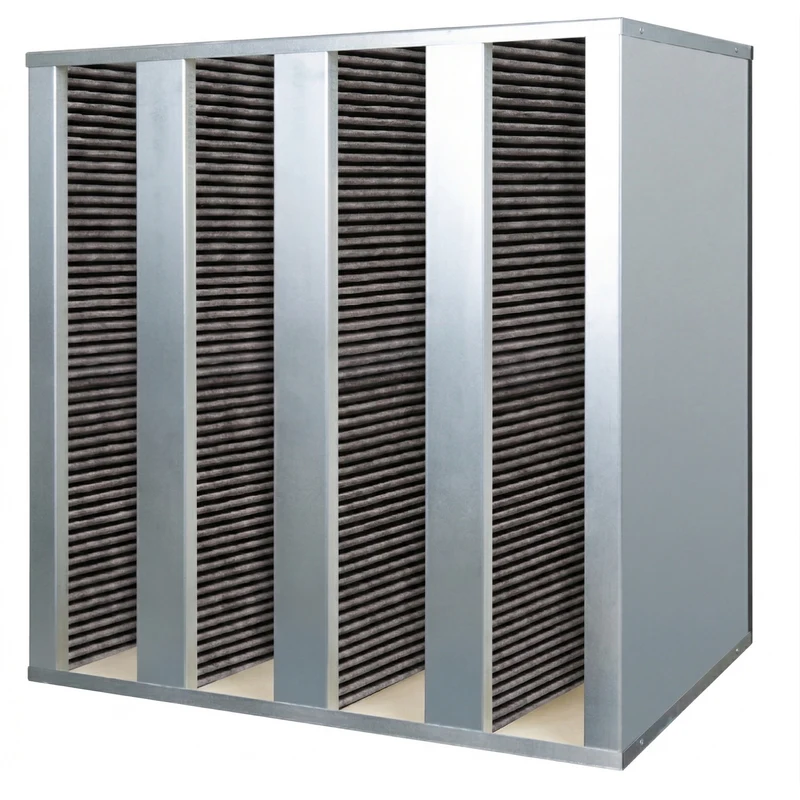
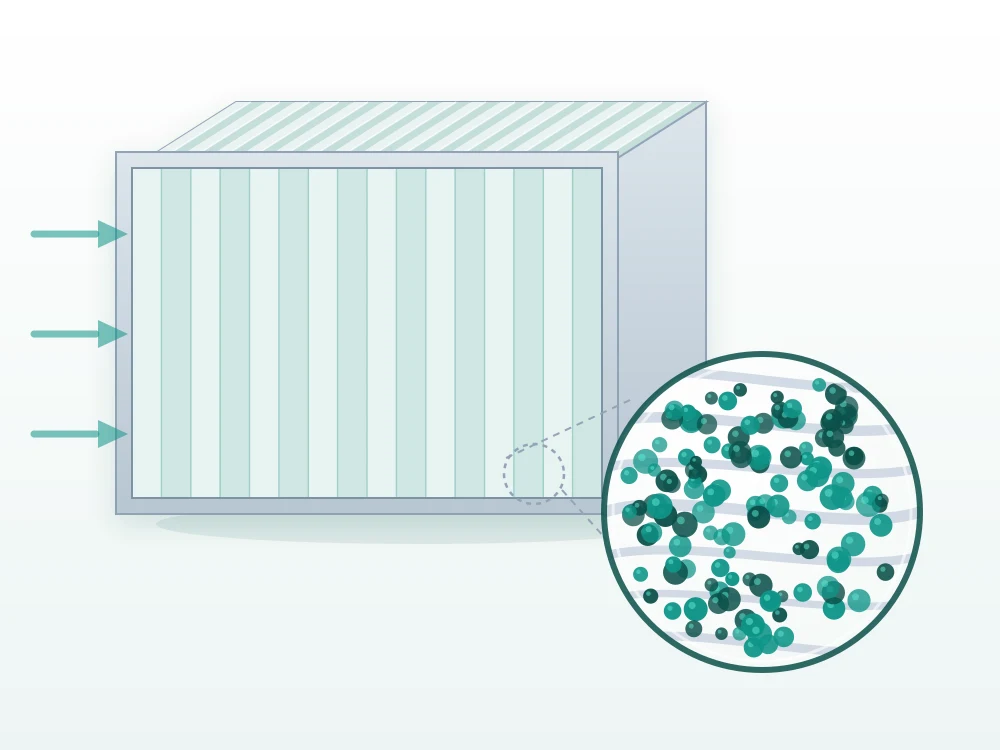
Acid-Removal AMC Ion Exchange Chemical Filter
Product Overview
Key Specifications
- Target Gases
- Strong acids: HF, HCl, HNO₃, HBr, H₂SO₄, SO₂. Weak acids: acetic, formic and nitrous (HNO₂). Deliberately not targeted: ammonia and amines, NOx, VOCs and esters, ozone, chlorine, organophosphorus dopants
- Removal Efficiency
- Initial SO₂ removal: 97.4% for the 128 mm composite pleat and the foam type; ≥95% for the 68 mm composite pleat
- Structure
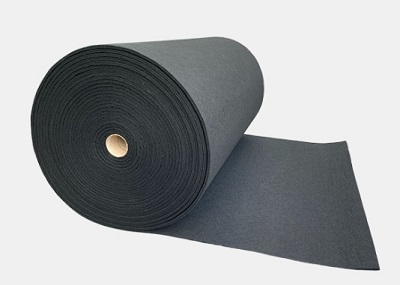
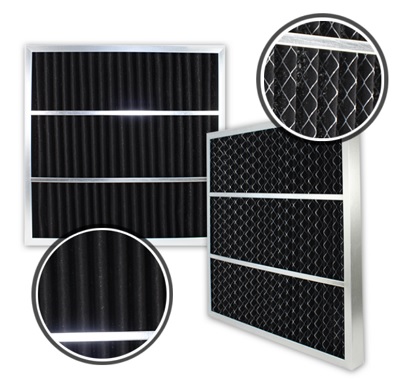
- Composite pleat (resin beads embedded in a fibrous structure, then pleated) or foam (resin beads fixed in open-cell polyurethane foam)
- Max. Operating Temperature
- Recommended operating temperature ≤ 40°C



Specifications
- Adsorbent
- Porous polystyrene/divinylbenzene polymer with terminal anion functionalisation; inert backbone, no adsorption pores, no aqueous acid impregnation
- Structure
- Composite pleat (resin beads embedded in a fibrous structure, then pleated) or foam (resin beads fixed in open-cell polyurethane foam)
- Frame
- Anodized aluminum
- Target Gases
- Strong acids: HF, HCl, HNO₃, HBr, H₂SO₄, SO₂. Weak acids: acetic, formic and nitrous (HNO₂). Deliberately not targeted: ammonia and amines, NOx, VOCs and esters, ozone, chlorine, organophosphorus dopants
- Adsorbent Weight
- Volumetric exchange capacity roughly 4× that of impregnated activated carbon (eq/L)
- Removal Efficiency
- Initial SO₂ removal: 97.4% for the 128 mm composite pleat and the foam type; ≥95% for the 68 mm composite pleat
- Max. Operating Temperature
- Recommended operating temperature ≤ 40°C
- Max. Relative Humidity
- Recommended relative humidity 30–60%
- Certification
- No secondary emissions — does not store NOx, does not release weak acids as pH falls, and does not release acetic acid from ester cleavage
Composite Pleat Specifications
| 厚度 | Frame H × W | Media Area | Adsorbent Net Wt. | Total Wt. | Rated Airflow | Rated ΔP |
|---|---|---|---|---|---|---|
| 68 mm | 800×485 mm | 4.75 m² | 2.68 kg | 4.16 kg | 1,000 m³/h | 12.9 Pa |
| 68 mm | 742×742 mm | 7.04 m² | 3.77 kg | 5.85 kg | 1,420 m³/h | 12.9 Pa |
| 68 mm | 800×690 mm | 7.04 m² | 3.77 kg | 5.85 kg | 1,420 m³/h | 12.9 Pa |
| 128 mm | 800×485 mm | 9.51 m² | 5.25 kg | 8.23 kg | 1,000 m³/h | 19.8 Pa |
| 128 mm | 742×742 mm | 13.98 m² | 7.53 kg | 11.69 kg | 1,420 m³/h | 19.8 Pa |
| 128 mm | 800×690 mm | 13.98 m² | 7.53 kg | 11.69 kg | 1,420 m³/h | 19.8 Pa |
Foam Type Specifications
| 厚度 | Frame H × W | Adsorbent Net Wt. | Total Wt. | Rated Airflow | Rated ΔP |
|---|---|---|---|---|---|
| 48 mm | 800×690 mm | 3.37 kg | 5.06 kg | 1,420 m³/h | 20.8 Pa |
| 48 mm | 800×485 mm | 2.38 kg | 3.57 kg | 1,000 m³/h | 20.8 Pa |
| 68 mm | 800×690 mm | 4.96 kg | 7.53 kg | 1,420 m³/h | 31.6 Pa |
| 68 mm | 800×485 mm | 3.47 kg | 5.35 kg | 1,000 m³/h | 31.6 Pa |
| 88 mm | 800×690 mm | 6.64 kg | 12.00 kg | 1,420 m³/h | 42.5 Pa |
| 88 mm | 800×485 mm | 4.66 kg | 8.43 kg | 1,000 m³/h | 42.5 Pa |
All rated airflows correspond to a face velocity of 0.71 m/s. Non-standard sizes and thicknesses are built to site conditions.
Detailed Description
Why acidic AMC has to be handled separately from activated carbon
Almost every acid that causes defects in semiconductor manufacturing is an H-X protic acid, one that donates a proton; Lewis acids can be set aside in practice. What they have in common is that they are reactive, corrosive, form salt crystals on contact with bases, and have a low dissociation constant — which is to say they are strong. The awkward ones are the acid precursors: not acids themselves, but substances that turn into acids on a surface once they take up water. - Sulphur dioxide forms sulphurous acid with water and then oxidises to sulphuric acid. Fast and strongly acidic, it is the most active precursor of the group. - Nitrogen dioxide forms nitrous and nitric acid with water. Less efficient, but it keeps happening. - PGMEA, the standard solvent in the lithography area, hydrolyses into PGME and acetic acid. This is a latent precursor — it may not act until it is already inside the filter. Note that hydrogen sulphide and the nitrogen oxides are not acids in themselves. Counting them toward a total-acid figure blurs the question that matters: which specific acid does this process, on this tool, need protecting from — not how many anions an impinger can be made to show. Where the acids come from is often misread too. Ambient outdoor air carries very little acid, and precursor levels are broadly falling, volcanic activity and biomass burning aside; levels around a plant may be raised by nearby stack emissions. But the bulk of the load originates inside the fab: hydrogen halides from wet etch, nitrogen compounds from dry etch, and ester solvents from the lithography area.How the two media differ mechanically
Activated carbon is a microporous carbon material, usually made from natural organic feedstock or coal, and not a clean, inert graphite structure. In impregnated grades the pores serve only as a carrier for the treatment chemistry. Three side effects follow unavoidably: - Physical adsorption always occurs, so volatile organics and esters will be taken in - Redox reactions always occur at the surface, so nitrogen oxides are converted and stored - Adsorption is reversible, so incoming strong acids displace weak acids already held, most visibly as pH falls Ion exchange resin is a porous polystyrene/divinylbenzene polymer with anionic functional groups at the chain ends. The backbone itself is clean and inert, and the functional groups are evenly distributed — unlike impregnated carbon, where the chemistry is coated onto the pore walls and its concentration varies with pore size. The characteristics are the mirror image: - No adsorption pores, so esters and volatile organics are not physically adsorbed - No redox activity inside the pore and sorption system, so nitrogen oxides are not stored - Acids bind chemically to the functional groups and are not released back into the airstream when conditions changeWhat selectivity buys you
How each protection target shifts on ion exchange media
Relative performance (0–100) of the same targets on two media types
Acid targets move up while every non-target drops to the floor — by design, not by defect. Activated carbon pores take in everything, so capacity is shared with organics and nitrogen oxides; on ion exchange resin only the anionic functional groups react, leaving the whole capacity for acids. The trade-off is that ammonia, chlorine, ozone and organophosphate dopants are not addressed at all, so sites that must control those still need carbon alongside.
Service life in the field
Strong-acid removal efficiency across 60 months in service
FFU-mounted ion exchange filter, tested with a strong-acid mixture
Efficiency falls only 8.5 percentage points over five years, and the reason is what the medium refuses to take in. Over the same period an activated carbon bed has already given most of its capacity to organics and nitrogen oxides, leaving little for acids. In the field this translates to hydrogen fluoride held below a third of the cleanroom target, with boron from the BF₃ by-product at half the target value.
Media construction: choosing between pleated composite and foam
The resin is the same; the carrier is not, and carrier construction pushes pressure drop and service life in opposite directions. The two charts in this section have to be read together — either one alone leads to the wrong choice. Pressure drop: pleating opens the media out to several square metres of effective area, so the air actually passes through the medium far more slowly than the face velocity suggests. Foam is a flat panel whose frontal area is simply the frame area.Initial pressure drop across the five media configurations
One face-velocity scale, three operating points: 0.5 / 0.71 (rated) / 1.0 m/s
At the same 68 mm depth, the pleated composite runs at four tenths the pressure drop of the foam — pleating spreads the media out to 7.1 m², whereas foam is a flat panel whose frontal area is simply the frame area. Depth alone therefore says nothing about pressure drop; it has to be read together with construction. What the foam buys in return is more sorbent per unit volume and a longer life: two ends of the same trade-off. A 40% rise in face velocity costs roughly 60% more pressure drop, so bringing face velocity down by moving up a frame size often saves more fan power than changing media.
Service life of the five media configurations, expressed as cumulative dose
Horizontal axis is cumulative SO₂ dose; the two constructions were tested at different concentrations, so only dose is comparable
Converting days into dose — concentration multiplied by time — is what puts the two constructions on the same ruler. It is also the IRDS position on AMC: there is no critical concentration, only a dose. Translated back to a site at 10 ppbv, the 128 mm pleated composite lasts around 871 days and the 88 mm foam around 1,290. Read alongside the pressure chart, the trade-off is complete: at the same 68 mm, the pleated composite costs four tenths the pressure drop but delivers half the life, because foam packs more sorbent into the same volume. Choose pleated when fan power is tight, foam when change-out labour is expensive.
Case one: wafer transport FFU, 28 months
One fab, one airstream, a batch of each medium installed side by side and removed after 28 months for media analysis and efficiency re-testing.What the media had accumulated after 28 months
Wafer transport FFU filters, post-removal analysis, grams
On the carbon filter 87% of what was captured has nothing to do with acids — organics and nitrogen oxides fill the pores first, leaving just 26 g of capacity actually spent on acids. Ion exchange resin has no adsorption pores; only the anionic functional groups react, so total load is a tenth as large and three quarters of it is acid. That is where the service-life gap comes from at identical size and airflow: not from capturing more, but from not spending capacity on things it was never meant to capture.
Efficiency loss across a concentration spike
Filters already 28 months in service, sulphur dioxide inlet at 20 ppbv
Spikes are the real test for a chemical filter — a process leak, a neighbouring stack, a seasonal shift in outdoor air can raise concentration by an order of magnitude within hours. Activated carbon loses 18.8 percentage points because stronger acids displace what the pores already held, so efficiency bleeds from both ends. Ion exchange binds chemically and has no displacement mechanism, losing only 13.5 points — its post-spike 66.3% is almost level with where the carbon filter stood before the spike, at 70.2%.
Case two: coater and developer inlet, five years
After five years, is the filter absorbing acetic acid or releasing it?
Coater/developer temperature-humidity inlet filter, acetic acid inlet at 4 ppbv
Activated carbon draws the process solvent PGMEA into its pores, where prolonged heat and humidity hydrolyse it, splitting off acetic acid that is then released downstream — the filter turns from a barrier into a source, measured at a net emission of 4.14 ppbv that attacks the chiller heat exchanger directly. Five hours of clean-air purging only brings the release down to 0.51 ppbv, which means the acetic acid is not surface residue but is still being generated. Ion exchange resin has no adsorption pores and does not take up esters, so there is nothing stored to cleave; after five years it is still removing.
Case three: reticle and bare reticle stockers
Acid headroom in reticle stockers, and what is left after six years
Top: concentrations in a bare-reticle stocker at 3 years. Bottom: efficiency of a pod stocker at 6 years
A bare reticle has no pod to protect it, so any ammonium sulphate or acetate crystal forming on the surface affects imaging directly — the control limit sits at the 200 pptv level. Downstream of the filter the reading falls below the limit of quantification, meaning the headroom is not "just inside spec" but unmeasurable. A second stocker filter at six years still delivers 88.1% on sulphur dioxide and 78.2% on acetic acid: weak acids decaying faster than strong ones is expected, because their bond to the functional group is weaker and later-arriving strong acids displace them. Change-out intervals should therefore be set by the weak-acid figure.
Case four: winter sulphur dioxide at the make-up air unit
Make-up air unit filters: what they collected, and how long they lasted
Top: load composition after removal. Bottom: remaining efficiency against years already in service
The ion exchange filter is at 49.4% after eight years, which looks worse than 90.2% for carbon at six months — except that is sixteen times the duration. The top row explains why: 43–46% of the carbon load is organics, so capacity was consumed by construction-phase diesel fumes and ambient volatile compounds long before winter sulphur dioxide arrived. Ion exchange takes up no organics at all; almost the entire load is acid salts, so capacity went into acids from day one through year eight. The selection question is whether efficiency holds across your change-out interval, not who is higher when new. Conversely, a site that must also control organics and nitrogen oxides cannot rely on ion exchange alone.
When activated carbon is the right answer instead
This is the first thing to confirm during selection, because getting it wrong is not a matter of slightly worse performance. It is no performance at all: - Chlorine, ozone and other oxidants — ion exchange has no mechanism for these; carbon is required - Ammonia and amines — anionic functional groups do not react with bases; base removal needs cation-type resin or acid-impregnated carbon - Volatile organics, esters and condensables — these need physical adsorption, which only carbon provides - Boranes, borate esters and other diffuse boron sources not accompanied by hydrogen fluoride — ion exchange is of limited use - Organophosphate dopants — as above In practice most plants combine the two by zone and by stage: carbon at the outdoor-air and exhaust sections for organics and oxidants, ion exchange close to the process — FFUs, tool inlets and stockers — as the final barrier against acids. Either one used alone leaves a gap.Selection and maintenance notes
Selection - Preventing acid release or acid formation at source takes priority over removing it afterwards. Permeation through tubing, and acid generated as media age, are both source problems; a new filter will not solve them. - Establish which specific acids need controlling, and to what target concentration, before anything else. Do not write the specification around total acids. - Weak acids decay faster than strong ones, because their bond is weaker and later-arriving strong acids displace them. Set the change-out interval from the weak-acid figures. - If the site also has an organics or ammonia problem, ion exchange has to be staged alongside carbon. Do not expect one stage to cover everything. Maintenance - A differential pressure gauge reads particulate blockage only; it says nothing about how saturated the chemical media are. This is the single most common misreading — a flat pressure drop does not mean there is capacity left. - Chemical media life depends on inlet concentration and airflow and cannot be inferred from a calendar. To pin down the change-out point, sample the outlet concentration periodically or send media out for residual capacity testing. - The particulate filters upstream and downstream are not optional. Without the upstream filter, dust blinds the media surface; without the downstream filter, fines abraded from the media pass straight into the cleanroom. - Ion exchange media produce no secondary emission, so a sudden rise in outlet concentration is always saturation or bypass leakage, never the media giving back what they held. That makes troubleshooting considerably simpler.Selection References
Before ordering, verify the efficiency grade, media type, and whether the operating environment fits your requirements.