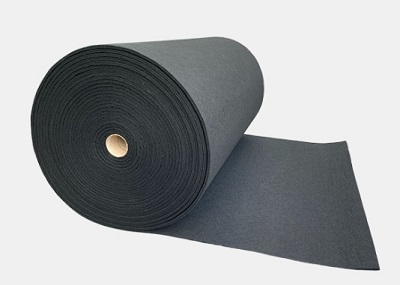
Activated Carbon Non-Woven Filter
Product Overview
Key Specifications
- Adsorbent
- Coconut-shell activated carbon powder (acid-gas, alkaline-gas and formaldehyde impregnated grades available)
- Adsorbent Weight
- 67–241 g/m²
- Depth
- 3 / 5 / 10 / 15 mm (±10%)
- Custom Sizes
- Supplied on 1.25 m wide rolls, or cut, die-cut or converted into pleated filters



Specifications
- Adsorbent
- Coconut-shell activated carbon powder (acid-gas, alkaline-gas and formaldehyde impregnated grades available)
- Filter Media
- Polyester (PET) non-woven
- Structure
- Three-layer composite: PET face / activated carbon / PET base
- Target Gases
- Odors, VOCs and solvent vapors, tobacco smoke and cooking fumes; impregnated grades also remove acid / alkaline gases and formaldehyde
- Adsorbent Weight
- 67–241 g/m²
- Basis Weight
- 188–478 g/m²
- Removal Efficiency
- PM2.5 count efficiency approx. 38–63% (face velocity 0.15 m/s, by grade)
- Depth
- 3 / 5 / 10 / 15 mm (±10%)
- Custom Sizes
- Supplied on 1.25 m wide rolls, or cut, die-cut or converted into pleated filters
- Max. Operating Temperature
- ≤ 60°C
- Max. Relative Humidity
- ≤ 80% RH
- Service Life
- Depends on odor concentration at site; typically 3–6 months indoors
- Applications
- Air purifiers, dehumidifiers, air conditioners, range hoods, building HVAC, and waste-bin odor control
- Packaging
- Rolls (50 m per roll for 3 / 5 mm, 30 m for 10 mm) or cut pieces
Some values are typical ranges for this product class; the shipped datasheet governs.
Standard grades and typical properties
| Grade | Thickness | Basis weight | Carbon content | Butane adsorption | Particle efficiency (PM2.5) | Standard roll |
|---|---|---|---|---|---|---|
| PF3-1.25-50-AC | 3 mm | 188 g/m² | 67 g/m² | 28 g/m² | ≥ 38% | 1.25 m × 50 m |
| PF5-1.25-50-AC | 5 mm | 312 g/m² | 143 g/m² | 52 g/m² | ≥ 48% | 1.25 m × 50 m |
| PF10-1.25-30-AC | 10 mm | 288 g/m² | 104 g/m² | 40 g/m² | ≥ 57% | 1.25 m × 30 m |
| PF10-1.25-30-AC-HC | 10 mm | 418 g/m² | 191 g/m² | 64 g/m² | ≥ 63% | 1.25 m × 30 m |
| PF15-1.25-20-AC * | 15 mm | 478 g/m² | 241 g/m² | 84 g/m² | ≥ 63% | 1.25 m × 20 m |
Particle efficiency is PM2.5 count efficiency at 0.15 m/s face velocity; butane adsorption indicates the saturation capacity of the carbon layer. * PF15-1.25-20-AC is made to order. Rolls can also be slit to 1.0 / 1.2 / 1.5 m widths.
Model Reference
| Model | Description | Size |
|---|---|---|
| PF5-595-595-AC | Activated carbon non-woven filter 595X595X5mm | 595 × 595 × 5 mm |
| PF10-430-660-AC | Activated carbon non-woven filter 430X660X10mm | 430 × 660 × 10 mm |
| PF3-380-2000-AC | Activated carbon non-woven filter 380X2000X3mm | 380 × 2000 × 3 mm |
| PF3-600-600-AC | Activated carbon non-woven filter 600X600X3mm | 600 × 600 × 3 mm |
| PF5-400-1250-AC | Activated carbon non-woven filter 400X1250X5mm | 400 × 1250 × 5 mm |
| PF10-383-482 | Activated carbon non-woven filter 383x482x10mm | 383 × 482 × 10 mm |
| PF5-500-500-AC | Activated carbon non-woven filter 500X500X5mm | 500 × 500 × 5 mm |
| PF3-320-320-AC | Activated carbon non-woven filter 320X320X3mm | 320 × 320 × 3 mm |
Common sizes are listed above. Other sizes, frame materials and efficiency grades can be made to order — please quote the model or size when requesting a quotation.
Detailed Description
What is activated carbon non-woven filter media
Activated carbon non-woven media, also sold as carbon filter fabric, carbon felt or carbon foam sheet, is a "two-in-one" sheet media. Its backbone is a polyester (PET) non-woven, and a layer of coconut-shell activated carbon powder is bonded between the fibres. As air passes through, the fibres stop hair, lint and 3–10 µm coarse dust, while the carbon adsorbs odor molecules and volatile organic compounds (VOCs). Its strengths are that it is thin, light, low in pressure drop and easy to convert: it can be cut from the roll, die-cut, pleated, or stacked behind a HEPA or pre-filter. The "black layer" inside most home appliances and air conditioners is this material. The trade-off is limited carbon per square metre (tens to a little over two hundred grams), so it suits indoor, low-concentration odor control. For high-concentration duties such as wastewater plants or process exhaust, a packed-bed or honeycomb carbon filter with tens of times more carbon is the right choice.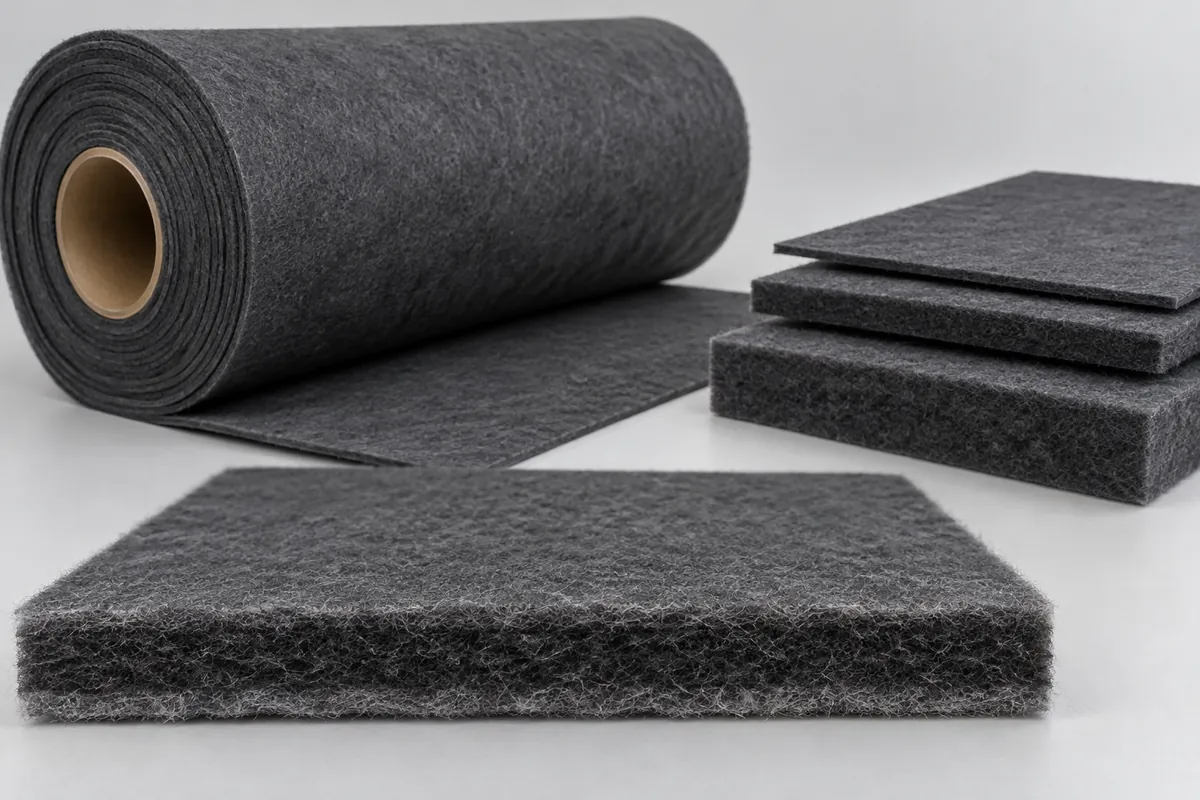
Three-layer structure and how adsorption works
Three-layer structure of carbon non-woven
Air flows top to bottom; the right side magnifies the pores of one carbon grain
- 1PET face layer—Catches coarse dust, protects the carbon
- 2Activated carbon layer—Coconut carbon bonded between fibres
- 3PET base layer—Supports the sheet, holds carbon dust in
Schematic; layer proportions exaggerated. Pore classes follow IUPAC definitions.
Carbon content, not thickness, drives odor capacity
Carbon content vs butane adsorption
Same 10 mm: twice the carbon, about 60% more adsorption
Typical values per grade; larger dots are thicker media. Odor capacity follows carbon content, not thickness.
Standard and chemically impregnated grades
| Type | Carbon treatment | Main targets | Typical use |
|---|---|---|---|
| Standard coconut carbon | Not impregnated, physical adsorption | VOCs, solvent odor, tobacco smoke, cooking fumes, pet and garbage odors | Air purifiers, air conditioners, dehumidifiers, HVAC return air |
| Acid-gas grade | Alkaline impregnant | Hydrogen sulfide, sulfur dioxide, hydrogen chloride, hydrogen fluoride, chlorine, nitrogen dioxide | Air intakes near wastewater or chemical sites, fab make-up air |
| Alkaline-gas grade | Acidic impregnant | Ammonia, amines, NMP | Restroom and livestock odors, around electronics processes |
| Formaldehyde grade | Formaldehyde-specific impregnant | Formaldehyde, low-molecular aldehydes | Newly renovated interiors, furniture and board storage |
Choosing thickness by application
| Thickness | Typical grade | Equipment and setting | Selection notes |
|---|---|---|---|
| 3 mm | PF3-1.25-50-AC | Compact purifier composite filters, AC front panels, waste-bin and refrigerator deodorizers | Thinnest, easiest to pleat and die-cut; first choice where space is tight |
| 5 mm | PF5-1.25-50-AC | Air purifiers, dehumidifiers, range hoods, HVAC return grilles | Best balance of carbon and thickness; the highest-volume grade |
| 10 mm | PF10-1.25-30-AC / PF10-1.25-30-AC-HC | Air handling units, fan inlets, office and restaurant odor control | High dust-holding capacity; choose high-carbon for heavier odors |
| 15 mm | PF15-1.25-20-AC (made to order) | HVAC sections with heavy odor load that still need low pressure drop | Highest carbon of any sheet grade; beyond this, move to a packed-bed filter |
Replacement interval and handling
The life of carbon non-woven is judged by "has the odor come back", not by pressure drop: saturated carbon looks the same, but odor slowly reappears at the outlet. Typical homes and offices replace it every 3–6 months; kitchens, pets, smoking or newly renovated spaces may need 1–2 months. If relative humidity stays above 70%, water vapor occupies the pores and life shortens noticeably. Do not wash it: water flushes the carbon powder out and fills the pores, and the media never recovers its original capacity after drying. Sunlight only releases a little surface odor and does not truly regenerate the carbon. If the surface is coated with dust, a pre-filter is missing upstream; adding one makes the carbon layer last much longer.Common applications
Odor filters for air purifiers, dehumidifiers, air conditioners and energy recovery ventilators; the front stage of range hoods and restaurant exhaust; return-air odor control in building AHUs and fans; waste bins, refrigerators, shoe cabinets and pet products; general odor control in electronics plants, laboratories and hospitals; and as the carbon layer for face masks and automotive cabin filters.Frequently Asked Questions
Does thicker carbon non-woven always remove more odor?
Not necessarily. Thickness mainly sets dust-holding capacity and pressure drop; odor capacity is set by carbon content per square metre. On this page, the 10 mm standard grade PF10-1.25-30-AC carries about 104 g/m² of carbon, less than the 5 mm PF5-1.25-50-AC (about 143 g/m²), while the 10 mm high-carbon PF10-1.25-30-AC-HC carries about 191 g/m² and adsorbs roughly 60% more butane than the standard grade. When comparing suppliers, write "carbon content in g/m²" into the specification, otherwise it is easy to buy media that is thick but light on carbon.
Can carbon non-woven be washed or sun-dried and reused?
Not recommended. Washing flushes out the carbon bonded to the fibres and leaves water in the micropores; even after drying, capacity never returns to that of new media. Sunlight only releases a small amount of surface odor and does not actually empty the pores. True regeneration of activated carbon needs heat treatment at several hundred degrees, which the PET fibres cannot survive, and the reaction in impregnated grades is irreversible. The economical approach is a washable pre-filter in front to stop dust, so the carbon layer only handles odor and lasts longer.
How often should it be replaced, and how do I know when?
Saturated carbon looks the same and its pressure drop barely changes, so judge by whether odor has returned. Purifiers and air conditioners in homes and offices are typically changed every 3–6 months; kitchens, pets, smoking or freshly renovated spaces may saturate in 1–2 months. If relative humidity stays above 70%, water vapor competes for pore sites and life shortens noticeably. If the equipment has a TVOC or odor sensor, replace when readings stay high; otherwise replace when odor can be smelled at the outlet again.
Can I buy full rolls and cut them myself? What is the minimum order?
Yes. Standard rolls are 1.25 m wide, 50 m long for 3 mm and 5 mm and 30 m long for 10 mm, and can be cut with a utility knife or fabric cutter — useful for customers with their own converting line or many different sizes. If you need less than a roll, or discs, custom shapes, or finished cardboard / aluminium framed pleated filters, we can cut and ship to your drawing. Impregnated grades (acid, alkaline, formaldehyde) and 15 mm are made to order with minimums set by specification; please include size, quantity, target gas and desired carbon content when requesting a quote.
Selection References
Before ordering, verify the efficiency grade, media type, and whether the operating environment fits your requirements.