Cylinder Cartridge-Type Chemical Filter
Product Overview
Key Specifications
- Adsorbent
- Premium (modified) activated carbon and comparable adsorbents
- Structure
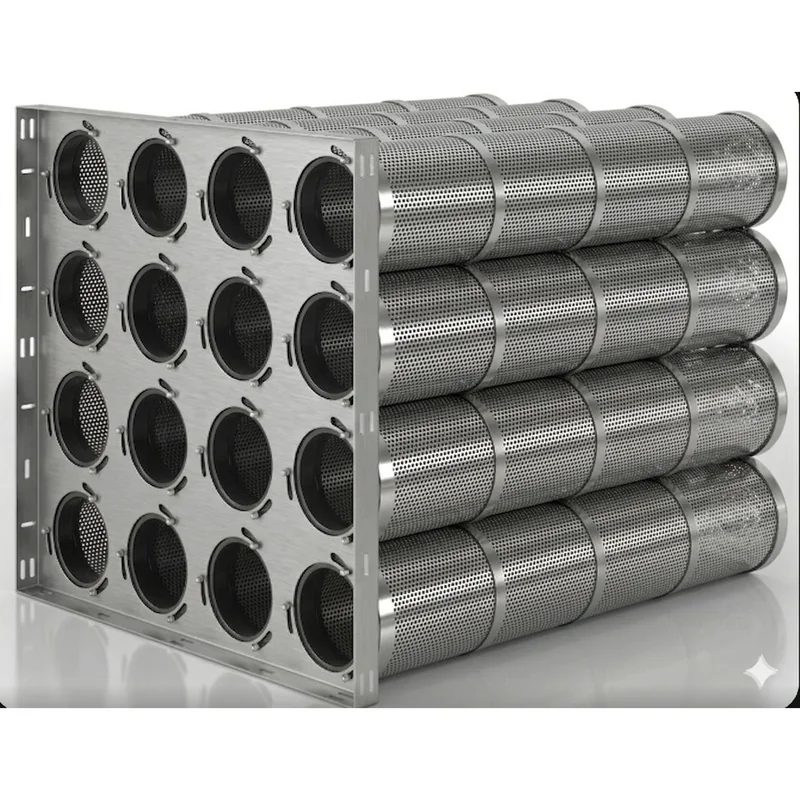
- Cylindrical canister with radial airflow; modular cartridge assembly
- Max. Operating Temperature
- ≤ 80°C
- Max. Relative Humidity
- ≤ 80% RH



Specifications
- Adsorbent
- Premium (modified) activated carbon and comparable adsorbents
- Structure
- Cylindrical canister with radial airflow; modular cartridge assembly
- Frame
- Galvanized steel / stainless steel or injection-moulded canisters; galvanized or stainless mounting plate
- Initial Pressure Drop
- 100–145 Pa @ 2.5 m/s
- Max. Operating Temperature
- ≤ 80°C
- Max. Relative Humidity
- ≤ 80% RH
- Mounting Orientation
- Leak-free gasket mounting; tool-free quick change
- Regeneration
- Metal canisters can be emptied and refilled; moulded canisters are replaced whole
- Certification
- SGS RoHS tested
Detailed Description
Cylinder chemical filter specifications
All three canister lengths share an outer diameter of 145 mm and an inner diameter of 87 mm; longer canisters hold more media and have lower initial resistance. Canisters are available in galvanised steel, stainless steel or injection-moulded plastic.| Canister length | Outer / inner diameter | Media volume | Initial resistance (face velocity 2.5 m/s) | Packed volume |
|---|---|---|---|---|
| 250 mm | 145 / 87 mm | 0.09 ft³ (about 2.5 L) | 145 Pa | 0.006 m³ |
| 450 mm | 145 / 87 mm | 0.17 ft³ (about 4.8 L) | 130 Pa | 0.01 m³ |
| 600 mm | 145 / 87 mm | 0.22 ft³ (about 6.2 L) | 100 Pa | 0.02 m³ |
Mounting plate sizes
Canisters plug into a mounting plate chosen to suit the AHU cross-section; plates are galvanised or stainless steel and 70 mm thick.| Mounting plate H×W×T | Packed weight | Packed volume | Material |
|---|---|---|---|
| 610×610×70 mm | 4.3 kg | 0.04 m³ | Galvanised / stainless steel |
| 305×610×70 mm | 2.6 kg | 0.02 m³ | Galvanised / stainless steel |
| 305×305×70 mm | 1.6 kg | 0.01 m³ | Galvanised / stainless steel |
Which media go in the canisters, and which gases do they remove?
Choose the fill by target gas: premium activated carbon for VOCs and alkaline gases, modified (impregnated) activated carbon for acid gases; blended fills handle several classes at once.| VOCs (premium activated carbon) | Alkaline gases (premium activated carbon) | Acid gases (modified activated carbon) |
|---|---|---|
| Organic vapours, formaldehyde, acetaldehyde | Ammonia, amines | Sulphuric acid, sulphurous acid, sulphur dioxide |
| Nitrogen oxides, sulphides | NMP, HMDS | Chlorine, hydrochloric acid, hydrogen sulphide |
| Paint, food and tobacco odours | Animal and restroom odours | Nitrous acid, hydrogen fluoride, hydrogen bromide |
Where is it used?
- Kitchen fumes and odours: barbecue, cheese, mould, tobacco and fire smoke, plus jet and diesel engine exhaust - Bathrooms and restrooms: urine odour and ammonia - Outdoor pollution and corrosive gases: protecting equipment and people's health - Process exhaust at semiconductor, display and pharmaceutical plants, the outlet of laboratory fume hoods, odour control at wastewater and chemical plants, and exhaust from printing, spray-coating and plating linesRefilling, operating conditions and safety
Metal canisters (galvanised or stainless steel) can be emptied and refilled once spent, while injection-moulded canisters are replaced whole. Operating conditions are ≤ 80°C and ≤ 80% RH, and the media have passed SGS RoHS testing. Activated carbon adsorbs oxygen from the air, so watch for low-oxygen hazards when staff enter closed housings holding chemical media or sample and work in poorly ventilated spaces.Frequently Asked Questions
How do I choose between the 250, 450 and 600 mm canister lengths?
Longer canisters hold more media and have lower resistance: 250 mm holds 0.09 ft³ at 145 Pa initial resistance, 450 mm holds 0.17 ft³ at 130 Pa, and 600 mm holds 0.22 ft³ at 100 Pa (face velocity 2.5 m/s). If the housing is deep enough, choose the long canister for longer life.
Can I refill the canisters myself?
Metal canisters (galvanised or stainless steel) can: empty the old media, refill with fresh media and reuse the canister body. Injection-moulded canisters are replaced whole. Choose the fill by target gas; we can supply the media.
How many canisters go on one mounting plate?
Mounting plates come in three sizes, 610×610×70, 305×610×70 and 305×305×70 mm, in galvanised or stainless steel. The number and layout of canisters per plate are provided on selection, based on airflow and canister length.
Is the cylinder type suitable for restaurant kitchen exhaust odours?
Yes. The deep media bed, large capacity and low bypass suit high-concentration kitchen fume odours; put a grease filter or particulate filter upstream first so oil mist does not block the activated carbon pores.
Selection References
Before ordering, verify the efficiency grade, media type, and whether the operating environment fits your requirements.