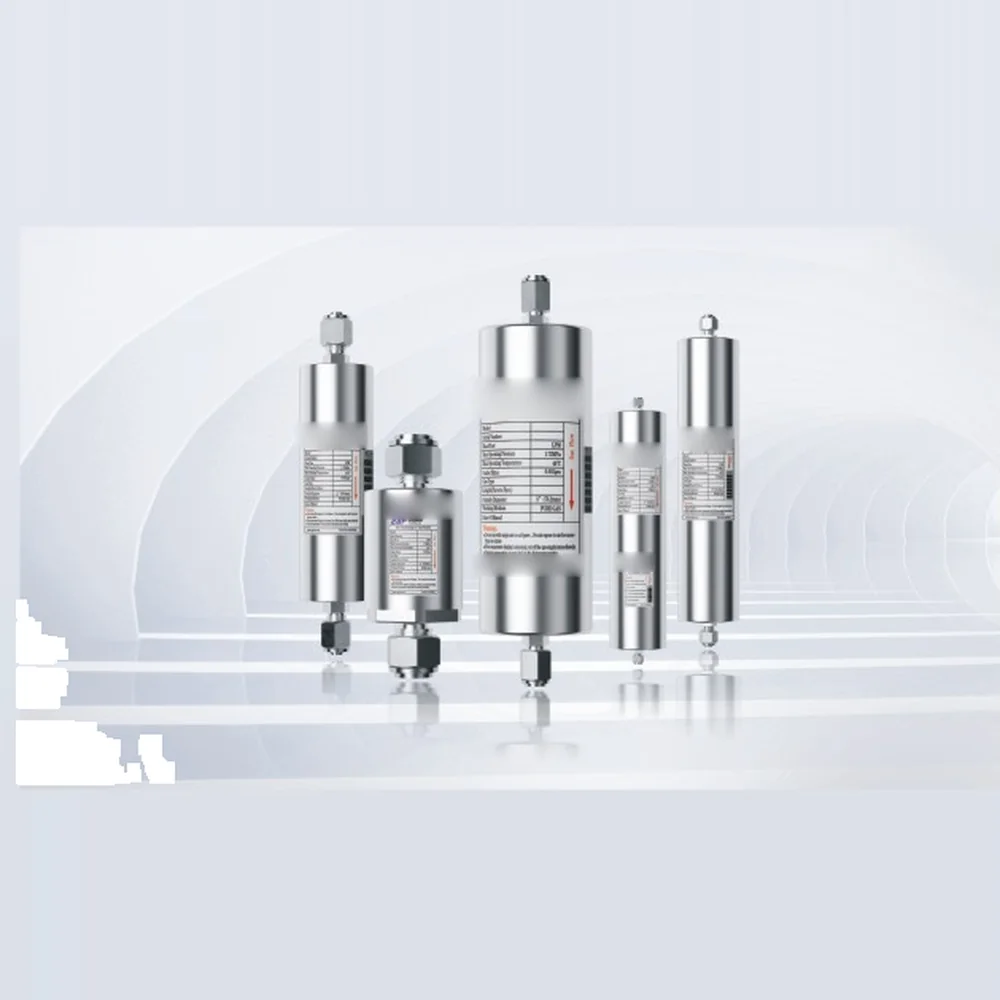
Gas Purifiers
High-Pressure POU Gas Purifier
Product Overview
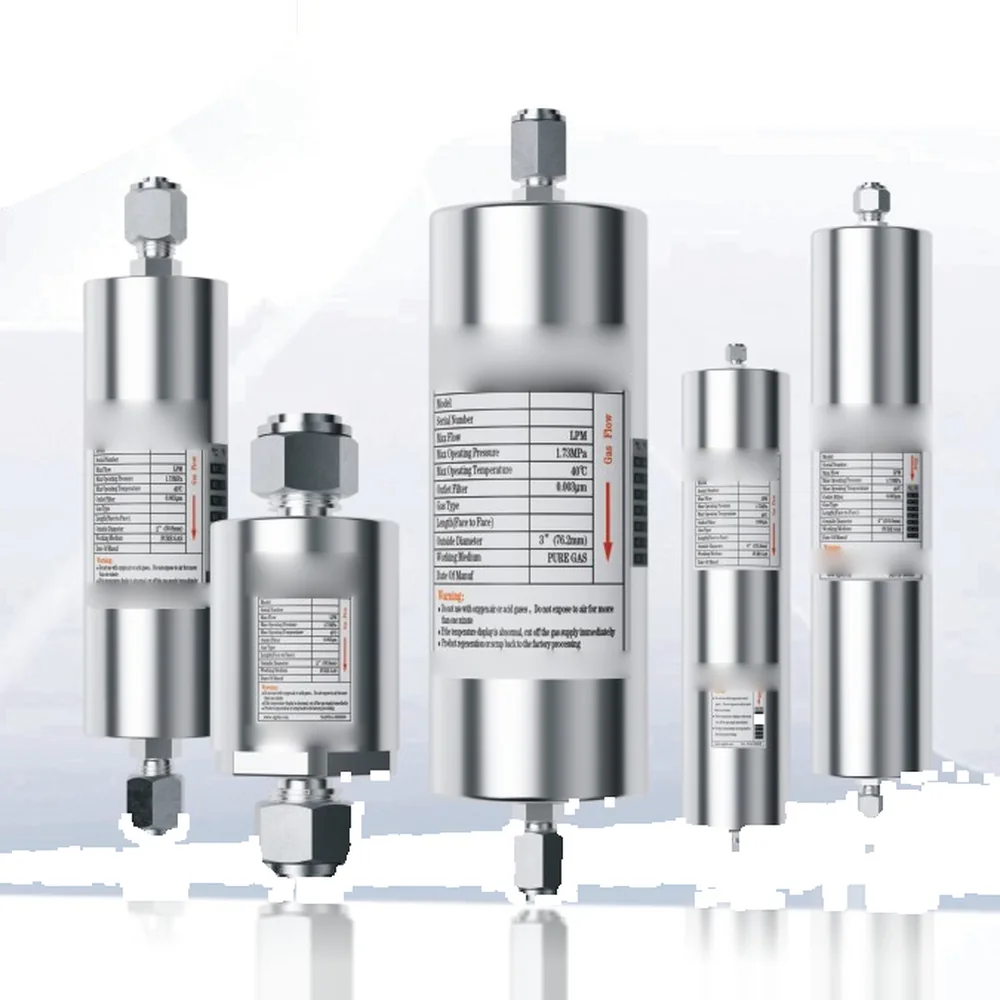
The high-pressure version of the inline POU purifier, rated to 18 MPa (HP) and 24 MPa (SP). It suits direct high-pressure cylinder supply, high-pressure processes, or cases where purification must happen before pressure reduction, with the same ppb-level outlet purity.
Features & Specifications
High-pressure POU selection table
| Model | Max. flow (SLPM) | Max. operating pressure (MPa) | Connection type | Length OAL (face to face) | Tube OD (mm) |
|---|---|---|---|---|---|
| BSP100-HP | 100 | 18 | 1/4"MVCR | 15.55"±0.03 | 60 |
| BSP100-SP | 100 | 24 | 1/4"MVCR | 15.63"±0.03 | 60 |
| BSP250-HP | 250 | 18 | 1/4"MVCR | 19.88"±0.03 | 102 |
| BSP250-SP | 250 | 24 | 1/4"MVCR | 20.04"±0.03 | 102 |
| BSP500-HP | 500 | 18 | 1/2"MVCR | 22.95"±0.03 | 133 |
| BSP500-SP | 500 | 24 | 1/2"MVCR | 23.19"±0.03 | 133 |
| BSP1000-HP | 1000 | 18 | 1/2"MVCR | 42.09"±0.06 | 180 |
| BSP1000-SP | 1000 | 24 | 1/2"MVCR | 45.55"±0.06 | 180 |
The table lists the specification and configuration of standard models only; please enquire for other special requirements.



Detailed Description
Where it applies
Ordinary POU purifiers are rated at around 1.73 MPa, which does not cover direct high-pressure cylinder supply, high-pressure carrier gas, or a process that requires purification upstream of the regulator. The high-pressure version uses a thicker vessel wall and high-pressure-rated fittings to raise the working pressure to 18 MPa (HP) or 24 MPa (SP).Why purify before pressure reduction
For the same mass of impurity, the volumetric concentration is lower and the gas density higher on the high-pressure side, so the bed works more efficiently per unit volume. More importantly, the regulator itself is a potential contamination source — seat outgassing and particle shedding during actuation both happen in the reduction stage. Placing the purifier upstream leaves everything downstream of the regulator unprotected; placing it downstream gives up the high-pressure efficiency. Both arrangements are used in practice depending on where the contamination originates, so please describe the existing pipework order when specifying.Suffix meanings
・HP: high-pressure type, maximum working pressure 18 MPa ・SP: super-high-pressure type, maximum working pressure 24 MPaProduct features
・Ambient catalytic adsorption, with no heating and no purge gas required ・Built-in high-precision filter with a filtration rating of 0.003 μm ・Returnable for factory regeneration, with an equipment life of over 20 years ・Impurity removal matches the standard POU at the same flow (H₂O, O₂, CO, CO₂, H₂ and NMHC < 1 ppb with a source gas quality of 5N or better)Applicable gases
N₂, H₂, O₂, Ar, He, Kr, Ne, Xe, CDA, CH₄, CO₂ and other bulk gases, plus a range of specialty gases.Processes and industries served
・Carrier gas systems fed directly from cylinders or bundles, bypassing the facility main ・High-pressure processes: certain deposition, annealing and pressurised chambers ・Gas filling and repacking stations, raising source quality before filling ・Research institutes and pilot lines, where runs are short and consumption is low and gas is drawn straight from the high-pressure sourceInstallation and layout notes
・Keep the pressure rating consistent across the whole chain: once the purifier is rated at 18 or 24 MPa, the fittings, valves and flexible hoses upstream and downstream must match — replacing only the purifier is not enough ・Provide relief and vent routing: a high-pressure section must have safety relief, and the vent has to be routed to a safe location ・Torque fittings to specification: MVCR face seals are more sensitive to torque and gasket condition under high pressure, and gaskets should be replaced on every reassembly ・Carry out a pressure-hold test after installation: pressurise with inert gas, hold, and confirm there is no pressure drop before introducing process gas ・Like the standard type, no electrical power and no purge gas are requiredMaintenance and regeneration
Factory regeneration follows the same logic as the standard POU, at 1–2 year intervals. The difference is that removal must be preceded by full depressurisation with pressure confirmed at zero — fittings must never be loosened with residual pressure in the vessel.Choosing between neighbouring models
| Model | Max. pressure | Flow | Where it fits |
|---|---|---|---|
| BSP-HP (this model) | 18 MPa (HP) / 24 MPa (SP) | 100–1000 SLPM | Direct high-pressure cylinder supply, purification before regulation |
| BSP standard | 1.73–6.9 MPa | 5–4000 SLPM | Point of use downstream of facility supply |
| BSS-HP high-pressure type | 24 MPa (240 bar) | 10–100 Nm³/h | High flow at high pressure with automatic regeneration |