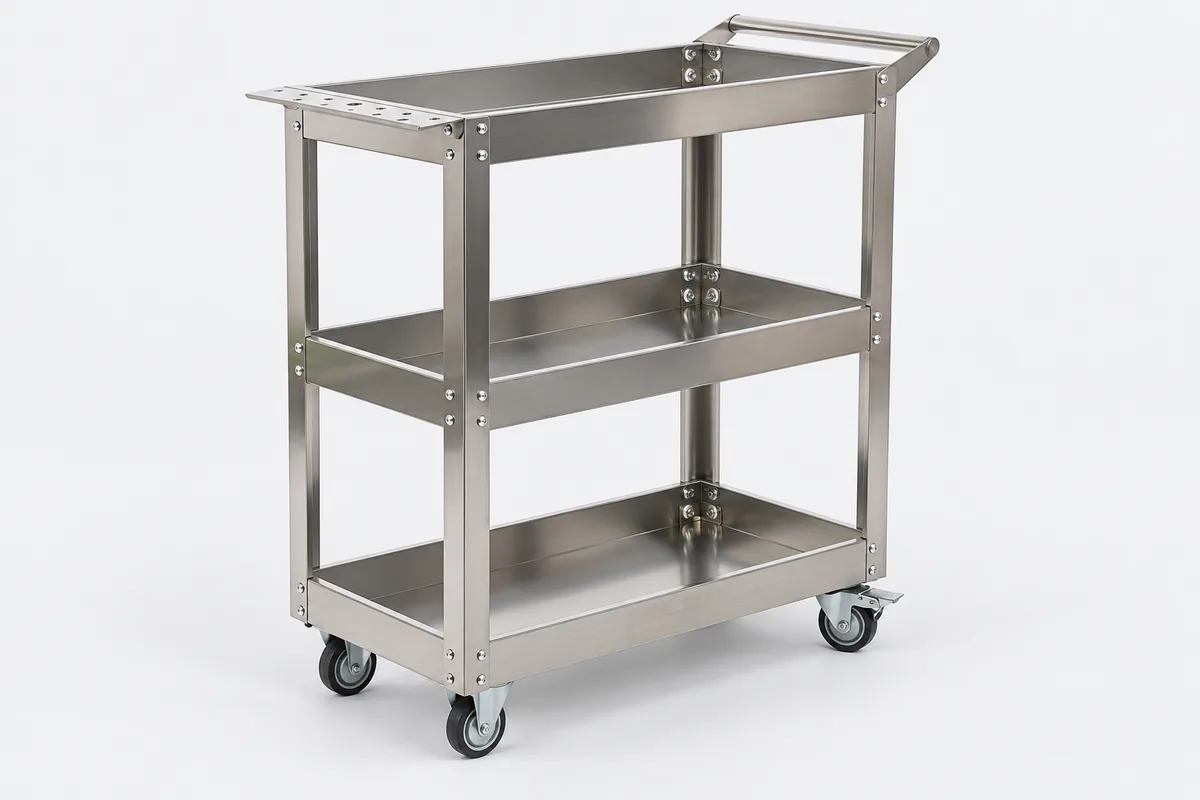
Cleanroom Stainless Steel Cart
Product Overview
Features & Specifications



Detailed Description
A cart is a moving source of contamination
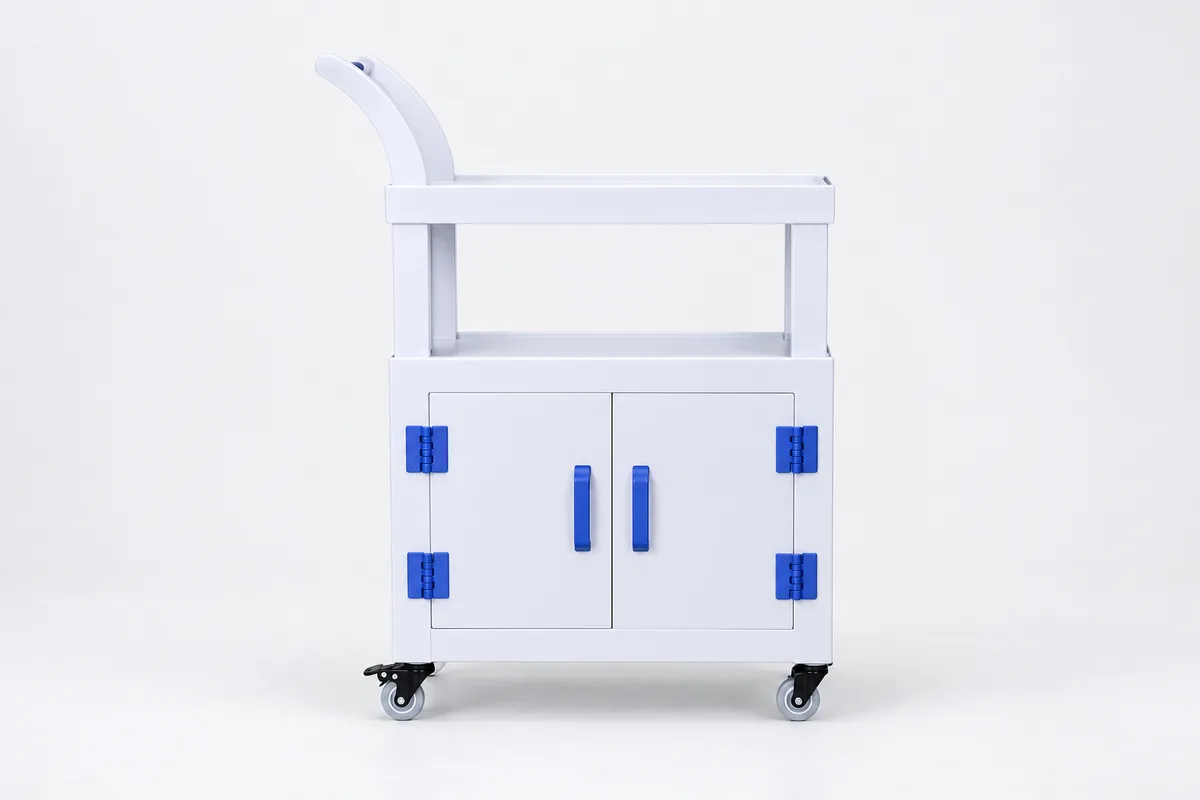
Fixed worktables and shelving stay put once they are in place, but a cart travels all day between corridors, doorways and equipment. Movement means friction, and friction generates particles; a cart also crosses between areas, carrying contamination from one place to another. So the question to ask when assessing a cart is not "how sturdy is it" but "how much does one trip bring in".Castors: tread, bearings, brakes
Match the tread to the floor: on epoxy resin floors use softer PU wheels to avoid scratching the floor and creating debris; on raised floors, check that the wheel diameter is clearly larger than the grating holes, otherwise the wheels drop into the holes and scrape debris off the hole edges. Bearings must be sealed: the grease in open bearings picks up dust and flings it out as the wheel turns; only sealed bearings keep the castor from becoming a moving source of contamination. Brakes: when a cart parked on a slope, at a lift entrance or beside equipment slides and collides, the damage is not limited to the load; the impact itself also releases a burst of particles. Castors are the first part of a cart to wear, so spare castors can be included in the purchase and replaced as a set once worn, rather than waiting until the tread breaks up.Choosing the cart type by load
| Cart type | Load carried | Design focus |
|---|---|---|
| Flat, perforated, folding, rack-backed | General materials, tools, packaging | Perforated decks let air pass; folding types save space when not in use |
| Lipped-edge, railed | Boxes and loose parts that slide off easily | Upstand height set by the load; inside corners must be easy to wipe |
| Anti-vibration, swivel anti-vibration, box-type anti-vibration | Wafer carriers, photomask boxes, precision parts | Damping structure isolates vibration transmitted up from the castors |
| Wafer carrier, photomask box, silicon ingot, silicon disc, glass sheet | High-value fragile items | Locating slots or cradles shaped to the item; held in place, not stacked |
| Solution bottle, solution drum, CMP water cart | Liquid containers | Low centre of gravity, spill upstands; liquid sloshing while pushing does not tip the load |
| Airtight cabinet, drawer | Items needing cover or compartments | Close-fitting doors; compartments stop items knocking together |
| Antistatic PCB substrate rack | Circuit boards | Vertical or horizontal slots; boards do not touch each other |
Crossing zones, the cart itself is a material transfer
EU GMP Annex 1 §4.10–4.11 identifies material transfer as one of the main sources of contamination in clean areas, and items entering grade A / B areas must go through a validated disinfection procedure; §4.7 also requires materials to resist cleaning agents and disinfectants. When a cart crosses zones, the body, the wheels and the load all go in together, which amounts to a material transfer. So the cart must be built so that it can be wiped and disinfected as a whole: no tube cavities that cannot be reached, easy-to-clean joints between the castor brackets and the body, and removable shelves. Many cleanrooms follow the rule that "carts inside the zone stay in, carts outside stay out", handing items over at a pass box or airlock instead of letting the same cart shuttle between the corridor and the work area.Pushing and load
A cart's rated load is a static figure; in actual use you also have to allow for the shocks of starting off, turning and crossing thresholds. For heavy items such as heavy solution drums or pumps, choose large-diameter wheels and add ramps at thresholds, so the whole cart does not jolt when pushed over a step.Maintenance: check the castors first
A cart's cleanliness declines with time in use, and the castors are the first to give trouble: fibres and hair wrap around the axles, the treads wear and shed debris, and the brake pads wear too. Put castor inspection into the routine maintenance schedule: remove anything wrapped around the axles, wipe the castor brackets and replace worn castors as a set; take removable shelves and trays off regularly for washing rather than only wiping the surface.Frequently Asked Questions
Carts keep getting their wheels stuck on the raised floor. How can this be solved?
Usually the wheel diameter is too small or the tread too narrow, so the wheel drops into a grating hole. When selecting, first measure the hole size of the raised floor: the wheel diameter must be clearly larger than the hole and the tread wide enough to bridge it; also avoid small hard wheels, because forcing a stuck wheel out scrapes debris off the hole edge. If the cart has to travel between raised floor and solid floor, the tread material must suit both surfaces; if necessary, use two carts and hand over at the zone boundary.
Do wafer carriers and photomask boxes always need an anti-vibration cart?
It depends on how sensitive the items are to vibration and on the route. The contents of wafer carriers and photomask boxes are high-value, damage from vibration is not always visible from outside, and routes often include lift thresholds and floor joints; in these cases the damping structure of an anti-vibration cart isolates the shocks coming up from the castors, and a box-type anti-vibration cart adds locating compartments so the boxes do not knock together. For short moves within the same room on a level floor, an ordinary lipped-edge cart with a locating tray is generally acceptable.
Can the same stainless steel cart go back and forth between general areas and clean areas?
Not recommended. EU GMP Annex 1 lists material transfer as one of the main sources of contamination, and entry into grade A / B requires a validated disinfection procedure; the wheels of a cart touch the floor of the general area directly and are the hardest part to disinfect thoroughly. The usual practice is to use one cart inside and one outside, handing items over at a pass box or airlock; where crossing zones is genuinely necessary, set up a fixed wipe-down and disinfection procedure at the entrance and choose a cart with sealed tube ends, removable shelves and no internal cavities, so the whole cart can be wiped completely.
Selection References
Before ordering, verify the efficiency grade, media type, and whether the operating environment fits your requirements.