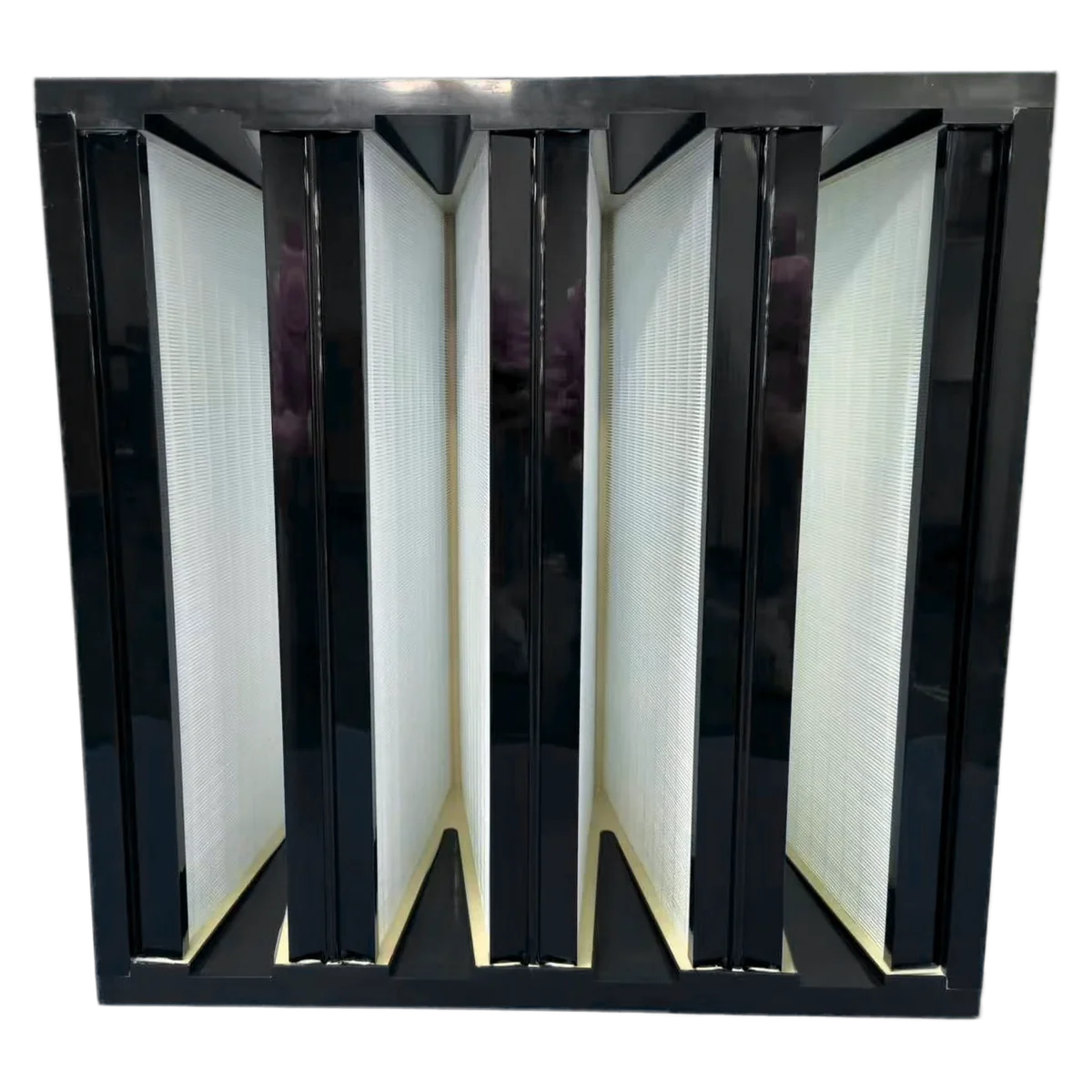
Explosion-Resistant MERV 15 V-Bank Filter for Power Plants
Product Overview
Key Specifications
- Efficiency Class
- MERV 15
- Rated Airflow
- 4,250 m³/h(2,500 ft³/min)
- Initial Pressure Drop
- 144.8 Pa
- Dust Holding Capacity
- ASHRAE dust 318.2 g; ISO Fine @600 Pa 1,181.8 g



Specifications
- Filter Media
- Glass fiber
- Frame
- ABS engineering plastic
- Separator
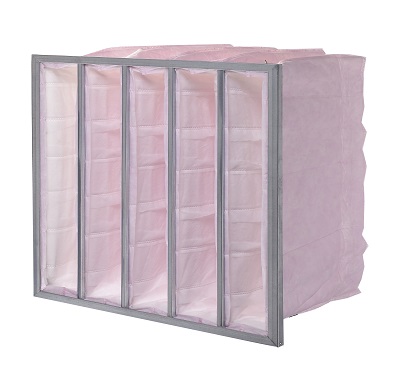
- V-Cell deep-pleat V design (4V-Bank)
- Test Standard
- ASHRAE 52.2
- Efficiency Class
- MERV 15
- Filtration Efficiency
- E1 (0.3–1.0 µm) 88.7%; E2 (1.0–3.0 µm) 99.3%; E3 (3.0–10 µm) 99.3%; average arrestance > 99%
- Rated Airflow
- 4,250 m³/h(2,500 ft³/min)
- Initial Pressure Drop
- 144.8 Pa
- Final Pressure Drop
- 450 Pa (set point)
- Dust Holding Capacity
- ASHRAE dust 318.2 g; ISO Fine @600 Pa 1,181.8 g
- Standard Dimensions
- 592 × 592 × 292 mm
- Certification
- Burst test at 1,000 Pa with no damage
Detailed Description
The problem this filter is built for
Gas turbine intakes, power plant boiler air supply and large air handling units all share the same constraint: the airflow is high and downtime is expensive. High airflow means high media face velocity, and an ordinary panel-type medium filter clogs quickly under it. Expensive downtime means the change-out interval has to be stretched as far as possible — and the filter must not collapse under abnormal differential pressure, because a ruptured frame or blown-through media sends unfiltered air straight into the equipment downstream. This V-Bank filter addresses both points: the deep-pleat V configuration maximises media area to buy low resistance and high dust holding capacity, while the one-piece ABS frame showed no damage under a 1,000 Pa differential.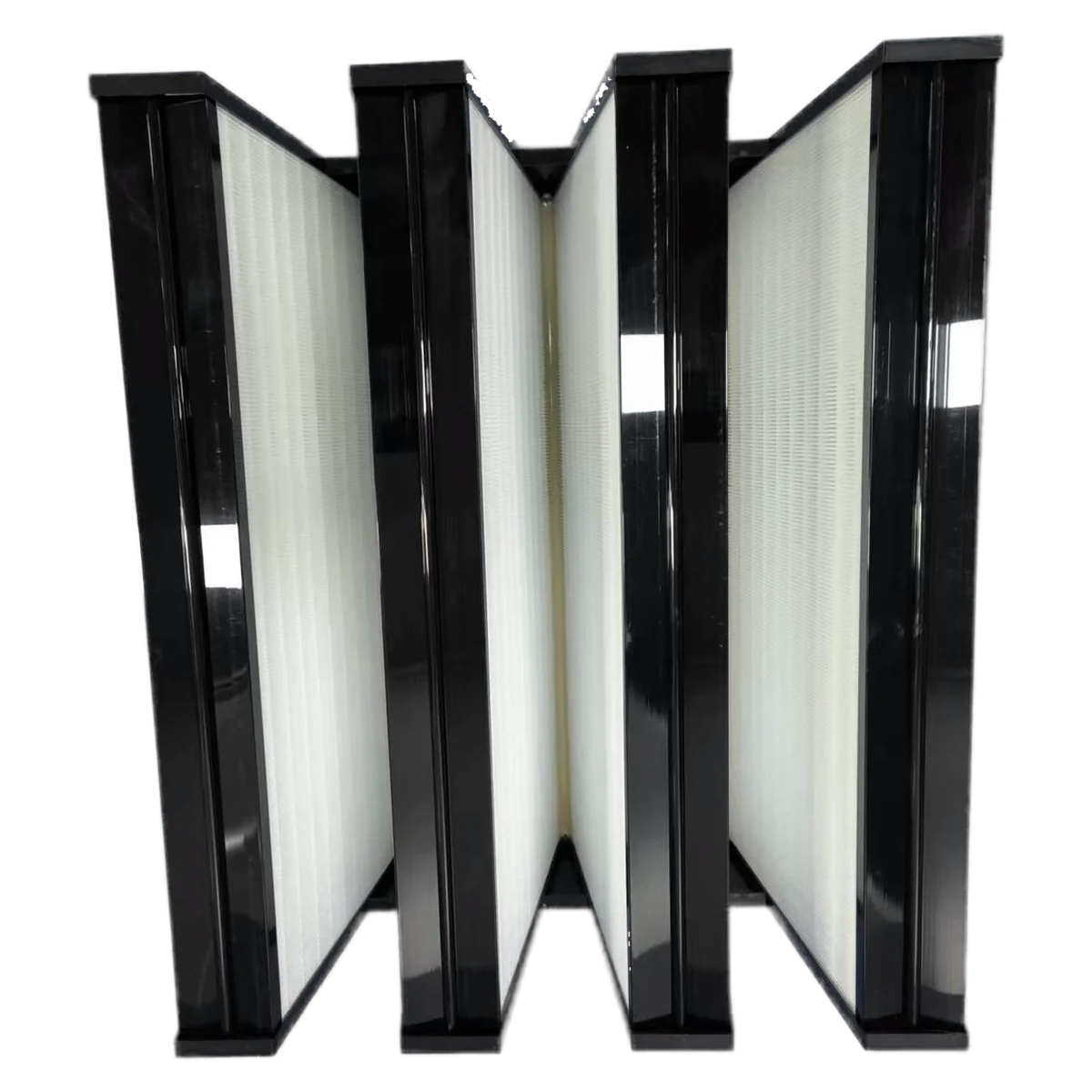
Why the V configuration delivers low resistance and high capacity at once
Resistance is driven mainly by the face velocity through the media. For the same 592×592mm frontal area, a panel filter offers roughly the frontal area itself in media; a V-Bank folds the media along the depth axis into several V sections, so the media area unfolds to several times the frontal area. Lowering face velocity produces two benefits simultaneously: initial resistance drops, taking fan energy with it, and dust accumulates more slowly on the media, extending both holding capacity and service life. At the rated 4,250 m³/h this filter shows only 144.8 Pa of initial resistance.Airflow vs Pressure Drop
Measured on the 592×592×292mm 4V model, covering 50%–125% of rated airflow
Pressure drop rises non-linearly with airflow. Keep the operating point at or below rated flow — pushing airflow up 25% raises initial resistance by about 42%, which shows up directly in fan energy.
How MERV 15 is determined
ASHRAE 52.2 does not rate a filter on its best out-of-box numbers. The procedure feeds dust in stages and re-measures fractional efficiency at every stage, then takes the worst moment across the entire sequence as the composite minimum efficiency, and assigns the rating from that. This filter's composite minimum is 88.7% for 0.3–1.0 µm and 99.3% for both 1.0–3.0 µm and 3.0–10 µm, giving MERV 15. Note that efficiency climbs as dust loads — glass-fibre media works by mechanical interception through its fibre structure, and accumulated dust narrows the pores, raising efficiency. Electrostatically charged media behaves the opposite way: the out-of-box figures look better, but the charge decays with service time and humidity, so efficiency falls.Fractional Efficiency Curve (MERV 15)
Measured per ASHRAE 52.2 across loading steps; X axis is geometric mean particle size (log scale)
MERV is assigned from the composite minimum efficiency — the filter's worst moment across the whole loading sequence, not the flattering out-of-box number. Even at its weakest, this model holds above 98% for particles larger than 1µm, and efficiency only climbs as dust accumulates, which is the key difference between glass-fibre media and electrostatically charged media.
Dust holding capacity is what sets the change-out interval
How much dust a filter absorbs between initial and final resistance converts directly into service life. Tested with ASHRAE synthetic dust to a 450 Pa endpoint, this filter holds 318.2 g; with finer ISO Fine dust and the endpoint relaxed to 600 Pa, capacity reaches 1,181.8 g. A practical way to read this: at the same airflow and the same final resistance setting, doubling the holding capacity doubles the change-out interval, which saves both consumable cost and downtime labour.Pressure Rise During Dust Loading
ASHRAE synthetic dust fed in stages until resistance reaches the 450Pa final value
The deep-pleat V configuration spreads the effective media area out, so the filter absorbs 318.2g of dust while resistance climbs from 144.8Pa to 450Pa. With finer ISO Fine dust and the endpoint relaxed to 600Pa, holding capacity reaches 1181.8g. Dust holding capacity is what sets the change-out interval — double the capacity at the same airflow and you halve the replacement frequency.
Pressure resistance and structural strength
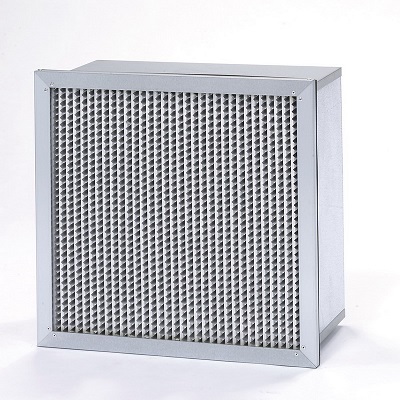
The ABS frame is formed in one piece, with the media sealed to the frame with potting compound to prevent bypass leakage. Under a 1,000 Pa differential pressure test the filter showed no damage — more than twice the 450 Pa final resistance set point, leaving adequate margin for abnormal conditions such as severe clogging, damper misoperation or sudden pressure surges.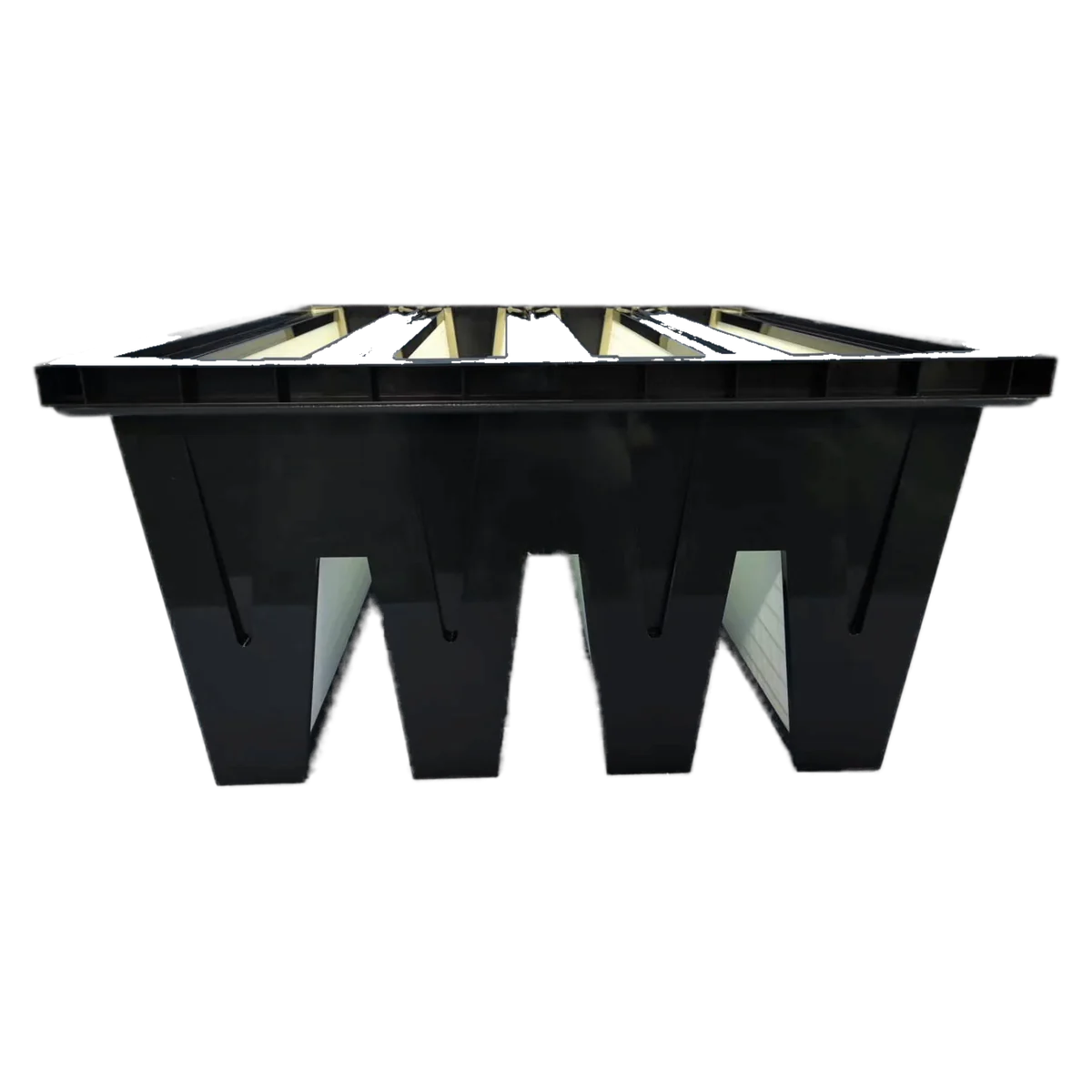
The media packs
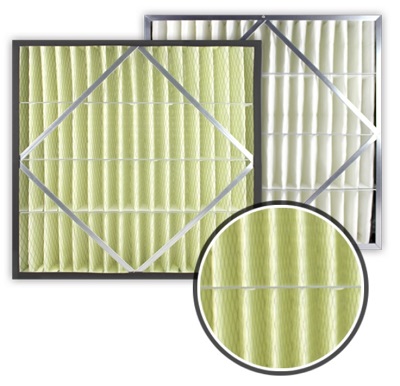
Each V section is built from an independent mini-pleat media pack. The glass-fibre media is separated by hot-melt adhesive beads that hold the pleat spacing, so airflow stays evenly distributed through the full depth of the media and no local face velocity spike develops from collapsed pleats.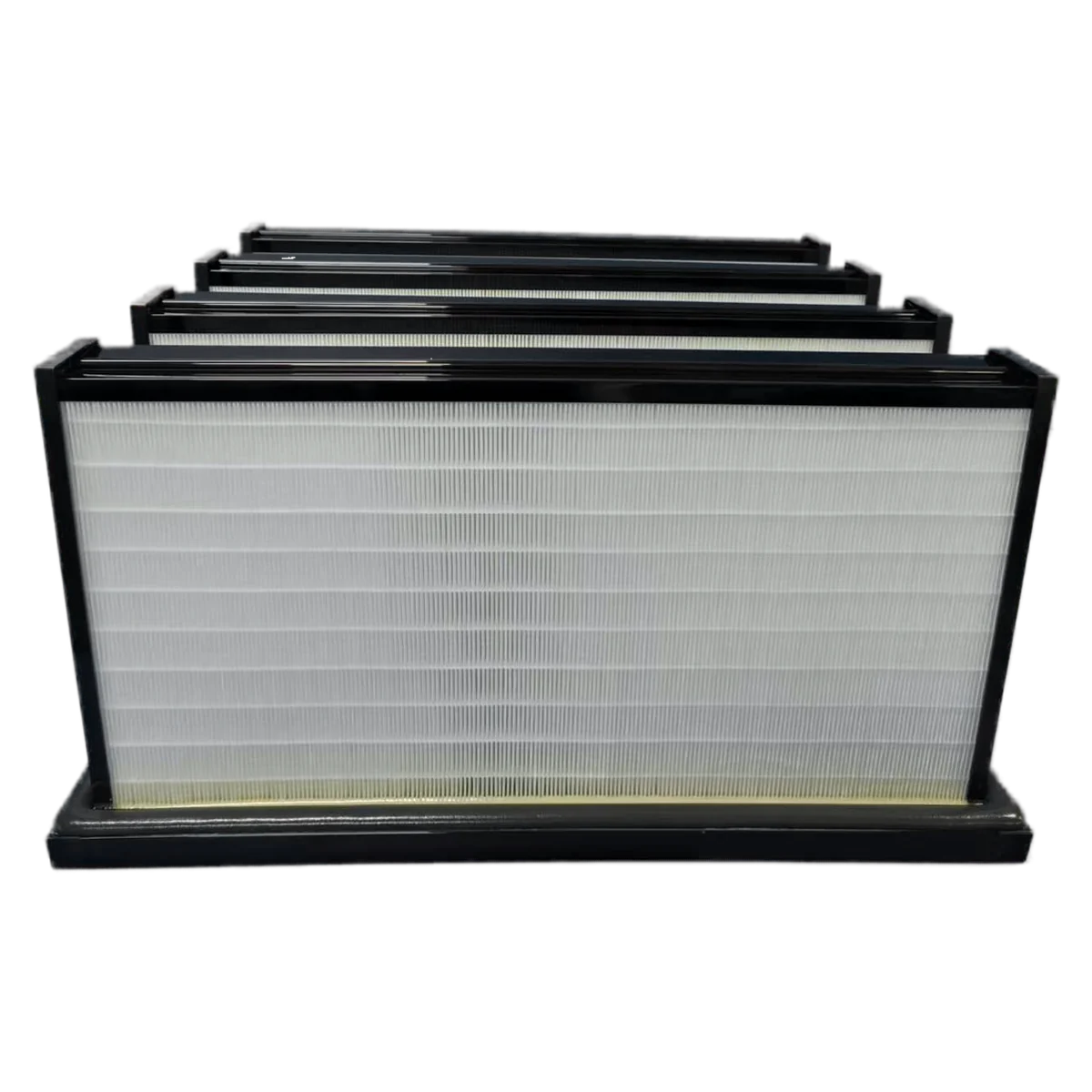
Where it is used
- Gas turbine and steam turbine intake filtration - Power plant boiler air supply, control room and switchgear room ventilation - Medium stage of large air handling units (AHU) - Data centres, underground substations and other high-airflow environments that are hard to shut down - Ventilation systems that must keep structural integrity under high differential pressureSelection guidance
Keep the operating point at or below rated airflow. The measured curve shows that pushing airflow up 25% (4,250 → 5,313 m³/h) raises initial resistance from 144.8 Pa to 205.5 Pa, a rise of about 42% — a cost that keeps showing up in the fan's annual energy consumption. If the site needs more airflow, specifying more V sections or a larger filter size works out better than running a single filter over speed. A pre-filter upstream (G4 / MERV 8 class) to capture coarse particles will noticeably extend the life of this stage.Selection References
Before ordering, verify the efficiency grade, media type, and whether the operating environment fits your requirements.