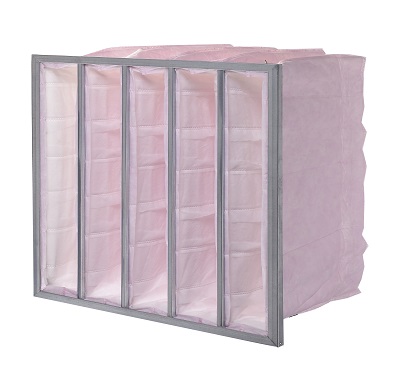
Bag Filter
Product Overview
Key Specifications
- Efficiency Class
- MERV 9 / 11 / 13 / 14
- Filtration Efficiency
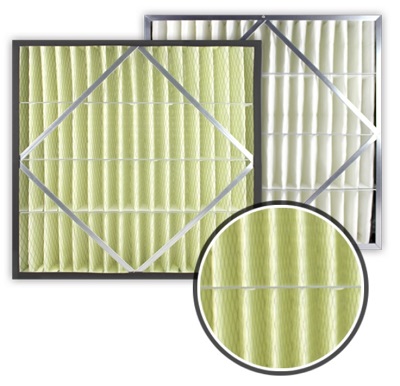
- Dust-spot efficiency 40–45% (brown) MERV 9, 60–65% (orange) MERV 11, 80–85% (pink) MERV 13, 90–95% (light yellow) MERV 14
- Max. Operating Temperature
- 50°C
- Filter Media
- Multi-layer synthetic fiber laminated onto non-woven backing for a reinforced filtration layer; durable media with no fiber shedding



Specifications
- Filter Media
- Multi-layer synthetic fiber laminated onto non-woven backing for a reinforced filtration layer; durable media with no fiber shedding
- Frame
- Galvanized steel as standard; stainless steel or aluminum available on request. Frame depth 20 mm
- Test Standard
- ASHRAE 52.1-1992
- Efficiency Class
- MERV 9 / 11 / 13 / 14
- Filtration Efficiency
- Dust-spot efficiency 40–45% (brown) MERV 9, 60–65% (orange) MERV 11, 80–85% (pink) MERV 13, 90–95% (light yellow) MERV 14
- Max. Operating Temperature
- 50°C
Model Reference
| Model | Description | Size |
|---|---|---|
| B3P85-12-24-12 | Bag filter 80~85% 12X24X12" 3 pockets | 12 × 24 × 12″ |
| B6P95-24-24-22 | Bag filter 90~95% 24X24X22" 6 pockets | 24 × 24 × 22″ |
| B6P85-24-24-12 | Bag filter 80~85% 24X24X12" 6 pockets | 24 × 24 × 12″ |
| B6P85-24-24-15 | Bag filter 80~85% 24X24X15" 6 pockets | 24 × 24 × 15″ |
| B6P85-24-24-10 | Bag filter 80~85% 24X24X10" 6 pockets | 24 × 24 × 10″ |
| B12P65-595-595-360 | Bag filter 65% 595X595X360mm 12 pockets, inlet-side gasket 3mm | 595 × 595 × 360 mm |
| B6P85-12-24-10 | Bag filter 80~85% 12X24X10" 6 pockets | 12 × 24 × 10″ |
| B8P85-24-24-21 | Bag filter 80~85% 24X24X21" 8 pockets | 24 × 24 × 21″ |
Common sizes are listed above. Other sizes, frame materials and efficiency grades can be made to order — please quote the model or size when requesting a quotation.
Detailed Description
Why make it into pockets?
In the same 24×24 inch opening, a flat panel holds only 0.37 m² of media. Sewn into pockets, the unfolded media area becomes roughly 5 to 17 times larger. More area means each part of the media receives less air, so resistance is lower, the filter holds more dust, and it lasts longer before replacement. Think of sewing one large sheet of fabric into several long pockets: the more and the longer the pockets, the more fabric hides behind the same opening.How much more media do pockets give?
Unfolded media area in a 24×24 inch opening (estimated)
Estimate: pockets × 2 sides × pocket length × pocket height (22 in). Tapered ends and seams make the real value slightly smaller.
| Configuration (24×24 inch opening) | Unfolded media area (approx.) | Times a flat panel |
|---|---|---|
| Flat panel filter | 0.37 m² | 1× |
| 6 pockets, 12 inch long | 2.04 m² | 5.5× |
| 6 pockets, 15 inch long | 2.55 m² | 6.9× |
| 8 pockets, 21 inch long | 4.77 m² | 12.8× |
| 10 pockets, 22 inch long | 6.25 m² | 16.8× |
Test data: how does resistance change with airflow?
A 24×24×15 inch, 6-pocket, 65% (orange) bag filter was tested by a third-party laboratory to ASHRAE 52.2. At its rated airflow of 2000 CFM (about 3400 m³/h), the initial pressure drop was 65 Pa. At half the airflow, 1000 CFM, it fell to just 20 Pa — about one third. This is also why more and longer pockets help: the same airflow is spread over more media, the air moves more slowly through each part of it, and resistance drops faster than the velocity does.Airflow vs initial pressure drop (third-party test)
24×24×15 in, 6 pockets, 65% (orange), tested to ASHRAE 52.2
Halve the airflow and the pressure drop falls to about one third. Data from a third-party test report on a single sample; values differ by efficiency, pocket count and length — the shipping specification governs.
| Particle size range | Typical examples | Captured by this bag filter |
|---|---|---|
| 0.3–1 μm (E1) | Bacteria, tobacco smoke, cooking-oil fumes | 28.0% |
| 1–3 μm (E2) | Vehicle exhaust particles, welding fumes, flour dust | 68.7% |
| 3–10 μm (E3) | Mold spores, dust-mite debris, cement dust | 88.3% |
How to choose among the four grades
| Dust-spot efficiency | Pocket color | ASHRAE 52.2 equivalent | Old European class (EN 779) |
|---|---|---|---|
| 40–45% | Brown | MERV 9 | F5 |
| 60–65% | Orange | MERV 11 | F6 |
| 80–85% | Pink | MERV 13 | F7 |
| 90–95% | Light yellow | MERV 14 | F8 |
Specifications and sizes
| Efficiency | Number of pockets | Size (W x H) | Pocket length |
|---|---|---|---|
| 45% 65% 85% 95% | 3B 4B 5B 6B | 24”x12” | 10” 12” 15” 18” 20” 21” 22” 24” 30” 36” |
| 45% 65% 85% 95% | 6B 8B 10B 12B | 24”x24” | 10” 12” 15” 18” 20” 21” 22” 24” 30” 36” |
Where it is used
- The medium-efficiency stage of central air handling units (AHU) and constant temperature and humidity units - Outdoor air handling units (PAH / MAU), filtering outside air before it enters the building - As the protective stage before a HEPA filter, extending the HEPA replacement interval - Facility HVAC maintenance at electronics and materials plants: usually replaced in one batch together with the pre-filters; on-site replacement and removal of used filters can be arranged as part of the maintenance jobFrequently Asked Questions
How do I choose the number of pockets and the pocket length?
Start with the depth the air handling unit leaves for the filter, then look at the airflow. A 24×24 inch opening takes 6, 8, 10 or 12 pockets; a 12×24 inch opening takes 3 to 6; pocket length runs from 10 to 36 inches. More and longer pockets mean more media: in the same 24×24 inch size, 6 pockets at 12 inches give about 2.04 m², while 10 pockets at 22 inches give about 6.25 m². More area means lower resistance, more dust held and longer intervals between changes — at the cost of a deeper installation space and a higher unit price. If unsure, ordering the same pocket count and length as the filter you are removing is the safest choice.
Which way should the pockets face when installing?
The pocket openings (the framed side) face the incoming air: air blows into the pockets and passes out through the media. The pockets should hang vertically, so that when the fan runs they inflate and stay apart, and when it stops they do not collapse onto each other. Installed sideways, the pockets sag and lie on top of one another, which effectively removes part of the media area and raises resistance.
Can you make stainless steel or aluminum frames?
Yes. The standard is a 20 mm galvanized steel frame; for humid locations, corrosive gases, or anywhere rust is not acceptable, stainless steel or aluminum frames are available. Stainless frames are a special build and are hard to schedule in very small quantities: we have had a request for just 2 units that could not be made, and a price was only possible once the quantity reached 50 or more. Please include the quantity when you ask for a quote.
What is the media made of? Do you offer needle-punched non-woven or washable versions?
The media is multi-layer synthetic fiber laminated onto a non-woven backing for strength, so fibers do not shed easily. We do not currently offer needle-punched non-woven media. Bag filters are disposable: once loaded with dust, the whole unit is replaced.
Do you have metric sizes (for example 592×592)?
Yes. Besides the inch sizes 24×24 and 12×24, metric sizes are made too, for example B12P65-595-595-360 (595×595×360 mm, 12 pockets, 65%, with a 3 mm gasket on the air-inlet side). Non-standard frame sizes can also be made — 530×530×290 mm and 590×550×210 mm are sizes we have produced. For a quote, please give the frame width × height × depth, number of pockets, efficiency and quantity.
Selection References
Before ordering, verify the efficiency grade, media type, and whether the operating environment fits your requirements.