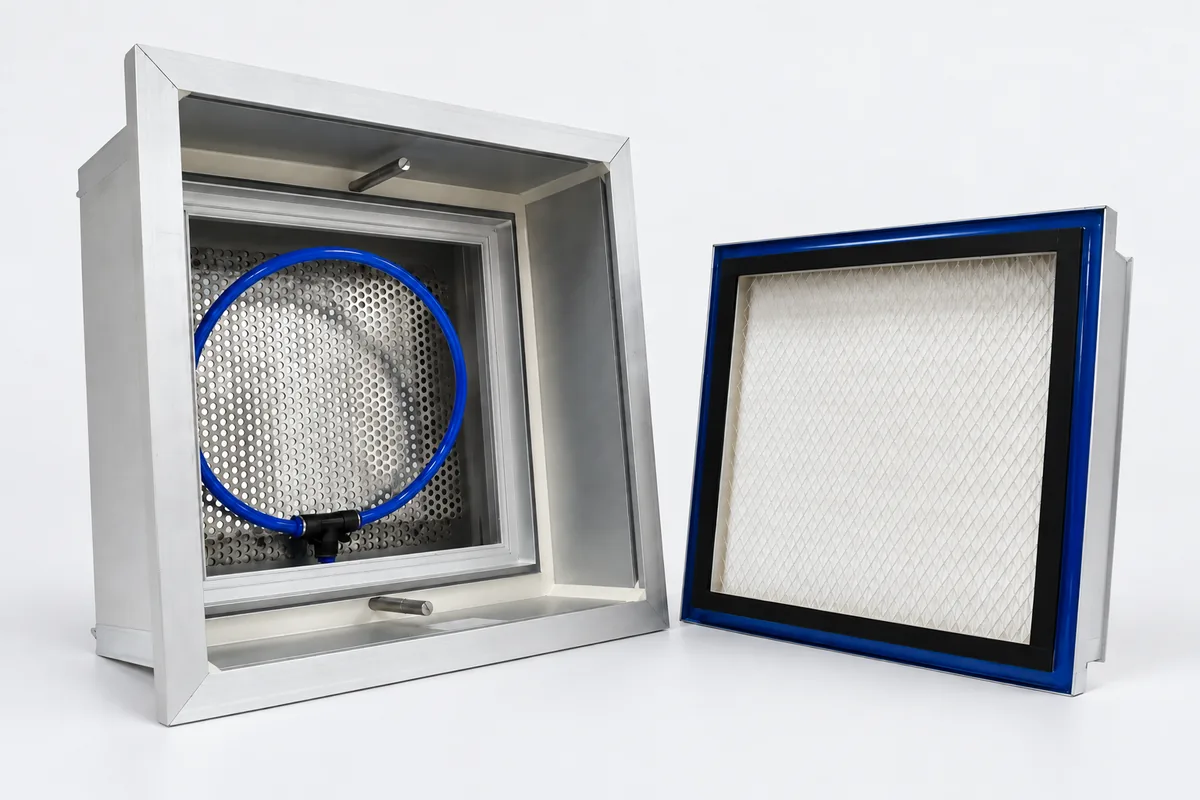
Liquid-seal HEPA Diffuser Box
Product Overview
Features & Specifications



Detailed Description
Retest frequency decides whether it is worth it
A gel-seal unit costs more than a gasket unit, and the grid or housing is more complex; whether it is worth it depends on how many times the filters will be leak-tested. The requirements for pharmaceutical and aseptic processing are:| Source | Requirement |
|---|---|
| EU GMP Annex 1 (2022) §4.25 | Integrity test after filter installation |
| EU GMP Annex 1 (2022) §4.32 | Periodic retesting; maximum interval 6 months for Grade A / B, 12 months for Grade C / D |
| FDA 2004 aseptic processing guidance | Leak test at installation; a single-point PAO / DOP scan reading reaching 0.01% of the upstream concentration is considered a significant leak; twice a year recommended for aseptic processing rooms |
Gel seal does not mean leak-free
This is the most common misunderstanding. Leak testing looks for three paths: pinholes or damage in the filter media itself, the bond between filter frame and media, and the seal between filter and housing. The gel seal deals only with the third; the first two can still leak, so scan testing after installation is still required and must not be skipped just because the unit has a gel seal. Testing can follow the HEPA / ULPA leak test in IEST-RP-CC034.5; according to available sources, ISO 14644-3:2019 Annex B.7 also covers leak testing of installed filter systems. When a leak is found, first identify its location: if it is on the media face, it is a filter problem; only if it runs all the way along the knife edge is it a sealing problem. At the factory, filters are classified to the European EN 1822-1:2019 or China's GB/T 13554-2020, which tests the filter itself; the scan after installation tests the whole "filter + seal + housing" system, and the two cannot substitute for each other.Checking the sealant and changing the filter
Routine maintenance of a gel seal is minimal; the critical moment is the filter change: Lift vertically: when removing the old filter, pull it straight down and out without tilting or tugging, to avoid dragging large amounts of gel out of the channel or leaving voids. Inspect the gel surface: after removing the old filter, check that the gel surface in the channel is continuous, with no gaps where gel was pulled out and no foreign matter; add gel and level it if necessary. Confirm insertion depth: the new filter's knife edge must be fully inserted into the gel, at the same height on all four sides, with no corner lifted. Retest: a filter change counts as reinstallation and requires a post-installation integrity test under Annex 1 §4.25. By contrast, it does not need the periodic checks of clamping bar torque and gasket ageing that a gasket type requires. It is advisable to keep the filter change dates, gel top-up records and retest results for each diffuser in the same record, so that when a retest finds a leak, it can be traced to the removal and refitting that caused it.Where the extra cost is not needed
If there is no requirement for periodic leak testing of the filters, as in the turbulent-flow clean areas of most electronics assembly plants, a gasket-type HEPA box is more cost-effective. The rule of thumb: rooms that are periodically leak-tested and where a shutdown is costly get the gel-seal type; the rest use the gasket type. When comparing the two, do not compare unit price alone; calculate "number of diffusers × retests per year × rework and downtime cost when a frame leak occurs" together. Grade A / B rooms are tested at least twice a year, and with many diffusers the rework risk of the gasket type accumulates; the same building can also mix them, with gel-seal units in high-grade rooms and gasket units in Grade C / D and support areas.Frequently Asked Questions
With gel-seal HEPA boxes, will leak testing never find a problem?
There is no guarantee. Leaks can occur in three places: pinholes or damage in the media, the bond between filter frame and media, and the seal between filter and housing. A gel seal solves only the third, so scanning after installation by methods such as IEST-RP-CC034.5 is still required. When a leak is found, look at where it is: on the media face it is a problem with the filter itself; only if it runs all the way along the knife edge is it a sealing problem, and the remedies are completely different.
How often should gel-seal HEPA boxes be retested for leaks?
EU GMP Annex 1 (2022) §4.32 sets a maximum interval of 6 months for Grade A / B and 12 months for Grade C / D; the FDA 2004 aseptic processing guidance recommends twice a year for aseptic processing rooms and treats a single-point PAO / DOP reading reaching 0.01% of upstream as a significant leak. In addition, each filter change counts as reinstallation and requires a post-installation integrity test under Annex 1 §4.25, without waiting for the scheduled interval.
What should be done if sealant is pulled out during a filter change?
First inspect the gel surface in the channel: if the gap is small and the surface is still continuous, level it and fit the new filter directly; if the gap is large, voids have formed or foreign matter has got in, add gel and level it first. Lift out and insert vertically, avoiding tilting or tugging that drags gel out. The new filter's knife edge must be inserted evenly into the gel on all four sides; after fitting, carry out a post-installation integrity test under EU GMP Annex 1 §4.25 to confirm there is no leak along the knife edge.
Selection References
Before ordering, verify the efficiency grade, media type, and whether the operating environment fits your requirements.