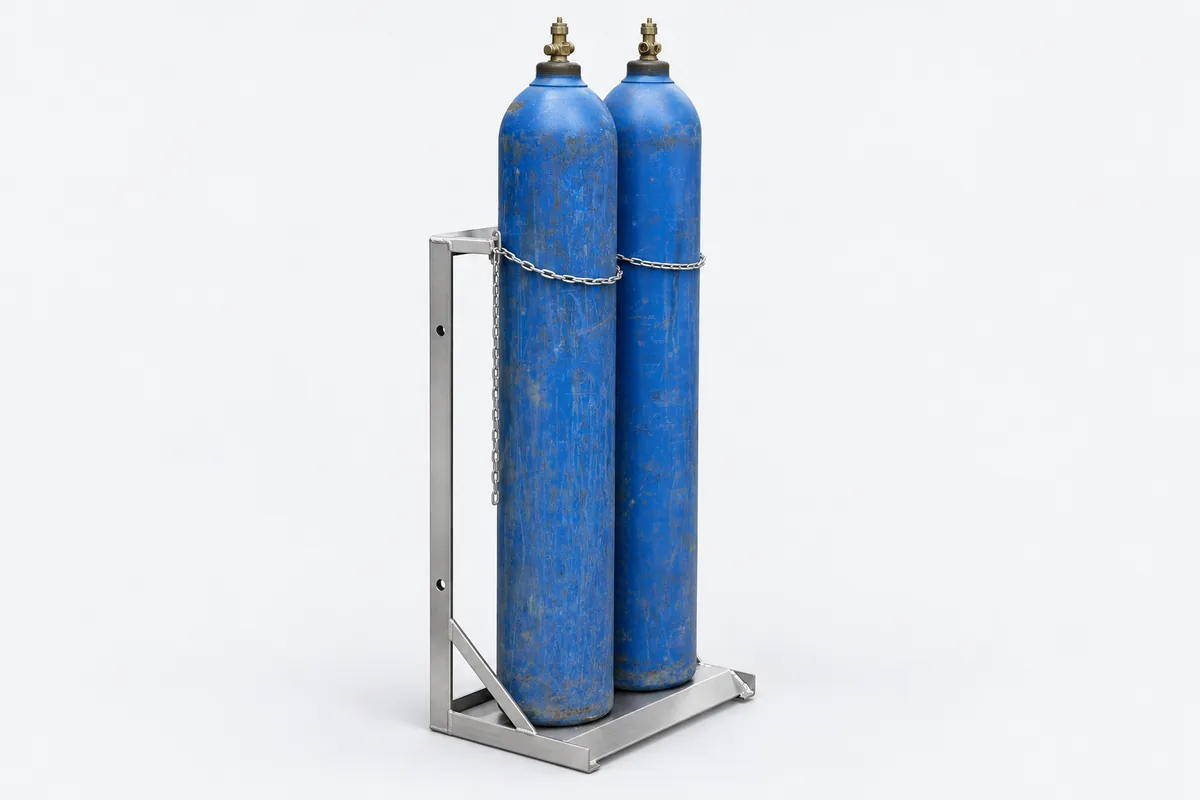
Gas Cylinder Restraint Rack
Product Overview
Features & Specifications



Detailed Description
The regulations require restraint, not leaning
In the US, OSHA 1910.101(b) requires compressed gas cylinders to be handled, stored and used in accordance with CGA P-1, which is currently in edition 13 (2022). The US National Research Council's Prudent Practices in the Laboratory §5.E.6 also requires cylinders to be strapped or chained in place. Restrained means the cylinder will not fall over when pushed or shaken by an earthquake. Leaning a cylinder against a wall, or wedging it between two pieces of equipment, relies on friction and luck and does not count as restraint.At what height should the chain go
The height of the restraint point directly determines how well it prevents toppling. If it is too low, the upper half of the cylinder can still swing freely, and when shaken the restraint point becomes a pivot that speeds up the fall. On the exact height, several US university safety guides differ slightly: Cornell recommends about 2/3 of the cylinder height, while WVU requires the restraint to be at least within the upper 1/3 of the cylinder. The common principle is that the restraint point must be above the centre of gravity. A single chain is the basic configuration; for taller cylinders, regions with frequent earthquakes or high-value cylinders, one chain can be fitted high and one low. When cylinders of different sizes share one rack, make sure each chain sits at the effective height for its own cylinder rather than putting all of them at the same height.The rack itself must be anchored
A restraint rack that simply stands against a wall without being anchored to the wall or floor structure with expansion bolts just ties several cylinders into a heavier group that falls together. During installation, make sure the anchor points are in a structural wall or floor slab rather than a lightweight partition; on a plate-type rack with a 3 mm base plate, the base plate itself must also be bolted to the floor.Keep oxygen and fuel gases apart
OSHA 1910.253(b)(4)(iii) requires oxygen cylinders in storage to be separated from fuel-gas cylinders (such as acetylene) by 20 ft (about 6.1 m), or by a barrier at least 5 ft (about 1.5 m) high with a fire-resistance rating of at least half an hour. So when planning restraint racks, do not put oxygen and fuel gases on the same rack; if the space only allows them to sit side by side, build a barrier between the two groups.| Type | Capacity | Suitable location |
|---|---|---|
| 4-cylinder rack (stainless steel or powder coated) | 4 cylinders | Cylinder storage areas, central gas supply areas |
| 3-cylinder, 2-cylinder racks | 3 cylinders, 2 cylinders | Laboratory walls, beside tools |
| Single-cylinder rack | 1 cylinder | Dedicated gas source for a single instrument |
| Stainless steel cylinder storage cabinet | Depends on cabinet design | Locations needing enclosure or central management |
| Stainless steel gas supply rack | Depends on piping design | Supply points with regulators and piping |
Gas cylinder carts: restraint applies during transport too
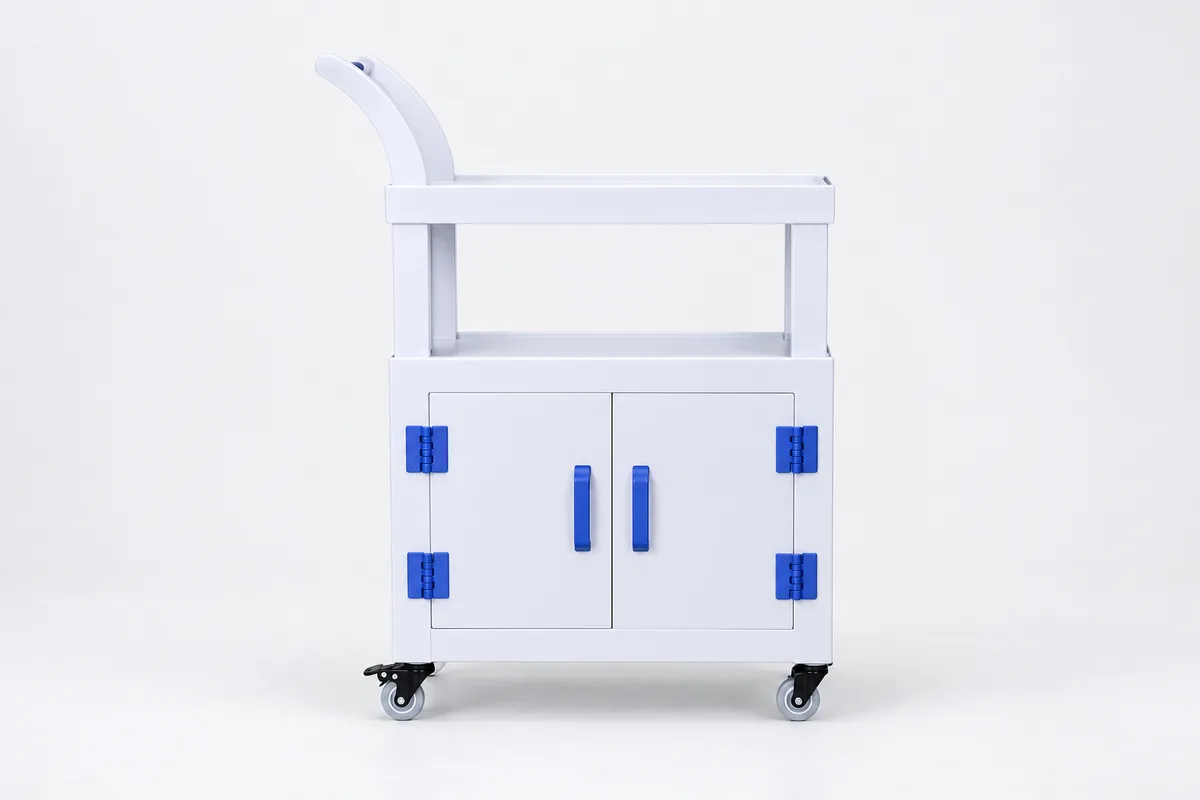
Prudent Practices §6.C.4 requires cylinders to be secured on a cart when moved, with the valve cap fitted to protect the valve. A full cylinder has a high centre of gravity, and once it starts to topple it is almost impossible to right it by hand, so the restraint on the cart is the main safety feature, not an accessory. Chain type: low cost and versatile, but the tension must be set correctly; a slack chain is as good as no restraint. Screw-clamp ring type: quick to operate and locks securely, suiting places with frequent cylinder changes. The carts use large-diameter wheels with a tilt-to-move design so that one person can move a full cylinder. Before buying, also walk the transport route once: threshold steps, lift car dimensions and floor joints are where things most often go wrong when actually pushing.Frequently Asked Questions
How high should the chain on a cylinder restraint rack be, and how many chains are needed?
The restraint point must be above the cylinder's centre of gravity. US university safety guides differ slightly: Cornell recommends about 2/3 of the cylinder height and WVU requires at least within the upper 1/3 of the cylinder; both point to the upper half. A single chain is the basic configuration; for taller cylinders, frequent earthquakes or high-value cylinders, one chain can be fitted high and one low. Where cylinders of different heights share one rack, the chain heights must be adjustable individually, and the 6 mm chain must be pulled tight enough that the cylinder cannot rock back and forth.
Can oxygen and acetylene cylinders go on the same restraint rack?
Not recommended in storage. OSHA 1910.253(b)(4)(iii) requires oxygen cylinders in storage to be separated from fuel-gas cylinders by 20 ft (about 6.1 m), or by a barrier at least 5 ft high with a fire-resistance rating of at least half an hour. In practice the simplest approach is to split oxygen and fuel gases onto two racks placed in two separate locations; where space is short, build a compliant barrier between the two racks. Cylinders in use and connected to welding equipment are a different situation; follow the site's rules of use.
What should I watch out for when moving cylinders on a cart during a cylinder change?
Fit the valve cap first, then load the cylinder onto the cart and secure it with the chain or clamp ring; Prudent Practices §6.C.4 requires both. A full cylinder has a high centre of gravity, so avoid sharp turns and sudden stops while pushing and slow down over thresholds; the standard cart carries two cylinders, so do not lean an extra one against it. A mixed-gas cylinder cart can carry different cylinder diameters at once, but each cylinder must have its own restraint point. On arrival, chain the cylinder to the restraint rack first and only then release it from the cart, so that it is never unrestrained at any moment.
Selection References
Before ordering, verify the efficiency grade, media type, and whether the operating environment fits your requirements.