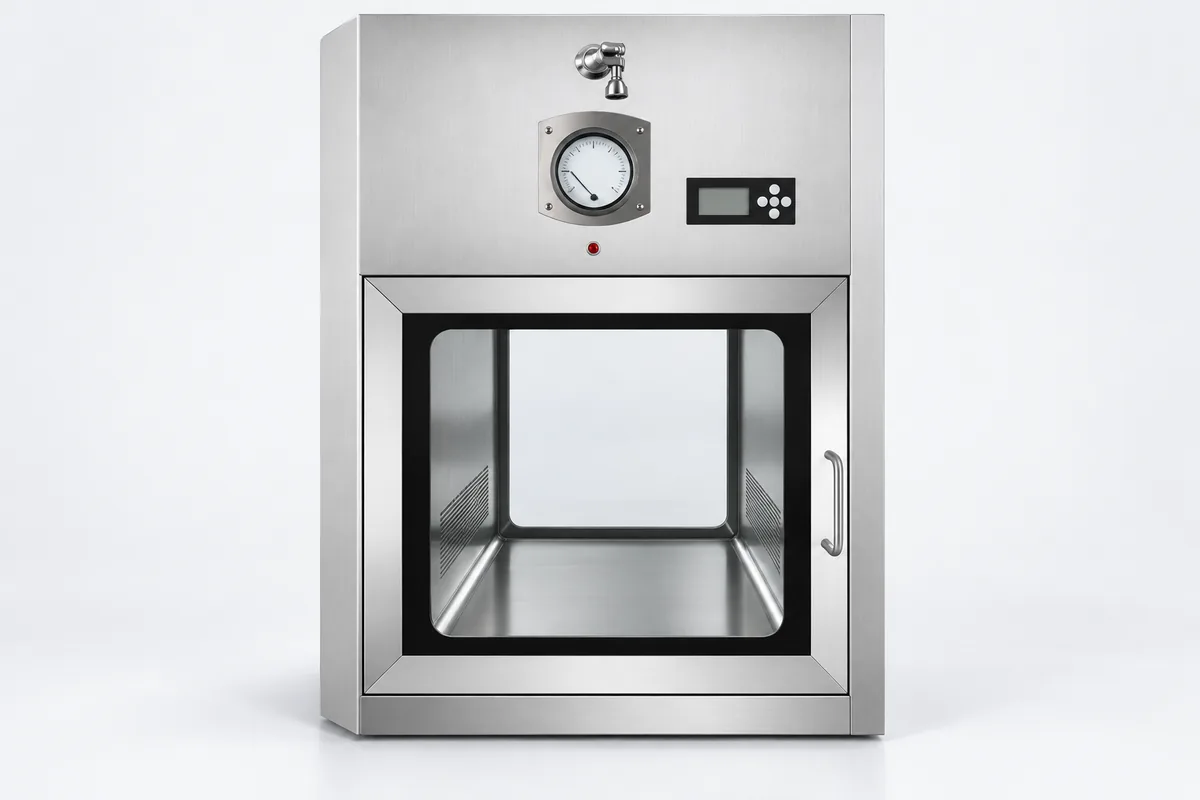
Laminar Flow Pass Box
Product Overview
Features & Specifications



Detailed Description
A short blast versus continuous flow
A blow-type pass box blows for a while when an item enters, knocks the surface particles off and stops; after that the chamber is just a closed space. A laminar type maintains unidirectional flow in the chamber continuously: as long as the fan is running, the air in the chamber keeps being replaced. The difference shows up while the item stays inside. After material is placed in the pass box, the other side may not take it out right away: the person there may be busy, waiting for a handover, or only dealing with it on the night shift. During this wait a blow type offers no airflow protection at all, while a laminar type keeps carrying settling particles away. The rule is simple: will the item stay in the pass box? If it is put in and taken out immediately, use a blow type; if it will be held temporarily or handover times are irregular, use a laminar type.Laminar flow does not replace material disinfection
This is the most common misuse of laminar flow pass boxes. EU GMP Annex 1 (2022) §4.10 and §4.11 list material transfer as one of the main sources of contamination in clean areas, and materials entering Grade A / B must go through a validated disinfection procedure. Filtered airflow deals with airborne particles and loose particles on surfaces; microorganisms adhering to packaging still have to be removed by wipe-down disinfection. A UV germicidal lamp also reaches only the surfaces in its direct light, not those shaded by the items. The correct sequence is: wipe and disinfect the packaging on the outside, then place it in the pass box, let the laminar flow maintain the chamber environment, and take it out on the other side according to the procedure. The value of laminar flow is keeping items that have already been cleaned from getting dirty again while they wait, not making untreated items clean.Allow an extra 500 mm in the opening height
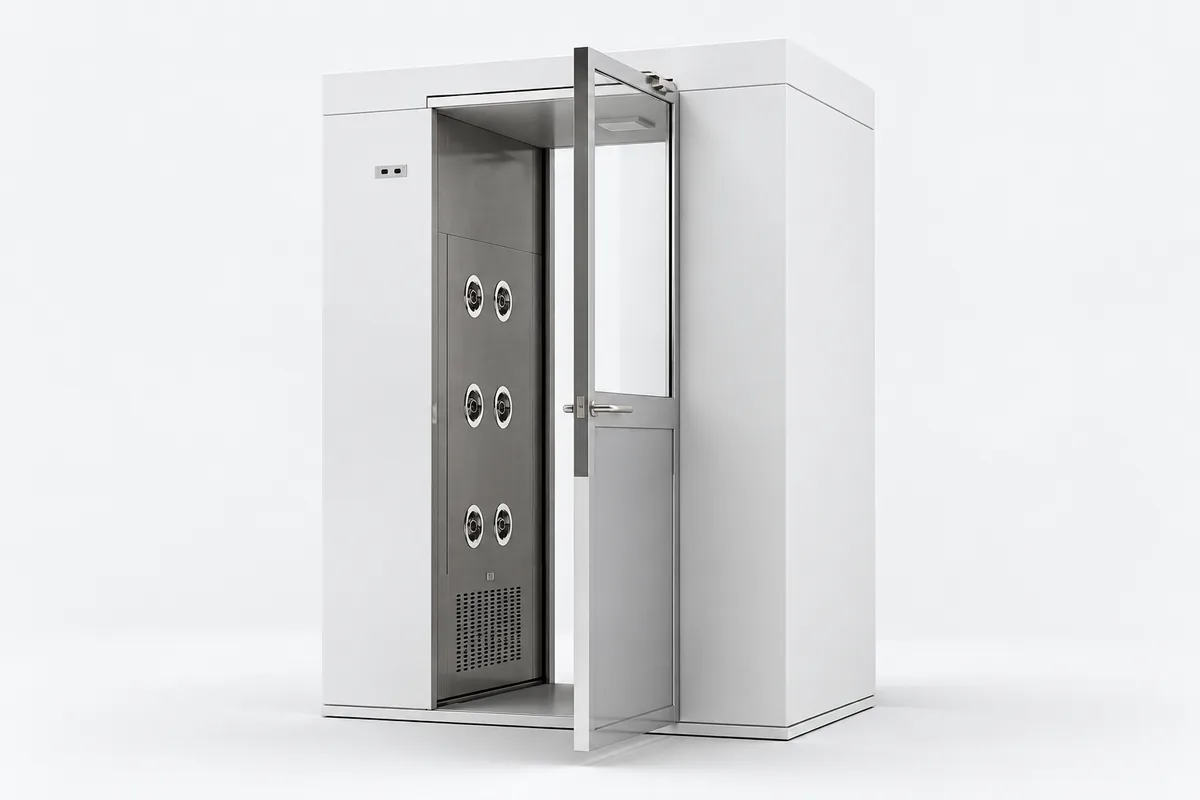
In the external dimension formula, the 500 mm added to the height is clearly more than the 200 mm added to the width and the 70 mm added to the depth, because that is the space taken by the fan and filter module at the top. The table below shows external dimensions calculated from several common internal sizes:| Clear internal size W×D×H mm | External size W2×D2×H2 mm | Wall opening reference W2×H2 mm |
|---|---|---|
| 500×500×500 | 700×570×1000 | 700×1000 |
| 600×600×600 | 800×670×1100 | 800×1100 |
| 700×700×700 | 900×770×1200 | 900×1200 |
Interlock delay and door opening sequence
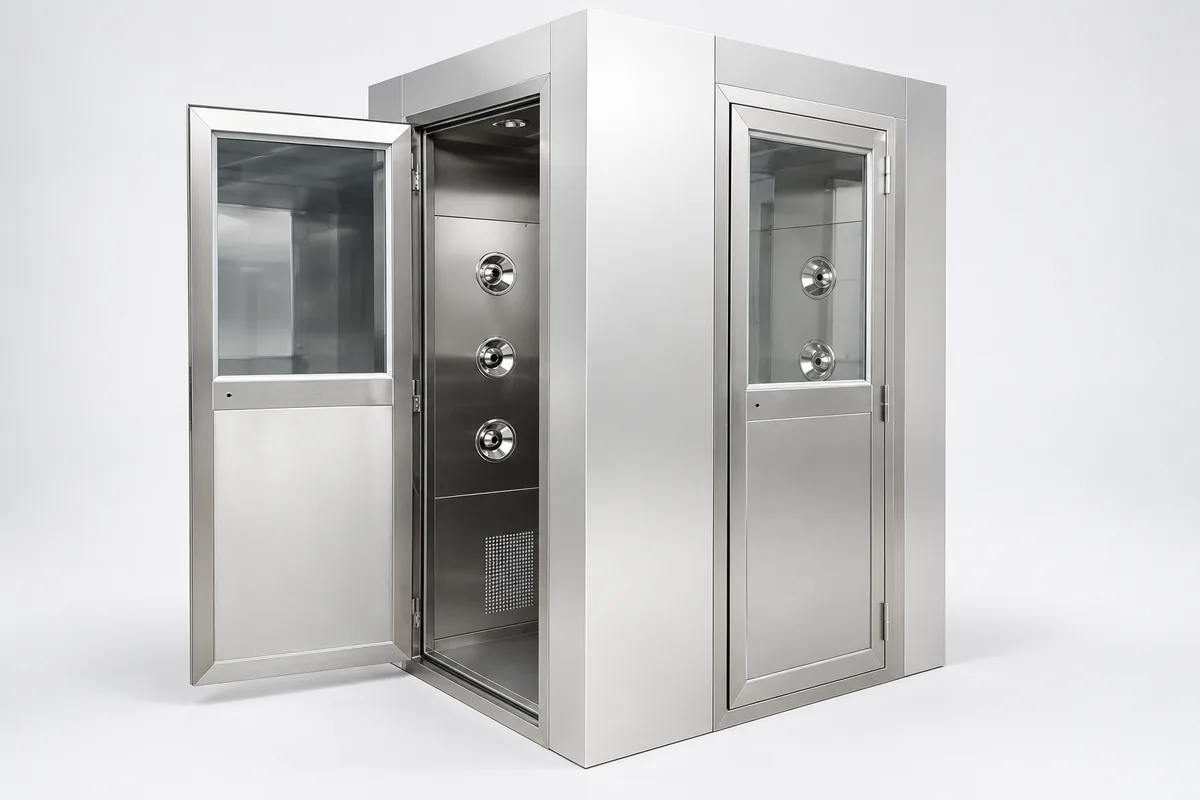
Annex 1 §4.13 mentions that a time delay can be set between the two doors where necessary. For a laminar flow pass box, the point of the delay is that after one side closes, the chamber is first flushed by the laminar flow for a while before the other side is allowed to open. If the delay is too short, the outside air just brought in has not yet been replaced; if it is too long, people queue at peak times. A sensible approach is to measure during validation, with a particle counter, how long the chamber takes to recover after the door closes, and set the delay accordingly. The optional DOP test port is an upstream injection point reserved for leak testing after the filter is installed; the differential pressure gauge is used to watch changes in filter resistance and judge whether replacement is needed.Choose the enclosure material to match the disinfection method
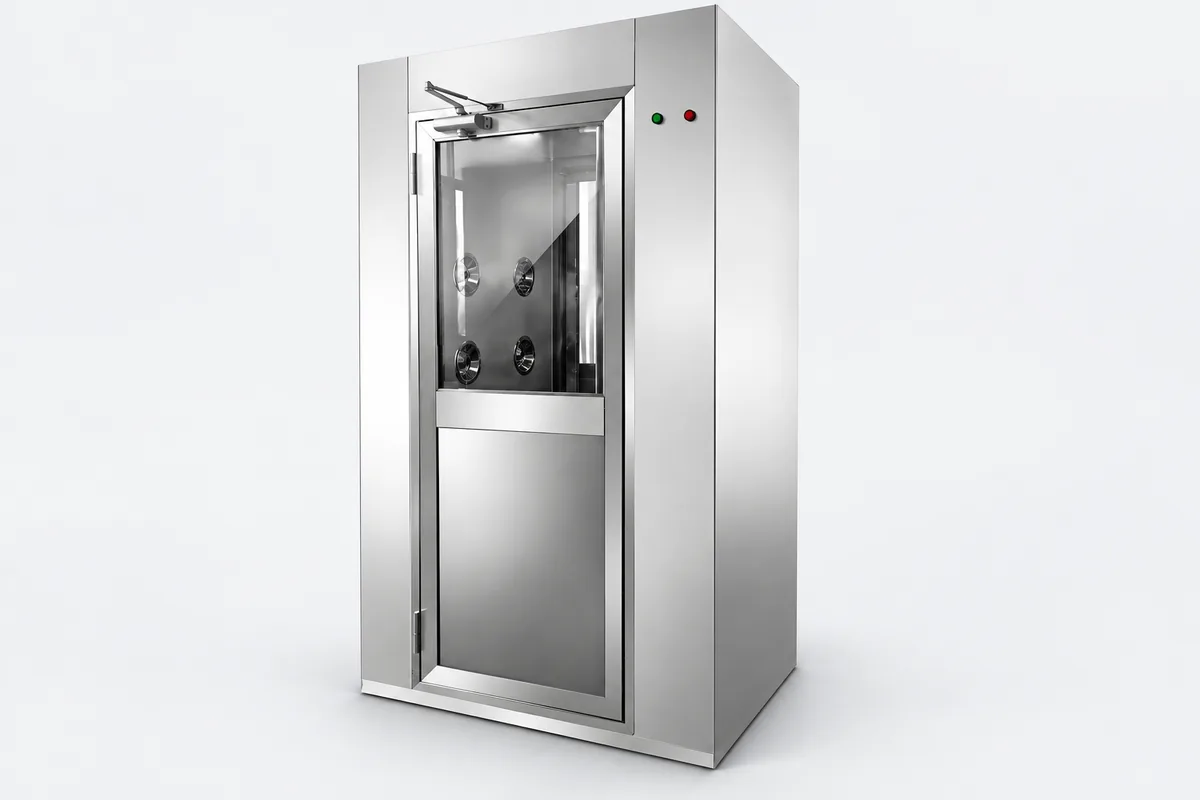
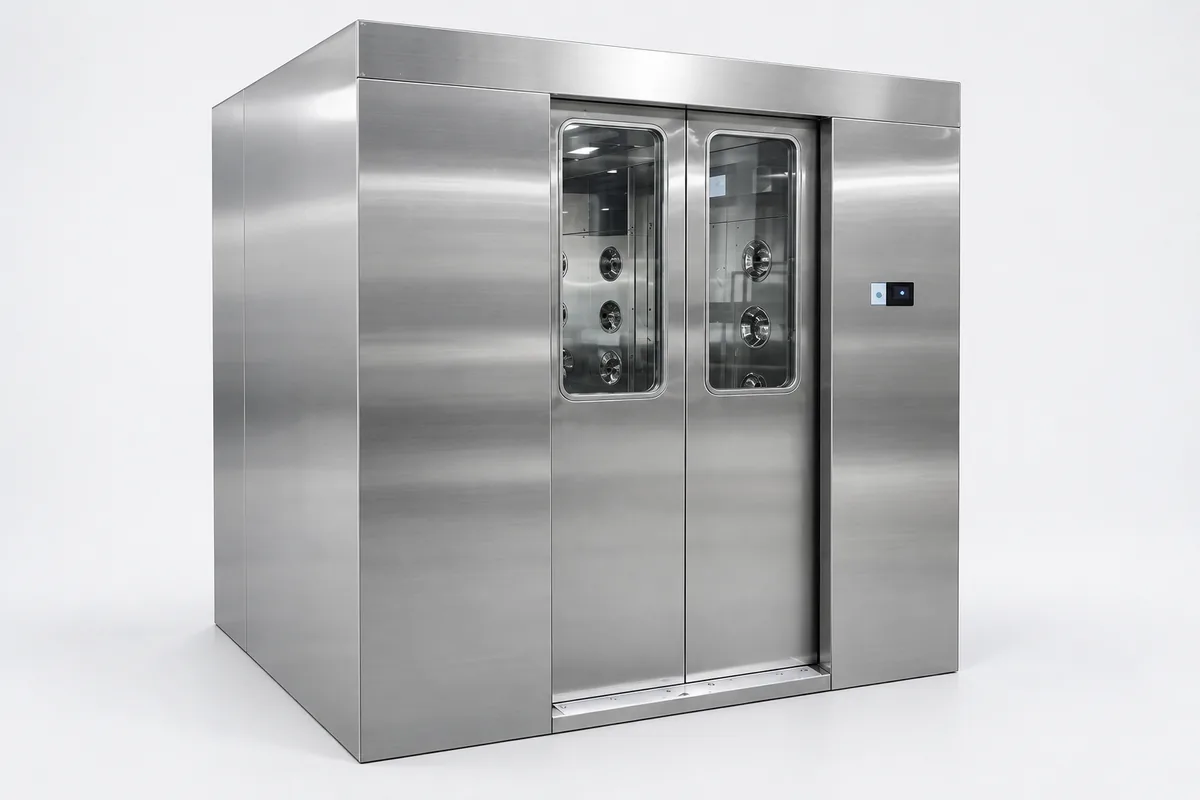
The inside of a laminar flow pass box is wiped and disinfected every day. EU GMP Annex 1 (2022) §4.5 requires clean area surfaces to be smooth, impervious and unbroken, and §4.7 requires materials that shed few particles and withstand the cleaning agents and disinfectants used. Powder-coated cold-rolled steel suits applications where disinfection is infrequent and mainly done with alcohol wipes; if chlorine-based or strongly oxidising disinfectants are used repeatedly inside the chamber, or the pass box leads into Grade A / B, all stainless steel is the safer choice, because once the powder coating is scratched through to the base metal, that is where rust and dirt start.Frequently Asked Questions
How large a hole must be cut in the wall for a laminar flow pass box?
Work it out from the clear internal dimensions: external width = internal width + 200 mm, depth = internal depth + 70 mm, height = internal height + 500 mm. For example, with an interior of 600 × 600 × 600 mm the external size is 800 × 670 × 1100 mm, and the wall opening is based on 800 × 1100 mm plus installation clearance. The extra 500 mm of height is the fan and filter module at the top, which makes it much taller than an ordinary non-blow pass box, and it is the dimension most often underestimated during wall construction.
With laminar flow, do materials still need to be disinfected before they go in?
Yes. Laminar flow deals with airborne particles and loose particles on surfaces; it does not kill microorganisms, nor does it remove those adhering to packaging. EU GMP Annex 1 (2022) §4.10 and §4.11 require materials to go through a validated disinfection procedure before entering Grade A / B. The sequence should be to wipe and disinfect on the outside first, then place the items in the laminar flow pass box; the laminar flow keeps them from getting dirty again while they wait for handover.
How long should the interlock delay on a laminar flow pass box be?
There is no universal number; it depends on the chamber volume, the airflow and how items are placed. The purpose of the delay is to let the laminar flow flush the chamber after one side closes before the other side may open: too short and it is as good as none, too long and people queue at peak times. It is advisable to measure during validation, with a particle counter, how long it takes after the door closes for particle levels in the chamber to return to baseline, use that as the minimum setting, and write it into the operating procedure.
Selection References
Before ordering, verify the efficiency grade, media type, and whether the operating environment fits your requirements.