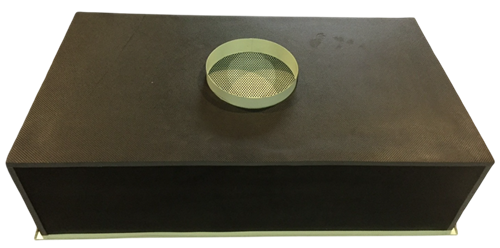
Operating Room / Negative-Pressure Isolation Ward Hospital HEPA Box
Product Overview
Features & Specifications



Detailed Description
In an operating room and an isolation room, HEPA goes in different places
An operating room protects the patient: the room is kept at positive pressure, clean air blows down from the HEPA box in the ceiling, and air flows out of the room so dirty air from outside cannot get in. A negative-pressure isolation room protects the people outside it: the room is kept at negative pressure, air flows from the corridor through the anteroom into the room, and room air must pass a HEPA filter on a dedicated exhaust duct before it is discharged outdoors.Operating room (positive) vs isolation room
Where the HEPA goes and which way the air flows
Schematic. Pressure differences and air changes follow local standards and the HVAC design; see the table below.
What do standards in Taiwan, the US and Japan require?
| Item | Taiwan (MOHW isolation hospital criteria) | US (CDC 2003, ASHRAE 170) | Japan (HEAS-02) |
|---|---|---|---|
| Operating room pressure | Positive, with a negative-pressure anteroom | Positive, at least 2.5 Pa | Positive |
| Operating room air changes | 15 or more per hour, with laminar airflow | 15 per hour, of which 3 outdoor air | General operating rooms 15 per hour, of which 3 outdoor air |
| HEPA in the operating room | No grade specified | ASHRAE 170: HEPA at the supply air terminal for orthopedic, transplant, neurosurgery and burn operating rooms | HEPA for ultra-clean operating rooms; final stage 98% or higher (dust-spot) for general operating rooms |
| Isolation room pressure | At least 8 Pa negative to the corridor, stepping down from corridor to anteroom to room | Negative, air flows into the room | Negative |
| Isolation room air changes | 12 or more per hour for new or renovated rooms, 6 or more for existing rooms; outdoor air 2 or more | 12 or more per hour | 12 or more per hour |
| Isolation room exhaust | Dedicated exhaust duct with HEPA; outlet at least 3 m above the roof, vertical discharge velocity above 15 m/s; room air may be recirculated only after HEPA | Exhaust directly outdoors; only if that is impossible, return through HEPA to a dedicated air handler | HEPA for recirculated air |
Specifications of this HEPA box
| Item | Specification |
|---|---|
| Efficiency | 99.99% (@0.3 μm) glass-fiber HEPA |
| Type and depth | Fully disposable 130 mm / room-side replaceable 170 mm |
| Rated airflow | 17.5 CMM (600×1210, 570×1170 mm) / 8.4 CMM (600×600, 570×570 mm) |
| Face velocity and initial pressure drop | 0.45 m/s, about 123 Pa |
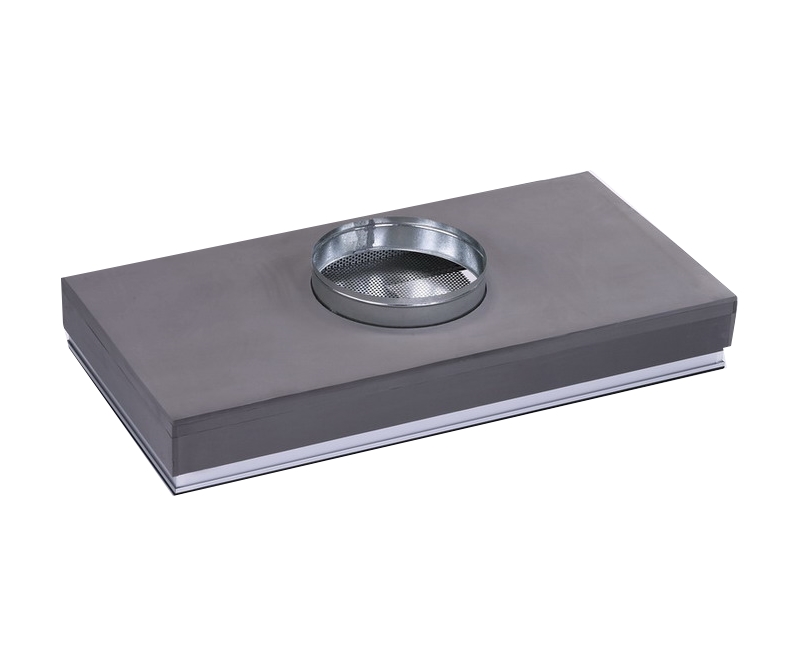
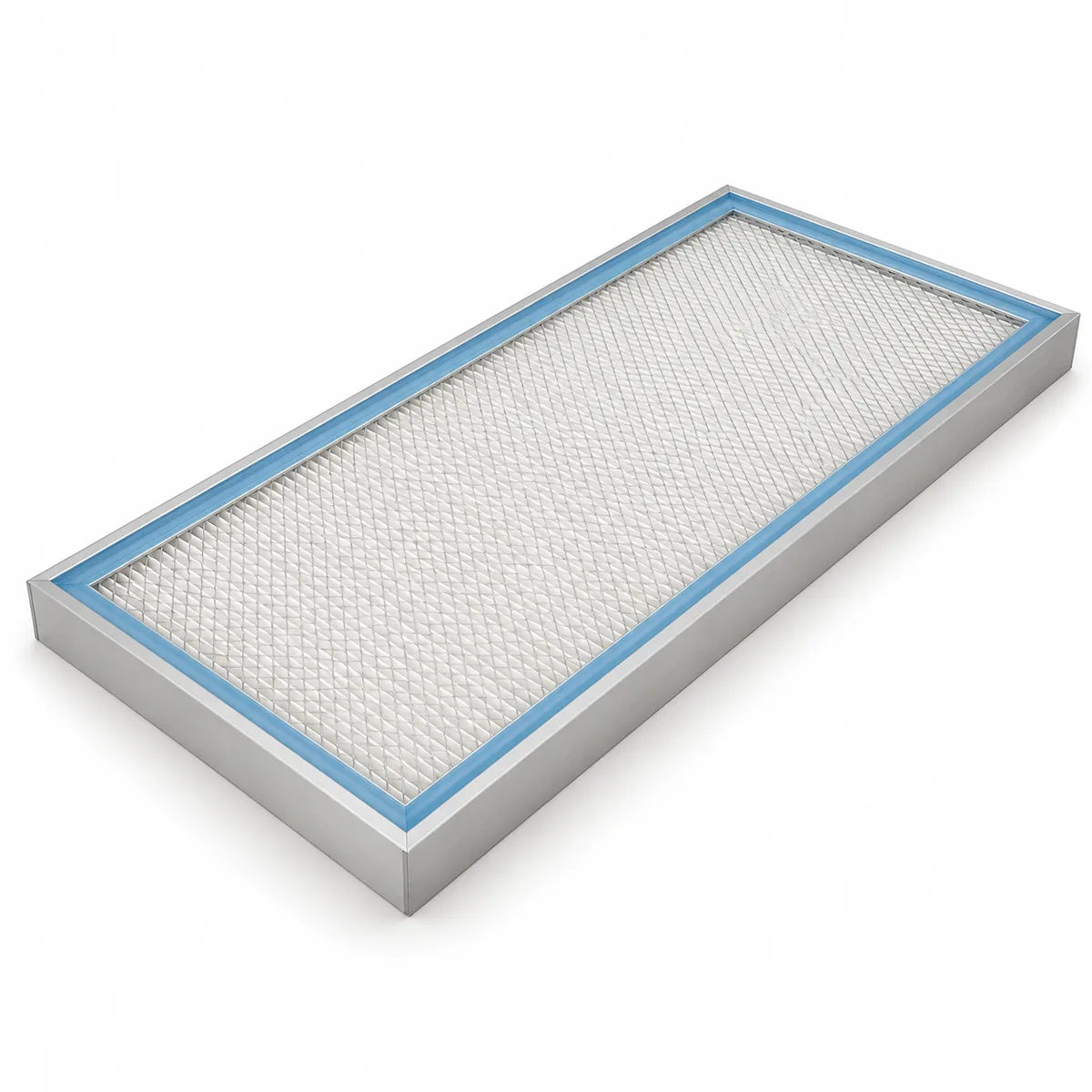
| Housing | Anodized aluminum frame, 12 mm external insulation, duct collar 8″–14″ |
How many units does an operating room need? Start from air changes
Take an operating room we actually estimated: 4.9 × 3.44 × 2.5 m, a volume of about 42 m³. At 15 air changes per hour it needs about 632 m³/h of supply air; the 600×600 mm unit is rated at 504 m³/h, and 632 ÷ 504 ≈ 1.25, so at least 2 units. This is only a rough estimate from air changes. The laminar zone over the operating table, temperature, humidity and pressure must be decided together in the HVAC design; also check that the ceiling void has at least 130 mm (disposable) or 170 mm (replaceable).What is used for isolation room exhaust?
The exhaust-side HEPA sits on a dedicated exhaust duct, not in a ceiling supply outlet. Hospital tenders often specify a bag-in/bag-out (BIBO) filter housing: staff change the filter through a plastic bag without touching the contaminated filter directly. The ceiling HEPA box handles the supply side; the two do different jobs in the same room.Frequently Asked Questions
Does an operating room have to use HEPA?
It depends on the type of surgery and the standard being followed. In the US, ASHRAE 170-2021 (2024 errata) requires HEPA at the supply air terminal for orthopedic, transplant, neurosurgery and burn operating rooms; Japan's HEAS-02 assigns HEPA to ultra-clean operating rooms, with a final stage of 98% or higher (dust-spot) for general ones; Taiwan's MOHW isolation hospital criteria require 15 or more air changes per hour with laminar airflow but do not specify a HEPA grade. The actual specification follows the hospital's design standard or tender requirements.
For isolation room exhaust, should I use a HEPA box or a BIBO?
Exhaust uses a BIBO housing or a HEPA filter on the exhaust duct, not a ceiling HEPA box. Taiwan's criteria require a dedicated exhaust duct with HEPA for negative-pressure rooms, with the outlet at least 3 m above the roof; a bag-in/bag-out (BIBO) housing lets staff change the filter through a plastic bag without touching the contaminated filter, which is why hospital tenders often specify it. The ceiling HEPA box is used on the supply side of the same room.
Can an operating room and an isolation room use the same HEPA box?
On the supply side, yes: both use a 99.99% (@0.3 μm) HEPA box at the ceiling supply terminal. The difference is the pressure design of the air conditioning — an operating room supplies more air than it exhausts to stay positive; a negative-pressure isolation room exhausts more than it supplies to stay negative, and also needs HEPA on the exhaust side. So the HEPA box should be chosen together with the HVAC design, not on its own.
In Taiwan, how negative must an isolation room be, and how many air changes per hour?
Under item 2.2 of the Ministry of Health and Welfare's isolation hospital criteria (published 29 August 2025): the room must be at least 8 Pa negative relative to the corridor, with pressure stepping down from corridor to anteroom to room; new or renovated rooms need at least 12 air changes per hour and existing rooms at least 6, with at least 2 of outdoor air; room air may be recirculated only after HEPA filtration; and the fans and HEPA filters must have monitoring such as differential pressure gauges or airflow displays.
Selection References
Before ordering, verify the efficiency grade, media type, and whether the operating environment fits your requirements.