What a teardrop light is
A teardrop light is a cleanroom pendant luminaire with a streamlined, curved profile, fixed beneath the ceiling T-bar grid between adjacent HEPA filters or FFUs, so that every ceiling cell can be left to the filters. It solves the dilemma of the unidirectional-flow cleanroom: once the ceiling is fully covered with filters there is no room for recessed fixtures, yet a fixture hanging in the airflow must not disturb the laminar flow. US patent US 5,313,375 describes this type of fixture as suspended from the T-bar framework of a standard ceiling grid, between the HEPA filters, with smooth sides that let the laminar flow pass on either side undisturbed.
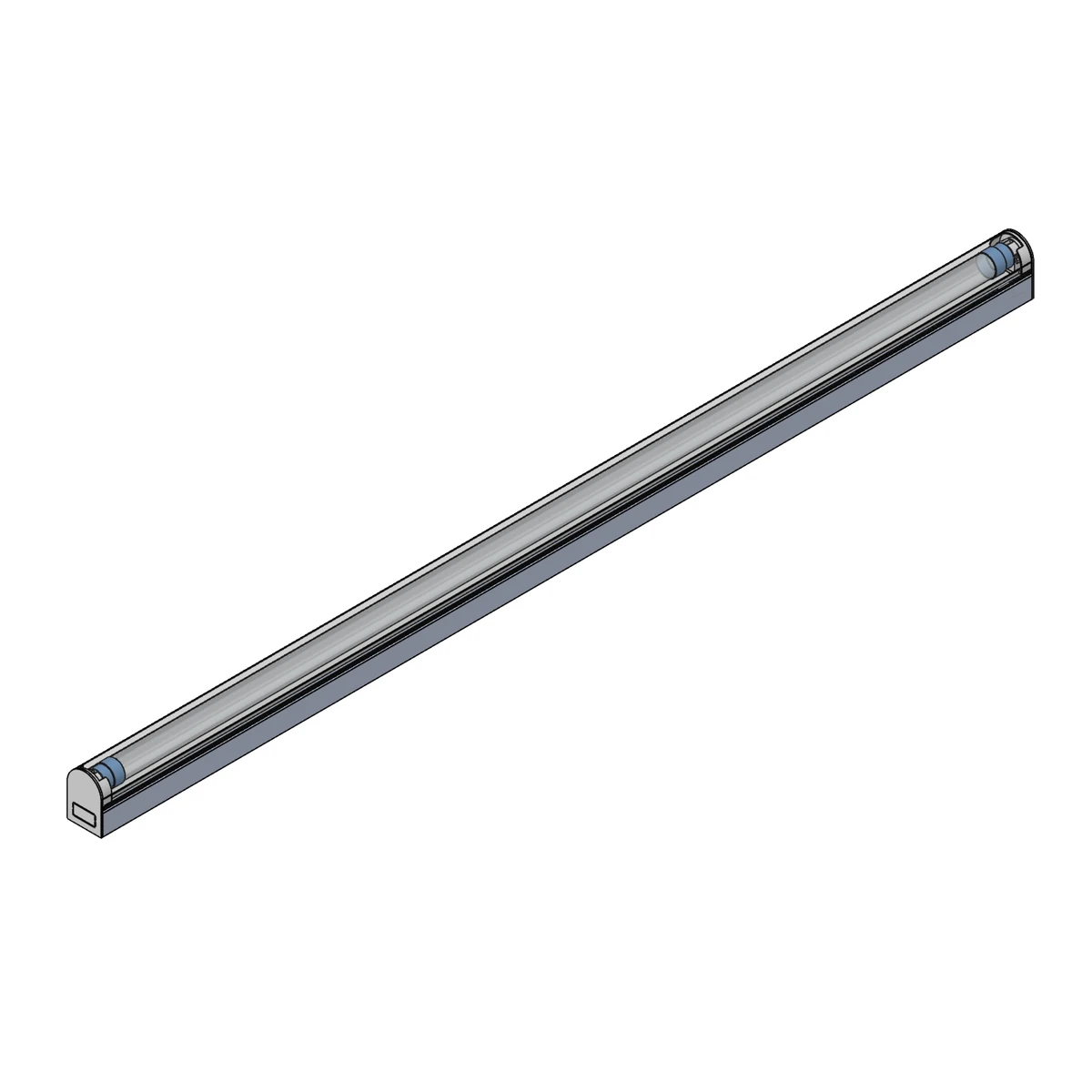
Replacing existing teardrop lights: comparison with TMX200 / TMX201 / TMX204 / TMX220
These four tube-type teardrop lights, common on site, use a T8 tube and quick-connect linking just like this product; the differences are the base material, the cover, the mounting method and the holes. This product accepts both T-bolt and self-tapping screw mounting, so when replacing, check the grid type and hole positions first; in most cases the ceiling does not need to be modified.| Item | This product | TMX200 | TMX201 | TMX204 / TMX220 |
|---|
| Base (wiring channel) material | Anodised extruded aluminium + PC+GF wire cover | Extruded aluminium alloy | Extruded aluminium alloy | Powder-coated steel profile |
| Cover | Clear PC, removable (optional; the standard version has no cover) | PC, removable | None | None |
| Linking type | 3-pin quick connector built into the fixture | Plug-in | 3-pin quick connector built into the fixture | 3-pin quick connector built into the fixture |
| Fixtures per chain | Trunk line per circuit design (conductor up to 2.4 mm) | 10 fixtures | Trunk line per circuit design (up to 2.0 mm) | Trunk line per circuit design (up to 2.0 mm) |
| Mounting | T-bolts or self-tapping screws, either | Self-tapping screw + clip | T-bolt | T-bolt |
| Wiring hole and terminal-block position | Customisable to the grid drawing (100 mm spacing between the two holes fixed) | Per that model's specification | Per that model's specification | Per that model's specification |
The data for the four TMX models are per the supplier-provided comparison table and have not been independently verified by this site; light-source type and replacement compatibility must be checked on site. Three selection differences: the base is anodised extruded aluminium with no paint layer that can chalk and shed (a difference against TMX204 / TMX220, a tie against TMX200 / TMX201); it accepts both T-bolt and self-tapping screw mounting, so it fits the existing position of any of the four; the wiring hole and terminal-block position can be customised to the grid drawing. Trade-off: scratches show more on extruded aluminium than on a coated finish, but the fixture hangs where people cannot reach; the removable cover is optional, and TMX200 has one too.
Replaceable-tube vs integrated LED teardrop light: the difference is the scope of repair
In an integrated LED teardrop light the LED module and the driver are both sealed inside the fixture; when it fails the whole fixture is replaced and reconnected. In this product the driver circuit is inside the tube and there is no driver in the fixture; when it fails you twist out the tube and fit a new one, the fixture and the wiring stay untouched, and changing colour temperature or moving into a yellow-light area also means changing only the tube. The price is that a single tube at 2,100 lm is about half of the integrated reference model, so the count must be based on an illuminance calculation.| Item | This product (four-foot single tube) | Integrated LED teardrop luminaire (reference model) |
|---|
| Light-source maintenance | Replaceable tube, driver circuit inside the tube, no driver in the fixture | Light source not replaceable, built-in driver, whole fixture replaced |
| Input voltage | AC 100–240 V | 220–240 V |
| Power / luminous flux | Tube 13 W / 2,100 lm | Fixture 39 W / 4,500 lm (also 32 W / 3,900 lm) |
| Yellow-light area | Fit a yellow-light tube (spectrum confirmed per process) | Separate amber version, whole fixture |
| Overall height | 65 mm | 84 mm |
| Weight | Tube 0.199 kg (body per selection) | 1.299 kg |
| Protection / dimming | Body IP per selection; tube not dimmable | IP40, IK03; DALI version dimmable |
| Fixtures per 16 A type-B MCB | To be confirmed for this model; Philips reference for the same-series 1200 mm mains tube is 150 tubes (inrush current 8 A) | 24 fixtures (inrush current 12 A) |
| Life | Tube 50,000 h (L70) | L70B50 50,000 h |
The reference-model figures are taken from the public datasheet of a representative integrated LED teardrop luminaire (2025 edition) and do not represent all integrated products. When to choose integrated: where high luminous flux per fixture, DALI dimming or whole-fixture protection of IP40 or above is required. When to choose replaceable-tube: where repairs must be done without removing the fixture or touching the wiring, where the site has 110 V circuits, or where yellow-light and white-light areas are to share the same fixture model.
Teardrop light construction: 8 components (exploded view)
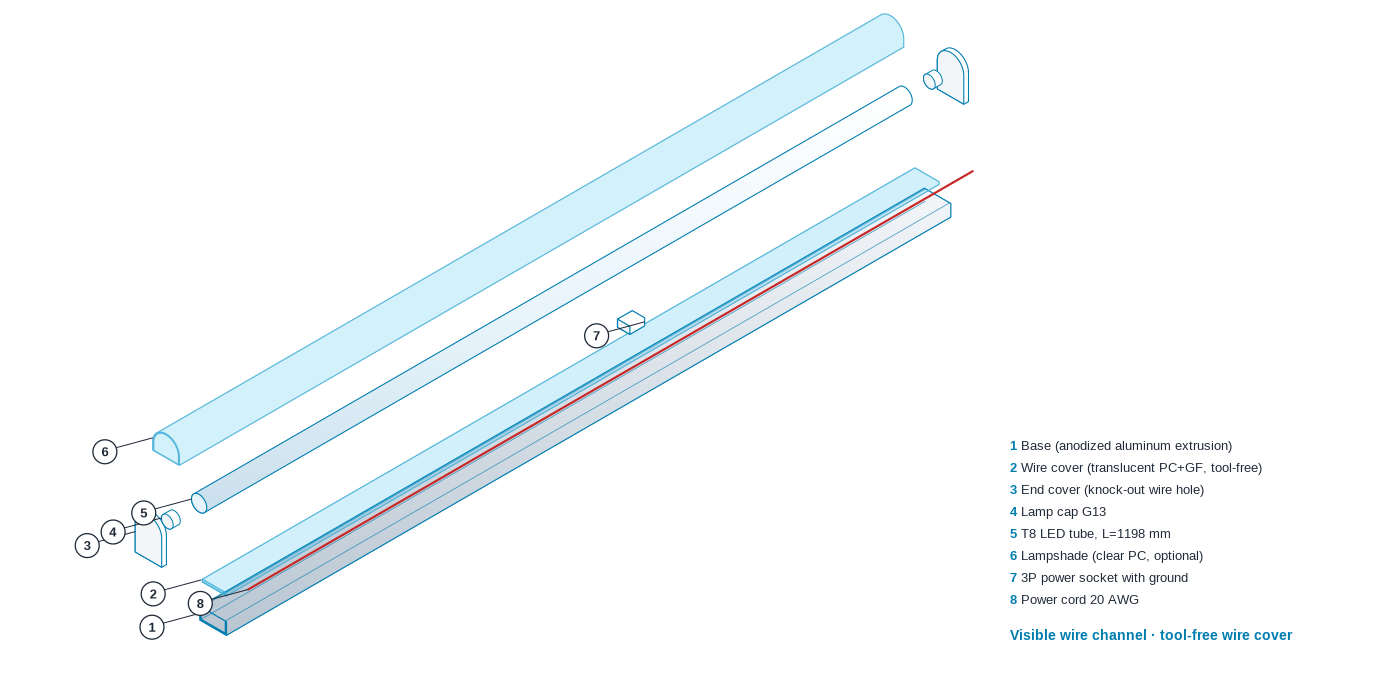
| No. | Part | Specification |
|---|
| 1 | Base | Anodised extruded aluminium |
| 2 | Wire cover | Translucent PC + glass fibre, fitted over the wiring channel of the base, behind the tube; see-through wiring channel, tool-free quick-release |
| 3 | End cap | White plastic, with knock-out wiring hole |
| 4 | Lamp holder | G13, white plastic |
| 5 | Tube | T8 LED, 1198 mm long |
| 6 | Cover | Clear PC, removable (optional) |
| 7 | Terminal block | 3P with earth tab, white plastic |
| 8 | Fixture power leads | Red L / white N, 20 AWG, PVC insulated, rated 105 °C, rated 600 Vac |
Assembly order: the power leads (8) and the 3P terminal block (7) sit in the wiring channel of the extruded aluminium base (1), which is closed by the translucent wire cover (2); the lamp holders (4) are fitted in the end caps (3) at both ends and hold the tube (5), and the clear PC cover (6) clips on when needed. The wire cover is translucent and lifts off without tools, so the wiring and the terminal block are always in view.
Teardrop light dimensions and mounting holes (three-view drawing)
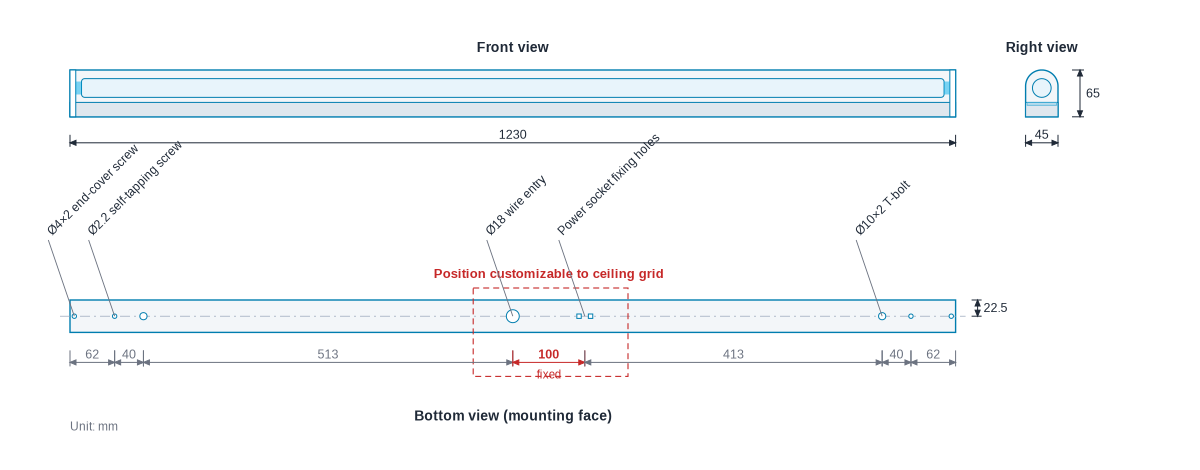
| Hole | Specification | Position |
|---|
| End-cap fixing hole | Ø4 × 2 | At both ends |
| Self-tapping screw hole | Ø2.2 | 62 mm from each end |
| T-bolt hole | Ø10 × 2 | 102 mm from each end (62 + 40) |
| Wiring hole | Ø18 | 615 mm from the left end on the standard drawing |
| Terminal-block fixing hole | — | 100 mm from the wiring hole (fixed dimension) |
| Hole centreline | — | 22.5 mm from the edge of the base (the centreline of the 45 mm wide base) |
How to read the drawing: the bottom view shows the flat base carrying the mounting holes (the face towards the ceiling); the dimension chain from left to right is 62 / 40 / 513 / 100 / 413 / 40 / 62 mm, 1230 mm in total. What can be customised: the wiring hole and the terminal-block fixing hole inside the red frame form one set whose position can be moved to suit the site's grid and wiring, while the 100 mm spacing between the two holes stays fixed; just attach the ceiling grid drawing with your order.
Teardrop light cross-section and shape: D-shaped profile, 65 mm high
The right-side view shows a D-shaped profile: one side is a 45 mm wide flat base that sits against the underside of the ceiling grid; the other side closes into a semicircular dome, where the tube and the clear cover sit, 65 mm high in total. Patent US 5,313,375 describes the vertical airflow in a unidirectional-flow cleanroom as 100–200 fpm (about 0.5–1.0 m/s); the squarer an object hanging in that flow and the flatter its underside, the larger the wake on its lee side. A low profile with the curved face pointing down blocks less airflow than a square lamp housing, and the curved face has no large flat surface where dust could settle, so it is easy to wipe.
Teardrop light vs recessed flat panel: comparison table
| Item | Teardrop light | Recessed flat panel |
|---|
| Mounting position | Beneath the grid bar, between filters | Takes up one ceiling cell |
| HEPA / FFU coverage | Takes no filter cell | Takes one filter cell |
| Effect on unidirectional flow | Low, curved profile, little effect | Flat panel face and frame tend to create eddies |
| Ceiling seal | No cut-outs | Gaps must be sealed (GB 50073-2013 §9.2.2) |
| Relamping | Twist out the tube from inside the room | Depending on type, may require access above the ceiling |
| Light output per fixture | One row of tubes every 4 feet, limited | Higher |
| Typical use | ISO 4–6, ceilings fully covered with FFUs | ISO 7–8, ducted ceilings with empty cells |
GB 50073-2013 §9.2.2 requires general lighting fixtures in cleanrooms to be surface-mounted on the ceiling; where they are recessed, the installation gap must be reliably sealed and cleanroom-specific fixtures must be used. A teardrop light is surface-mounted by nature. The patent document is also candid about the limitation: only one row of tubes every 4 feet, so light output is limited, and areas with high illuminance requirements need the twin-tube version or closer row spacing.
Choosing the cover for a cleanroom teardrop light: no cover vs clear removable PC cover
| Item | No cover (standard) | With clear removable PC cover |
|---|
| Light source position | Frosted-glass T8 tube exposed | Tube, lamp holders and contacts all enclosed in the clear PC cover |
| Relamping | Twist out the tube, the fixture stays in place | Remove the PC cover first, then change the tube; the cover can be refitted repeatedly |
| Light | Direct | Clear cover, no diffusion |
| If a tube breaks | Fragments fall straight down | The cover reduces the risk of fragments scattering |
| Cleaning | Wipe the housing and the tube | The outside is one continuous curved surface, can be wet-wiped |
| Recommended for | General electronics and optoelectronics clean areas (Class 10,000 or less stringent) | Class 1000 (ISO 6) or stricter grades, areas with regular wet wiping or spray disinfection (cleaning-agent compatibility to be confirmed separately), places at risk of impact |
The rule for the cover: at a cleanliness grade of Class 1000 (ISO 6) or stricter, add the cover (optional); what it protects is the cleanroom environment, not the light. Check the cleaning agents first: plastic parts such as the PC cover, wire cover and lamp holders are affected by sulphides, petroleum-based solvents and certain cleaning agents, so please list the cleaning agents and disinfectants used on site with your enquiry.
Philips MASTER LEDtube 13W865: full tube specifications
| Category | Item | Specification |
|---|
| General | Cap-base | G13 (Medium Bi-Pin) |
| General | Rated life | 50,000 h |
| General | Switching cycles | 200,000 |
| Optical | Colour code / colour temperature | 865 / 6500 K (Cool Daylight) |
| Optical | Luminous flux | 2100 lm |
| Optical | Luminous efficacy | 161 lm/W |
| Optical | Colour rendering Ra / colour consistency | 80 / <6 |
| Optical | Beam angle | 240° |
| Optical | Lumen maintenance at end of rated life | 70% |
| Electrical | Power | 13 W |
| Electrical | Voltage / frequency | 100–240 V / 50–60 Hz |
| Electrical | Lamp current | 53–150 mA |
| Electrical | Power factor | 0.9 |
| Electrical | Starting time | 0.5 s; 60% light output within 0.5 s |
| Electrical | Dimming | Not dimmable |
| Temperature | Ambient temperature | −20 to 45 °C |
| Temperature | Storage temperature | −40 to 65 °C |
| Temperature | T-case maximum | 65 °C |
| Mechanical | Tube | Frosted glass, 1200 mm long, double-ended |
| Mechanical | Net weight | 0.199 kg |
| Ordering | Order code / 12NC | 929002483608 |
| Ordering | EAN | 8719514301122 |
| Ordering | Packaging | 1 tube per pack, 20 packs per outer box |
| Approvals | Approval marks | EU RoHS, KEMA Keur; Energy Saving Product |
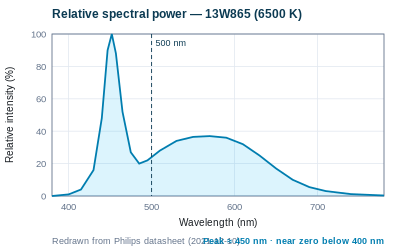
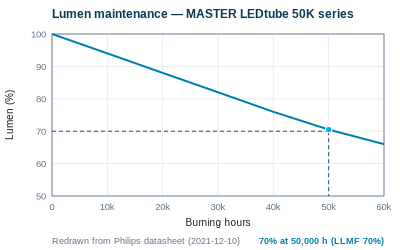
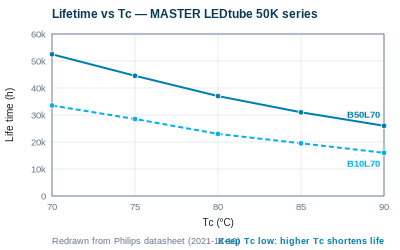 Reading the three curves: the spectrum peaks in the blue at about 450 nm and is close to 0 below 400 nm, so the tube cannot be used as is in yellow-light areas (see the yellow-light section below). Lumen maintenance is about 70% at 50,000 h, which is the datasheet's LLMF of 70%; at 60,000 h it is about 66%. Temperature affects life: on the Philips 50K series curve, B50L70 is about 52,500 h at a tube temperature Tc of 70 °C and falls to about 26,000 h at 90 °C; this tube's T-case maximum is 65 °C, so pay attention to heat dissipation when a cover is fitted or the space is enclosed.
LED teardrop light source: Philips 13 W vs T8 36 W fluorescent
| Item | Philips MASTER LEDtube 13 W / 865 | Conventional T8 36 W / 865 fluorescent tube |
|---|
| Power | 13 W | 36 W (excluding ballast losses) |
| Luminous flux | 2100 lm | About 3070 lm |
| Efficacy | 161 lm/W | About 85 lm/W |
| Rated life | 50,000 h (70% lumen maintenance) | About 15,000 h (50% failures) |
| Switching cycles | 200,000 | Frequent switching shortens life |
| Start-up | Lights up in 0.5 s | Needs preheating |
| Mercury | None | Yes |
| Ballast | Not required, 100–240 V double-ended wiring direct to mains | Required |
An honest comparison: this LED tube delivers about thirty percent less luminous flux than a 36 W fluorescent tube, so a one-for-one swap makes the work surface darker. What it saves is power (13 W against 36 W) and trips into the cleanroom to change tubes (the 50,000 h and 15,000 h life ratings are defined differently and cannot simply be divided); the number of fixtures must be recalculated with the method below.
Cleanroom illuminance standards (GB 50073 / GB 50472)
| Source | Area | General lighting illuminance |
|---|
| GB 50073-2013 §9.2.3 | Production rooms in cleanrooms without daylight windows | 200–500 lx |
| GB 50073-2013 §9.2.3 | Auxiliary rooms, personnel and material cleansing rooms, air locks, corridors | 150–300 lx |
| GB 50472-2008 §12.2.1 | Main production rooms in electronics industry cleanrooms | 300–500 lx |
| GB 50472-2008 §12.2.1 | Auxiliary work rooms, cleansing rooms, air locks and corridors in electronics plants | 200–300 lx |
GB 50073-2013 §9.2.4 further requires a general lighting uniformity of not less than 0.7, with fixtures evenly distributed. Process areas in semiconductor and display fabs are often specified higher; Japanese lighting manufacturers' cleanroom design data commonly target about 1,000–2,000 lx on the work surface.
How many teardrop lights: illuminance conversion table
Lumen method: number of fixtures = target illuminance × area ÷ (luminous flux per fixture × utilisation factor × maintenance factor). The table below assumes a single tube of 2100 lm, a utilisation factor of 0.6 (white interior, low-hung fixtures) and a maintenance factor of 0.8:| Target illuminance | Four-foot single-tube fixtures per 100 m² | Average area covered per fixture |
|---|
| 300 lx | 30 fixtures | About 3.3 m² |
| 500 lx | 50 fixtures | About 2 m² |
| 750 lx | 75 fixtures | About 1.3 m² |
| 1,000 lx | 100 fixtures | About 1 m² |
The estimated single-tube ceiling: with one row of single-tube fixtures along every 1200 mm grid line (fixture 1230 mm, with a gap between adjacent fixtures), each fixture covers about 1.44 m², which under these assumptions gives roughly 700 lx; for higher targets switch to the twin-tube version or add more rows. These figures are only a first estimate; for the final layout please send the floor plan and ceiling grid drawing and we will run the calculation in lighting software.
Teardrop lights for yellow-light areas (photolithography): precautions
6500 K white light cannot be used as is: the Philips spectrum above peaks at about 450 nm, which exposes photoresist; resist manufacturers mostly require everything below 500 nm to be filtered out. Fit yellow-light tubes or amber filter sleeves instead: the fixture body is the same as in white-light areas; tube compatibility and filter characteristics are confirmed separately when ordering. Check yellow-light tubes on a logarithmic spectrum: many LED yellow-light tubes still have side lobes at 420–450 nm that do not show up on an ordinary linear spectrum plot.
Teardrop light installation and linking (3-pin quick connector)
| Item | Specification |
|---|
| Mounting | T-bolts (Ø10 holes, 102 mm from each end) beneath the T-bar grid; on ceilings without a grid, self-tapping screws (Ø2.2 hole, 62 mm from each end) |
| Arrangement | Single fixture, or end-to-end in a continuous row |
| Wiring | Knock-out wiring hole in the end cap; the trunk line enters through the Ø18 wiring hole to the 3P terminal block with earth tab |
| Linking | 3-pin quick connector built into the fixture, no wire stripping or crimping along the row; the wire cover is tool-free quick-release and translucent, so inspection does not mean taking the fixture down |
| Trunk conductor diameter | Up to 2.4 mm (2.0 mm wire can be used) |
| Fixtures per chain | Confirm from the tube inrush current, the circuit-breaker rating and the wiring design; the Philips reference for the same-series 1200 mm mains tube is 150 tubes per 16 A type-B MCB (inrush current 8 A); to be confirmed for this model 13W865 |
| Power supply | AC 100–240 V, double-ended tube power, no ballast; trunk line and circuits configured on site |
Teardrop light selection in 6 steps
| Step | What to confirm | Options |
|---|
| 1 | Cleanliness grade and ceiling type | Full FFU coverage / ducted ceiling with terminal HEPA outlets |
| 2 | Target illuminance and area | Work out the count from the illuminance standards and conversion tables above |
| 3 | Cover | No cover / clear removable PC cover (recommended for Class 1000 or stricter, optional) |
| 4 | Colour temperature | 6500 K / 4000 K / yellow-light tubes |
| 5 | Length and number of tubes | Four-foot single tube (standard) / four-foot twin tube |
| 6 | Mounting and holes | T-bolts or self-tapping screws; wiring hole and terminal-block position customised to the grid drawing |
Send the ceiling grid specification, floor plan and the cleaning agents used on site with your enquiry and we can reply directly with the fixture count, layout and hole drawing.