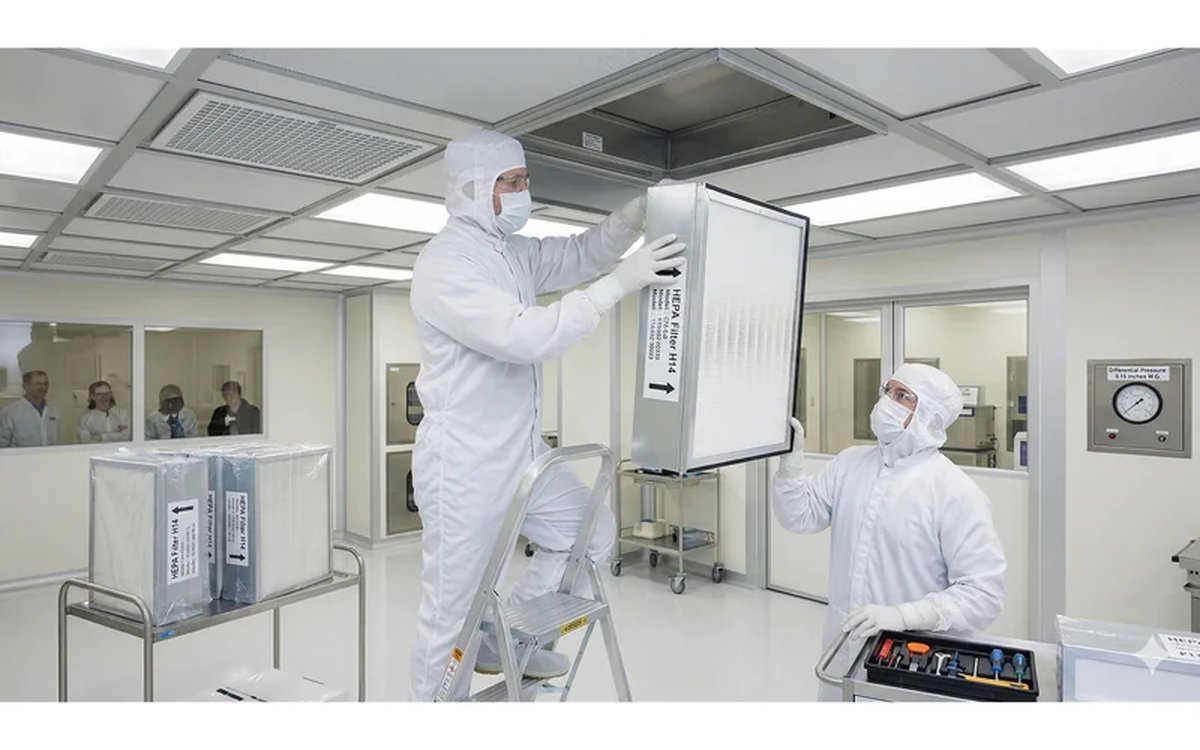
The V-Bank HEPA Filter suits the final stage of an air handling unit (AHU), where high airflow is needed at a low pressure drop. In the same 610×610×290 frame at the same 2000 CFM (56.6 CMM), a 6V has an initial pressure drop of about 249 Pa, about 25% lower than the roughly 333 Pa of a high-capacity aluminum-separator filter. Selection comes down to three things: airflow, number of Vs, and frame and gasket. Cleanroom ceiling outlets and FFUs do not use V-bank filters; they use mini-pleat HEPA filters.
How is a V-Bank HEPA filter built?
A V-Bank HEPA Filter is a high-efficiency filter made of several thin mini-pleat packs set at an angle in a V shape inside one frame. It is replaced as one filter; it is not a housing. Because the packs are angled, the same opening holds more media than a flat panel would, so it handles high airflow at a low pressure drop. Versions are named by the number of Vs: the number is how many V shapes are in the frame.
Same 610×610×290 at 2000 CFM: how different is the pressure drop?
Top: how a V-bank is built. Bottom: initial pressure drop of two HEPA filters from one quotation
Both are rated at 2000 CFM (56.6 CMM); pressure drops were 25.4 and 34 mmH₂O, converted to Pa. See the table in the text for other versions.
V-bank, aluminum-separator and mini-pleat HEPA: what is the difference?
All three are HEPA filters. They differ in how the media is pleated and how deep the frame is, and as a result the airflow that the same 610×610 opening can handle differs by more than 5 times. The mini-pleat HEPA has a thin frame; the HEPA aluminum-separator filter and the V-bank have deep frames.
| Type | Construction | Depth | Rated airflow at 610×610 | Initial pressure drop | Typical location |
|---|---|---|---|---|---|
| Mini-pleat HEPA | Shallow pleats, thin frame | 70 mm | About 10 CMM | About 123 Pa | Cleanroom ceiling outlets, FFUs |
| Aluminum separator, standard | Deep pleats with corrugated aluminum separators between them | 292 mm | 32.6 CMM | About 249 Pa | Final stage of an air handling unit |
| Aluminum separator, high capacity | Same as above, with more media pleated in | 290 mm | 56.6 CMM | About 333 Pa | Final stage of an air handling unit |
| V-bank (6V) | Mini-pleat packs arranged in a V shape | 290 mm | 56.6 CMM | About 249 Pa | Final stage of an air handling unit, bag-in/bag-out filter housings |
There are two ways to read this. At the same 56.6 CMM, the V-bank's pressure drop is about 25% lower than that of the high-capacity aluminum-separator filter; at the same pressure drop of about 249 Pa, the V-bank handles about 1.7 times the airflow of the standard aluminum-separator filter. The figures for the 6V V-bank and the high-capacity aluminum-separator filter come from the same quotation; the rest are taken from model ratings and product specifications.
A pressure drop 84 Pa lower: how much electricity does it save in a year?
Estimated for one filter at 56.6 CMM, the saving is about 1160 kWh over a year of non-stop operation. The calculation is airflow × pressure drop ÷ fan efficiency:
| Item | Value | How it is derived |
|---|---|---|
| Airflow | 0.943 m³/s | 56.6 CMM ÷ 60 |
| Pressure drop difference | 84 Pa | 333 Pa − 249 Pa |
| Air power saved | About 79 W | 0.943 × 84 |
| Converted to fan power consumption | About 132 W | Assuming a combined fan and motor efficiency of 60% |
| Annual electricity difference | About 1160 kWh | 132 W × 8760 hours |
This is the figure for one filter; multiply it by the number of filters in the air handling unit. The 60% is an assumed value, so substitute the efficiency of your own fan. Also, this compares the initial pressure drop of new filters; the gap between the two changes as dust builds up.
How to choose from 2V to 8V: airflow and pressure drop compared
Look at the airflow first, then at the pressure drop your air handling unit can accept. More Vs means more media in the frame, and usually a lower pressure drop at the same airflow: at the same 56.6 CMM, the 4V is about 300 Pa and the 6V is 230 Pa.
| Version | Frame size (mm) | Rated airflow | Initial pressure drop |
|---|---|---|---|
| 2V | Per selection | 28.3 CMM | About 300 Pa |
| 3V | 289×595 | About 1600 m³/h (about 26.7 CMM) | 250 Pa |
| 4V | Per selection | 56.6 CMM | About 300 Pa |
| 5V (single header) | 592×592 | 56.6 CMM | About 294 Pa |
| 5V (99.99%) | 610×610×290 | About 48 CMM (1700 CFM) | 250 Pa |
| 6V | 610×610×290 | 56.6 CMM (2000 CFM) | About 249 Pa |
| 6V | 610×610×292 | 56.6 CMM | 230 Pa |
| 8V | 607×607×290 | 70 CMM | 300 Pa |
The values come from different quotations and model ratings, with media and pack counts that are not identical, so use them for the general range; to compare two versions, use the same quotation.
| Your situation | Recommendation | Why |
|---|---|---|
| 610×610 opening, airflow up to 56.6 CMM | 6V | Lowest pressure drop at the same airflow, about 230–249 Pa |
| Airflow needs to reach 70 CMM | 8V 607×607×290 | The version with the highest rated airflow in the table; initial pressure drop 300 Pa |
| Efficiency must be 99.99% | Check the rated airflow first | The 5V 610×610×290 is rated at about 48 CMM; above that, choose a different version |
| Half-size opening (289×595, 305×610) | 3V | Airflow is about half that of a full-size filter |
| Dusty site, worried about fast clogging | Choose a higher V count | Some customers have told us outright that they do not use 2V or 4V because they clog easily |
When should you not use a V-Bank HEPA filter?
The V-bank is a deep-frame filter for air handling units and filter housings. In the situations below, another type is a better fit.
| Situation | Use instead | Why |
|---|---|---|
| Cleanroom ceiling outlets, FFUs | Mini-pleat HEPA | These use thin 50/70 mm frames at a face velocity of 0.45 m/s; the V-bank is 290 mm deep, with a face velocity of about 2.5 m/s at the opening |
| Air handling unit too shallow for 290 mm | 150 mm aluminum separator | At 610×610, the standard version is 17.0 CMM at about 249 Pa |
| Aluminum or stainless steel frame needed | Aluminum separator | Current V-bank models come only in galvanized steel, galvanized steel with single header, and ABS plastic frames |
| Only medium efficiency is needed | MERV 15 V-bank filter | The medium-efficiency grade has its own V-bank version, so there is no need to go up to HEPA |
| Odors or chemical gases must be removed | Chemical filter | HEPA captures particles only; it does not remove gases |
FFUs and ceiling outlets need a thin, uniform outlet face, and that is where the mini-pleat belongs. For the medium-efficiency grade, see the Pressure-Resistant MERV 15 V-Bank Filter; for V-bank filters that remove gases, there is a separate article, Chemical Filter V-Bank, 4V or 6V: How to Choose.
How to specify the frame, gasket and efficiency of a V-Bank HEPA filter
When replacing, specifying the same as the old filter is the safest choice, especially the header direction and which face the gasket is on.
| Item | Options | How to decide |
|---|---|---|
| Frame | Galvanized steel, galvanized steel with single header, ABS plastic | A single header is a flange around one side of the frame; it must line up with the mounting frame |
| Gasket | Outlet face, back of the header, double gasket | A normal air handling unit uses an outlet-face or header-back gasket; a bag-in/bag-out filter housing uses a double gasket |
| Efficiency | 97%, 99.97%, 99.99% (@0.3 μm) | HEPA means 99.97% or higher at 0.3 μm; the 97% grade does not count as HEPA |
| Size | 610×610, 592×592, 607×607; half sizes 289×595, 305×610 | Measure the frame of the old filter; common depths are 290/292 mm |
A double gasket has gaskets on both faces and is for bag-in/bag-out (BIBO) filter housings. "Only 99.97% or higher counts as HEPA" is the definition in the US Department of Energy standard DOE-STD-3020; for the confusion over names, see High-Efficiency Filter vs HEPA Filter.
6 things to prepare before requesting a quote
- 1Number of Vs (2V, 3V, 4V, 5V, 6V, 8V)
- 2Frame size and depth
- 3Efficiency (97%, 99.97% or 99.99%)
- 4Frame material, and whether it has a header
- 5Which face the gasket is on (outlet face, back of the header, or both faces)
- 6System airflow (CMM or CFM) and the initial pressure drop you can accept
Ideally, also attach a photo of the old filter, so the label and header direction are clear at a glance. For the full specifications of the V-bank, aluminum-separator and mini-pleat types, compare them one by one from the HEPA/ULPA filter category.
FAQ
Q: Are the V-Bank HEPA Filter, the V-Bank Filter Box and V-Bank the same thing?
Yes, they are the same. "V-Bank" is the common industry term and "V-Bank Filter Box" is the former name; both refer to a one-piece filter with mini-pleat packs arranged in a V shape inside a frame. It is not a housing: it fits straight into the existing filter frame of an air handling unit or filter housing, so no separate housing is needed.
Q: Can a V-Bank HEPA filter be installed in a cleanroom ceiling or on an FFU?
It is not suitable. Ceiling outlets and FFUs use 50/70 mm mini-pleat HEPA filters at a face velocity of 0.45 m/s; the V-bank is 290 mm deep, with a face velocity of about 2.5 m/s at the opening, and is meant for the final stage of an air handling unit.
Q: Is a higher V count always better?
Not necessarily. At the same airflow, more Vs usually means a lower pressure drop; for example, at the same 56.6 CMM, the 4V is about 300 Pa and the 6V is 230 Pa. But the V count has to be considered together with the airflow: the 8V 607×607×290 is rated at 70 CMM and the 2V at 28.3 CMM, so first confirm which version's rating your system airflow falls within.
Q: My system is 52 CMM. Which version should I choose?
Most 610×610 V-bank filters are rated at 56.6 CMM, so 52 CMM is within the rating, and below the rated airflow the pressure drop is lower than the stated value. Note, however, that the 99.99% 5V 610×610×290 is rated at about 48 CMM; 52 CMM exceeds that, so choose a version rated at 56.6 CMM or more.
Q: Does a 97% V-bank filter count as HEPA?
No. HEPA usually means 99.97% or higher at 0.3 μm; the 97% grade is used where requirements are lower. For projects whose specification calls for HEPA, choose 99.97% or 99.99%.
Q: Can a V-Bank HEPA filter remove odors?
No. HEPA captures particles; odors and chemical gases need activated carbon or a chemical filter in addition.