Bag in Bag out (BIBO) Filtration System
Product Overview
Features & Specifications



Detailed Description
When bag-in/bag-out is needed
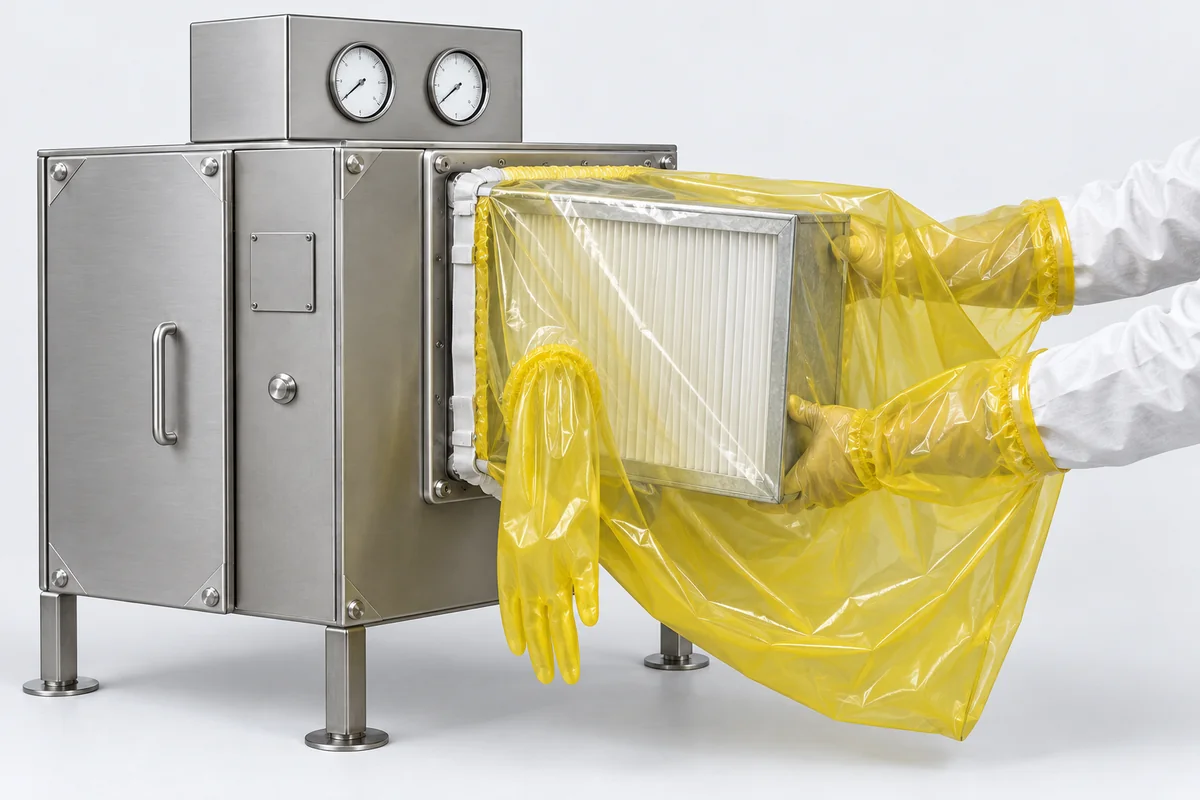
Whatever an exhaust HEPA filter captures stays on the filter, so the moment the filter is changed is when personnel exposure risk is highest. The purpose of BIBO is to let that operation take place inside a sealed bag: the old filter is pulled from the access port straight into a PVC bag, the bag is sealed, cut and carried away with the filter inside, and the opening of the housing remains closed off by a bag at all times. The 6th edition of the U.S. CDC / NIH BMBL states that if a BSL-3 laboratory has HEPA filter housings, they should have bubble-tight isolation dampers, decontamination ports and/or bag-in/bag-out, allow each filter to be leak tested individually, and be certified at least once a year; for BSL-4, HEPA housings must allow in-situ decontamination. Appendix A also notes that BIBO is suited to cases where gaseous decontamination is not possible or where chemicals or radionuclides are present, and that it must be specified at the time of procurement, because retrofitting it later requires a major engineering evaluation. In China, clause 6.3.3.8 of GB 19489-2008 requires exhaust HEPA filters to allow in-situ decontamination and leak testing, and clause 5.1.9 of GB 50346-2011 (a mandatory provision) sets the same requirement for Level 3 and Level 4 containment zones. What these codes have in common is "in-situ decontamination plus in-situ leak testing"; BIBO is the provision that makes the filter change safe, not a piece of equipment that satisfies the requirements on its own. In planning, bubble-tight isolation dampers should be installed in the ductwork upstream and downstream of the housing, and decontamination ports should be provided. BIBO captures particles, not gases: a HEPA filter can only capture particles and aerosols. Toxic or radioactive gases need a separate activated carbon adsorption section, and noble gases such as krypton and xenon cannot be captured by ordinary filter media.Housing construction and filter-change layout
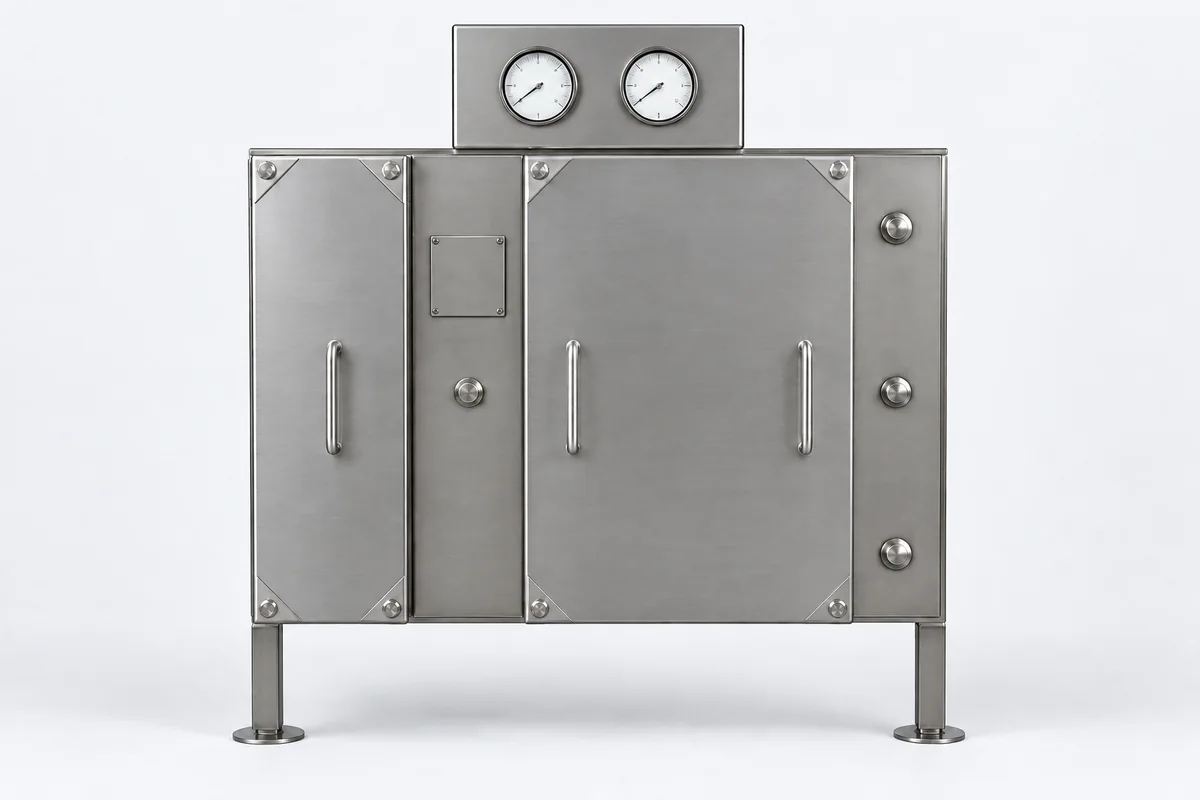
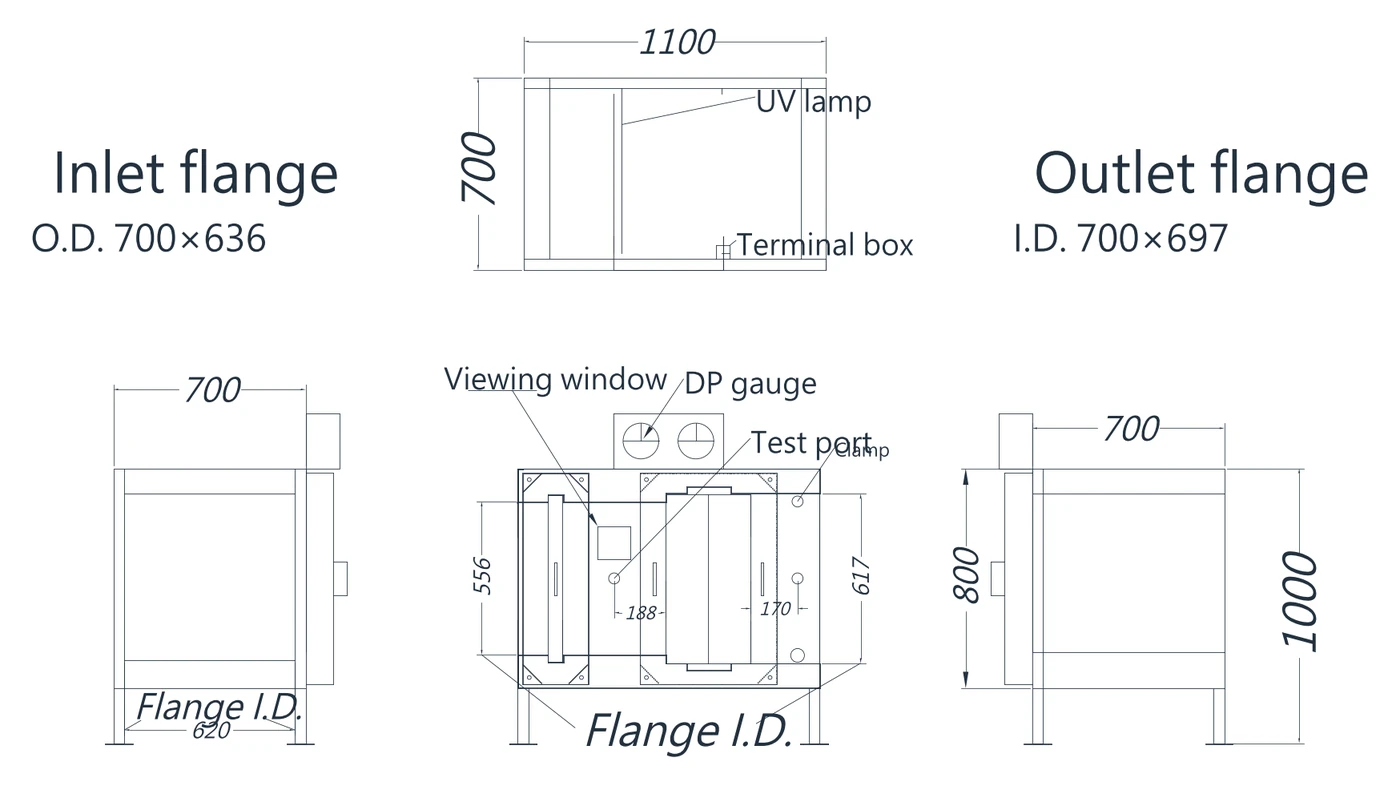
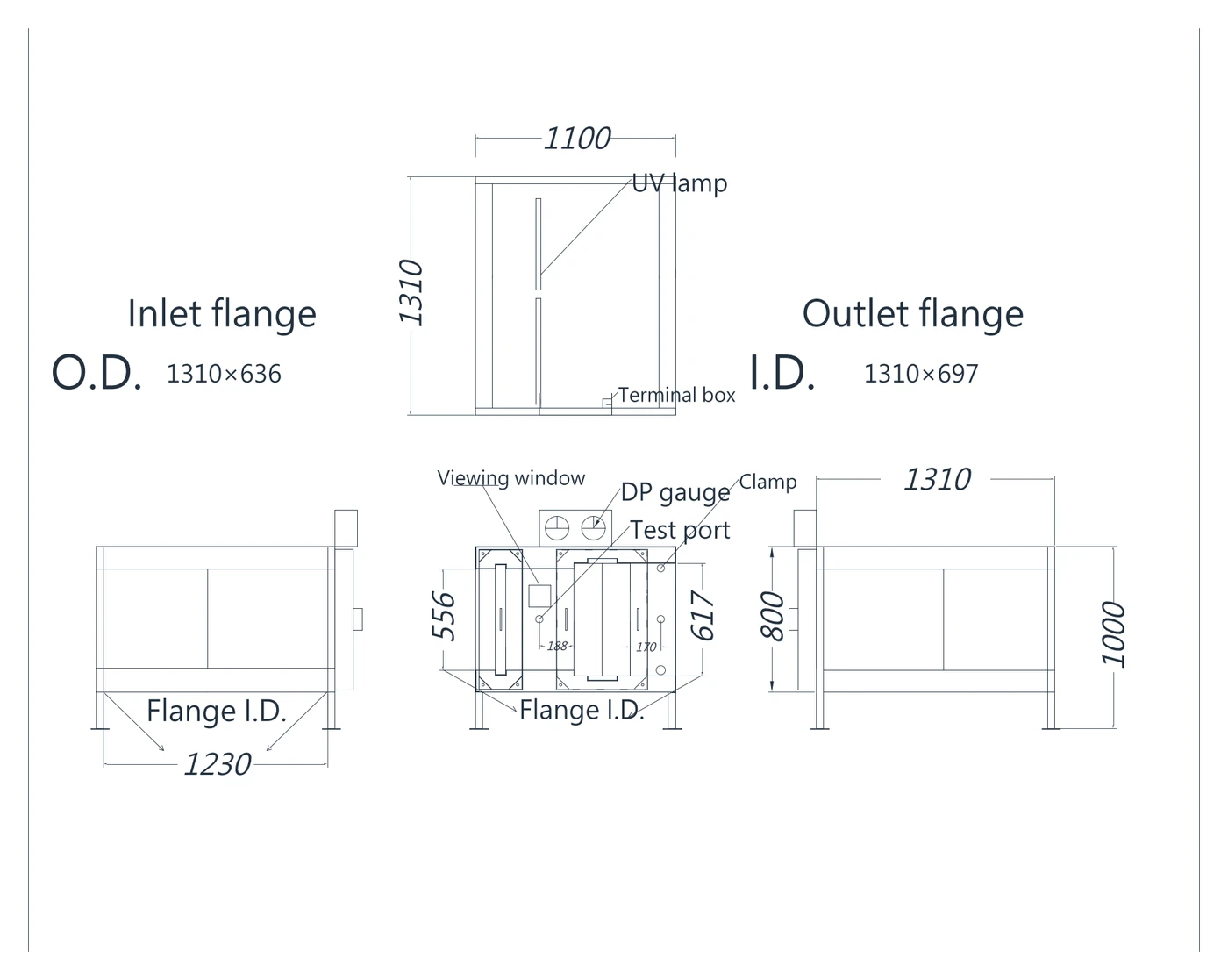
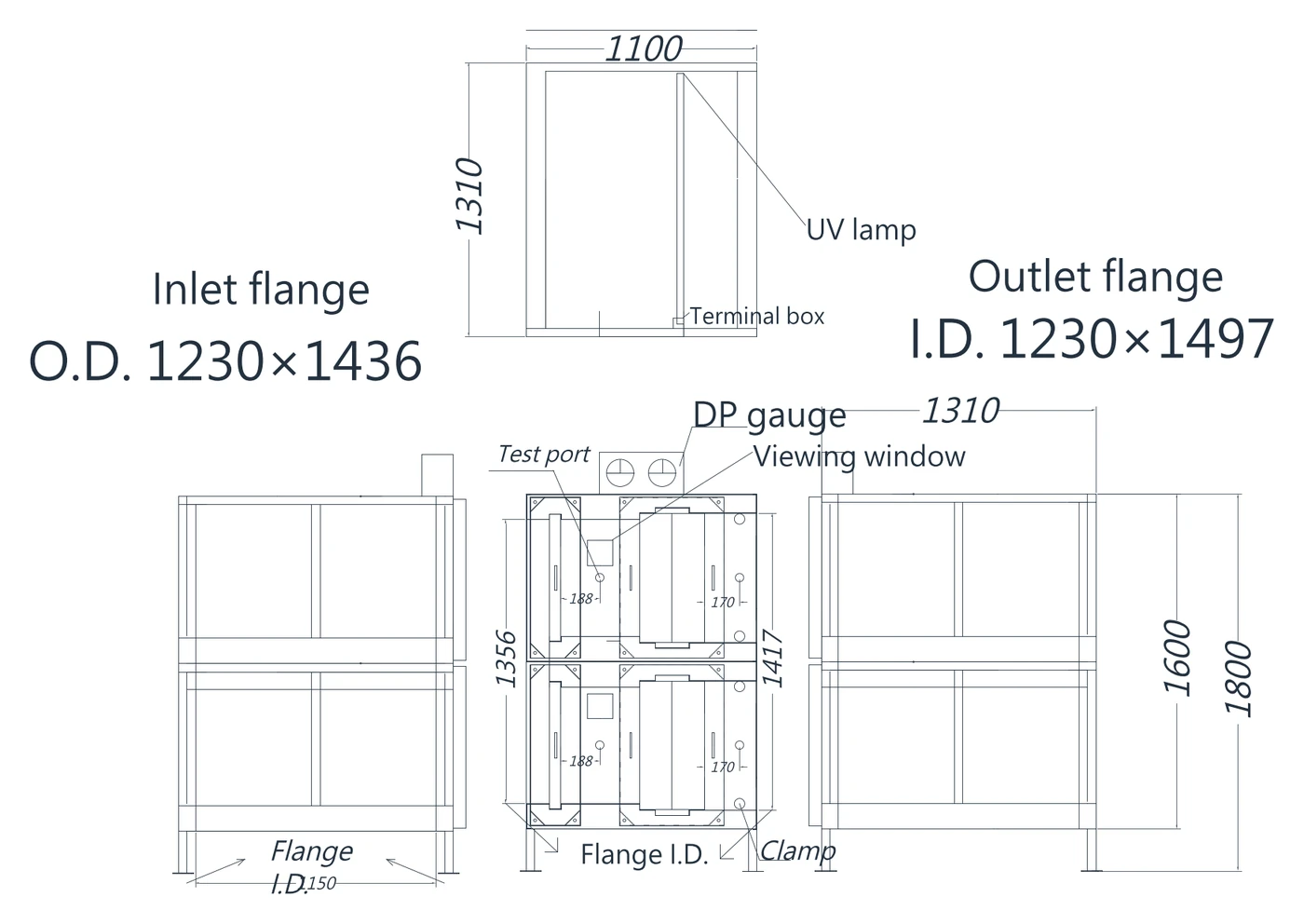
The U.S. Department of Energy handbook DOE-HDBK-1169 (Nuclear Air Cleaning Handbook) recommends the following for BIBO housings: a welded stainless steel housing with all seams sealed; a bagging ring at each access port with two continuous ring ribs, the bag being secured with a strap between the two ribs; pressure taps upstream and downstream; and shut-off dampers upstream and downstream of the filters, so that the housing can be isolated during a filter change and the bag is not blown out or sucked in when the door is opened. The corresponding features of this product: a fully welded 2.0 mm SUS304 housing; separate access ports for the pre-filter and the HEPA filter; a filter clamping mechanism operated from outside the housing to seat the HEPA filter, so no one has to reach inside to adjust it; two differential pressure gauges that show the resistance of the pre-filter and the HEPA filter separately to indicate when to change them; a UV-C lamp that irradiates the upstream face of the filter; and upstream and downstream test ports that allow on-site scan leak testing to be done from outside the housing.Models and dimensions
| Model | Airflow m³/h | HEPA / pre-filter quantity | Overall W×D×H mm |
|---|---|---|---|
| BIBO-34 | 3,400 | 1 | 1100×700×800 |
| BIBO-68 | 6,800 | 2 | 1100×1310×800 |
| BIBO-102 | 10,200 | 3 | 1100×1920×800 |
| BIBO-136 | 13,600 | 4 | 1100×1310×1600 |
| BIBO-204 | 20,400 | 6 | 1100×1920×1600 |
In-place leak testing: do not mix up 0.01% and 0.05%
HEPA filters are tested individually at the factory; once installed in the housing, it still has to be confirmed that the filter, its seal and the housing as a whole do not leak, which is why an on-site scan leak test is required. The two figures commonly quoted mean different things: 0.01%: the acceptance limit for a single leak during scanning. Under IEST-RP-CC034.5, no single-point reading may exceed 0.01% of the upstream concentration; clause 10.1.7 of GB 50346-2011 likewise treats a photometer penetration above 0.01% as a leak. 0.05%: the overall leakage acceptance value recommended in the DOE handbook for the in-place test of a complete filter bank in nuclear air treatment systems; it is not a single-point acceptance limit. A field example: the exhaust BIBO of a BSL-2 laboratory on a hospital campus underwent an overall efficiency test under the local laboratory biosafety regulations, with PAO as the test aerosol. The upstream concentration was 28 µg/L (the regulations require 10–100 µg/L) and the downstream reading was < 0.0002%, below the acceptance criterion of < 0.005%, so the unit passed. Before the test, the HVAC system had been balanced and run continuously for more than 24 hours. As for test frequency, BMBL requires BSL-3 filters and housings to be certified at least once a year, and the filters must also be retested after every filter change.Housing airtightness and acceptance
A leak-free filter does not mean a leak-free housing: access doors, the through-wall shaft of the clamping mechanism, the test ports and the welds are all possible leak paths. Clause 6.3.3.9 of GB 19489-2008 states that HEPA filter units used outside the containment zone must be able to withstand 2500 Pa structurally, and at 1000 Pa the leakage per minute must not exceed 0.1% of the net chamber volume; clause 10.1.11 of GB 50346-2011 tests the tightness of exhaust HEPA filter units by the pressure decay method, and its commentary explicitly covers bag-in/bag-out units. In the U.S., ASME AG-1 Section HA covers housings and pressure-boundary leak testing. At acceptance you can require: a housing pressure decay test, a scan leak test of each filter after installation, and functional checks of the differential pressure gauges and the UV lamp, with the test conditions and acceptance values written into the purchase specification.Rehearse before the first filter change
The DOE handbook specifically warns that bagging is not a foolproof procedure and that a rehearsal should be carried out before the first actual filter change. BMBL also points out that in most cases filters should be decontaminated before removal, commonly with formaldehyde, vaporized hydrogen peroxide (VHP) or chlorine dioxide. For the filter-change procedure and bag specifications, see the BIBO PVC replacement bag page.Frequently Asked Questions
Can a bag-in/bag-out filter housing handle radioactive or toxic gases?
Not with HEPA alone. A HEPA filter can only capture particles and aerosols; toxic or radioactive gases (such as radioactive iodine) need an additional activated carbon adsorption section, which is available as an option for this product. Noble gases such as krypton and xenon cannot be captured by ordinary filter media and need other treatment methods. The specification should therefore read "captures radioactive, toxic or infectious particles / aerosols"; if the exhaust contains gases that need treatment, state their composition when requesting a quotation so that an adsorption section can be planned separately.
With bag-in/bag-out, is in-situ decontamination still needed?
In biosafety laboratories it usually is. The 6th edition of BMBL requires HEPA housings in BSL-4 to allow in-situ decontamination and points out that in most cases filters should be decontaminated before removal; GB 19489-2008 and GB 50346-2011 also require in-situ decontamination and leak testing for exhaust HEPA filters in Level 3 and Level 4 containment zones. BIBO keeps the filter change free of contact with contaminants, while in-situ decontamination reduces the hazard of the filter itself; the two complement each other. In planning, provide bubble-tight isolation dampers and decontamination ports upstream and downstream of the housing.
How many filters should the unit hold, and how is airflow calculated?
Each HEPA filter (610×610×290 mm) is rated at 3,400 m³/h with an initial resistance of about 336 Pa. Number of filters = design airflow ÷ 3,400, rounded up: for example, 6,000 m³/h calls for the 2-filter BIBO-68, and 12,000 m³/h for the 4-filter BIBO-136. The 1–3 filter units are all 800 mm high; the 4-filter and 6-filter units are arranged in two tiers and are 1600 mm high, so the plant room clear height must also allow about 200 mm for the stand plus maintenance space above. As dust builds up, filter resistance rises, so the fan must be able to overcome the final filter resistance plus the duct resistance.
Selection References
Before ordering, verify the efficiency grade, media type, and whether the operating environment fits your requirements.