Bag-in Bag-out PVC Change-Out Bag
Product Overview
Features & Specifications



Detailed Description
Why 0.2 mm PVC
The U.S. Department of Energy handbook DOE-HDBK-1169 (Nuclear Air Cleaning Handbook) describes change bags as transparent plastic, usually PVC or PE, at least 0.008 in (about 0.2 mm) thick, and notes that PVC may not be suitable in high-radiation environments. The 0.2 mm PVC sheeting of this product corresponds to that minimum thickness, and the transparent section lets the operator see the filter and the seal position inside the bag during the operation. The bag has to be strong enough to bear the weight of the filter and the pulling, yet soft enough to work through. A deep 610×610×290 mm HEPA filter loaded with dust is not light, so during the operation let the bottom of the bag support the filter as much as possible rather than holding it only by the glove sleeves.How the bag is built
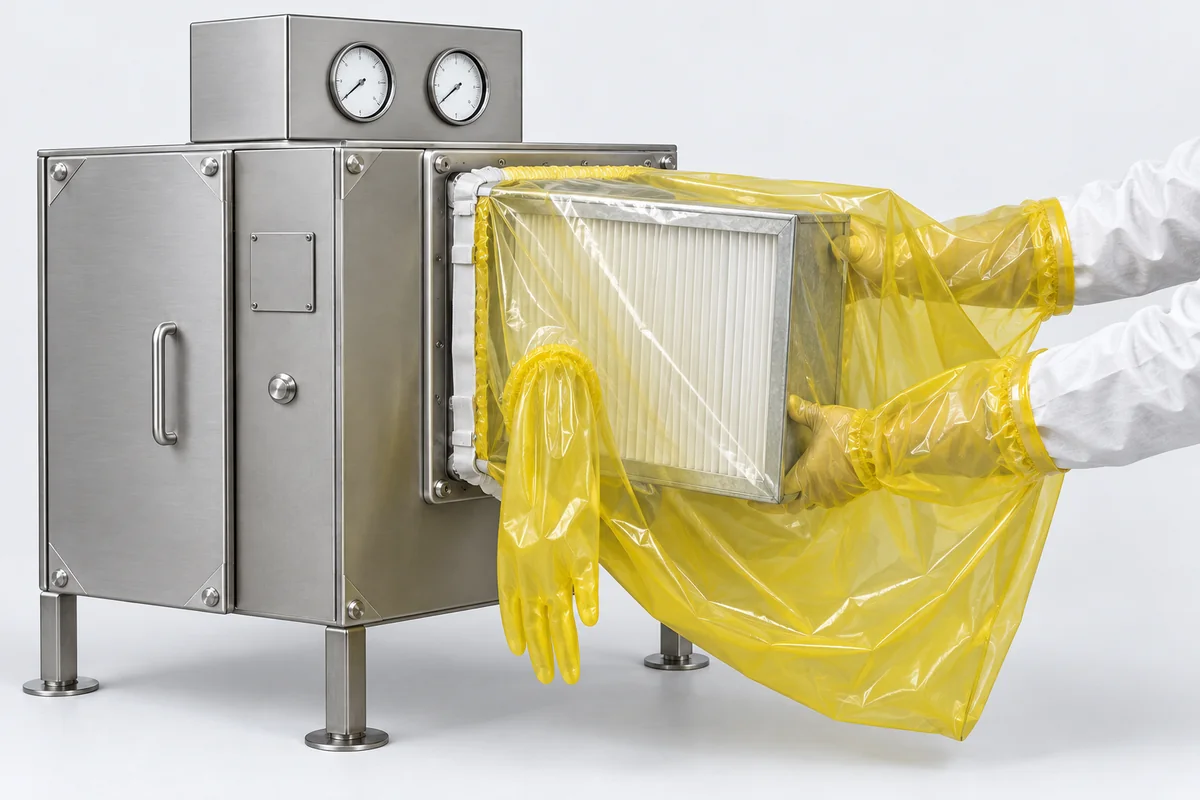
Bag mouth and strap: the bag mouth is fitted over the ring rib on the access port flange, held snug by the elastic band and then tightened with the strap. The DOE handbook recommends that the bagging ring on the access port have two continuous ring ribs, giving the strap a positive seat; the bag-change method of this product makes use of exactly these two ribs: the new bag goes on the second rib and the old bag mouth is first moved back to the first rib, so the access port is always closed off by at least one bag. Transparent viewing section: the 300 mm transparent section at the bag mouth is used to check that the mouth sits fully on the ring rib and that the seal is in the right position. 3 glove sleeves: the 2 at the rear are used to pull out and install the filter; the 1 at the front is smaller and is used to gather in the remnant of the old bag for sealing and cutting. No standard sets the number of glove sleeves; 2–3 is common, depending on the housing and the change method.Change procedure
1. Remove the access door: take off the access door of the filter housing. 2. Release the clamping: turn the filter clamping knobs (upper and lower sets) counterclockwise to loosen them. 3. Pull out the old filter: put both hands into the two glove sleeves at the rear of the bag, pull out the handle under the filter, draw the filter out of the housing and move it into position at the rear of the bag. 4. Seal and cut: twist the bag tight about 30 cm above the front glove sleeve, seal it and cut it; both sides of the cut must be sealed. 5. Fit the new bag: release the strap buckle on the flange and move the old bag mouth back from the second ring rib on the flange to the first; fit the mouth of the new bag, which already contains the new filter, over the second ring rib and tighten the strap. 6. Remove the old bag remnant: through the small glove sleeve at the front of the new bag, pull the old bag mouth off the flange, gather it into the small sleeve, twist it tight and seal it, then cut off the small sleeve; next, use the two rear glove sleeves to install the new filter in the housing. 7. Restore: turn the clamping knobs clockwise to tighten them, fold the bag and tuck it inside the access port, then refit the access door and tighten it.Sealing methods
The method described in the DOE handbook is to make two seals on the bag about 0.25 in apart and cut between them, so that the housing side and the old-filter side each remain sealed; the seals can be made by heat sealing, or by twisting and closing with a binding ring or tape. Step 4 of this procedure follows the same principle: twist tight, seal both sides, then cut in the middle. Which sealing method to use should be decided by the user's safety officer according to the level of hazard. The DOE handbook also warns that bagging is not a foolproof procedure and that a rehearsal should be done before the first actual filter change; in biosafety laboratories, decontamination with formaldehyde, vaporized hydrogen peroxide (VHP) or chlorine dioxide is in most cases completed before the filter is changed.How many spares to keep
Every filter change needs 1 new bag for each access port: when the pre-filter and HEPA filter are changed together, have 1 size L and 1 size S bag ready. Base the spare quantity on "number of access ports × filter changes per year", add extra bags for rehearsals and accidental tears, and confirm at purchase that the bag mouth circumference matches the access port flange.Frequently Asked Questions
How do I choose between size L and size S replacement bags?
It depends on the access port. Size L has a mouth circumference of 84" and a length of 96" and is used for the HEPA access port; size S has a circumference of 68" and a length of 96" and is used for the pre-filter access port. The mouth circumference must match the ring rib on the access port flange: too small and it will not fit over it, too large and it cannot be strapped tight. Each access port uses 1 bag per filter change: for a single-filter housing where the pre-filter and HEPA filter are changed at the same time, that means 1 size L and 1 size S bag, and multi-filter housings need more according to the number of access ports; if the housing is not one of our standard models, please provide the outer perimeter of the access port flange so that the bag size can be confirmed.
How should the removed filter and bag be disposed of?
Keep them sealed and dispose of them directly according to their waste category; do not open them on site. The old filter is sealed in the rear section of the bag with both seals closed, and the whole package is treated as contaminated. The approach in the WHO Laboratory Biosafety Manual, 4th edition, is to remove the filter in a sealed, airtight container and then decontaminate or incinerate it separately; radioactive or chemical contamination is handled according to the waste rules of the organization concerned. If in-situ decontamination was completed before the change, the disposal category may differ; follow the safety officer's determination.
Can a replacement bag be reused?
No, each bag is used only once. During a filter change the bag is cut: one part seals in the old filter and is carried away, and the other remains on the first ring rib of the flange, where it is gathered in, sealed and cut off through the small glove sleeve of the next new bag. A reused bag has already been twisted and cut at its seal and body, so its seal can no longer be guaranteed. Before a 0.2 mm PVC bag is unpacked for use, it should also be checked for holes and for an intact transparent section.
Selection References
Before ordering, verify the efficiency grade, media type, and whether the operating environment fits your requirements.