One Name, Two Different Things
In the filtration industry, "high-efficiency filter" is one of the most misunderstood terms.
Ask ten people "what grade is a high-efficiency filter?" and you may get ten different answers: some say H10, some say H13, some just answer "it's HEPA."
The core issue: "high-efficiency" is a relative concept, not a standard grade. Relative to a G4 pre-filter or F7 medium filter, H10 is indeed "high-efficiency" — but its MPPS efficiency is only 85%, which is an entire order of magnitude below HEPA H13's 99.95%.
This article draws a clear line between "high-efficiency filters" and "HEPA filters" so you won't be misled by names when specifying or purchasing.
Grade Comparison Table
The following maps common market names to actual EN 1822 / ISO 29463 grades.
"High-Efficiency Filter" vs "HEPA Filter" Name Mapping
Same thing? Not always. Know the grade to avoid name confusion
| Common Name | Actual Grade | MPPS Eff. | Test Standard | Test Method |
|---|---|---|---|---|
| High-eff filter (≥95%) | H10–H12 | 85–99.5% | EN 1822 | Overall efficiency |
| HEPA (standard) | H13 | ≥99.95% | EN 1822 / ISO 29463 | MPPS scan method |
| HEPA (high-end) | H14 | ≥99.995% | EN 1822 / ISO 29463 | MPPS scan method |
| ULPA | U15–U17 | ≥99.9995% | EN 1822 / ISO 29463 | MPPS scan method |
Efficiency at MPPS (most penetrating particle size, 0.1–0.3 µm). EN 1822 / ISO 29463 HEPA threshold is H13 (≥99.95%).
The Critical Threshold: H13
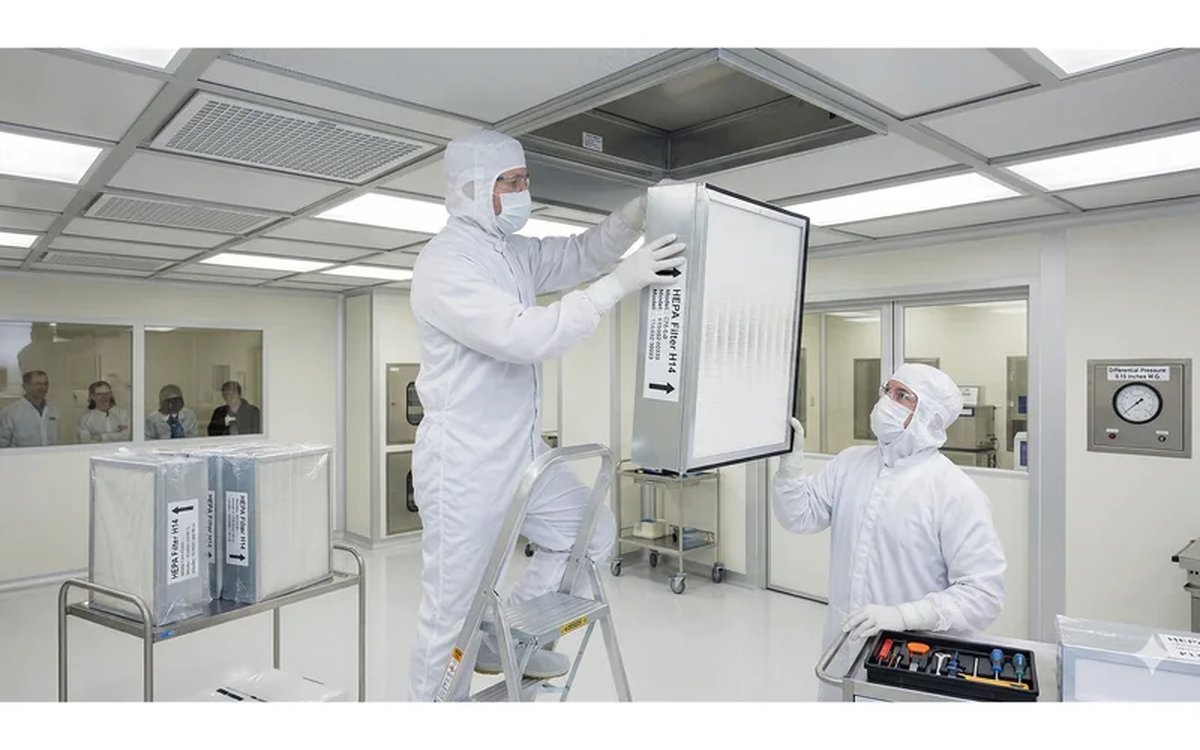
EN 1822 and ISO 29463 define H13 (MPPS ≥99.95%) as the starting point of HEPA. H10–H12 fall under the broader "high-efficiency" category but strictly speaking are not HEPA.
An analogy: the difference between H12 and H13 is like a platinum credit card versus a black card — both are "premium," but the access levels are very different.
Why the Confusion? Three Historical Reasons
1. National Standards Weren't Unified
Before EN 1822 (Europe), each country had its own classification:
- ▸The US used ASHRAE 52.2 / MIL-STD-282 — anything with DOP efficiency ≥99.97% (@0.3 µm) was called HEPA
- ▸Japan used JIS B 9908 with different test particles and methods
- ▸Taiwan historically followed US or Japanese standards, so the definition of "high-efficiency" drifted
2. Translation Ambiguity
In Chinese, both "high-efficiency filter" and "HEPA filter" translate to terms that overlap. The English acronym HEPA (High Efficiency Particulate Air) actually has a precise efficiency threshold, but translations blur this distinction.
3. Marketing Language
Some suppliers label H10–H12 filters as "high-efficiency" or even "HEPA-type" / "HEPA-grade." Technically not wrong, but it easily misleads buyers unfamiliar with standards into thinking they are equivalent to H13.
How Big Is the Efficiency Difference Really?
Intuitively, 99.5% vs 99.95% seems like only a 0.45 percentage-point gap. But consider the penetration:
- ▸H12 (99.5%): Out of 10,000 MPPS particles, 50 penetrate
- ▸H13 (99.95%): Out of 10,000 MPPS particles, only 5 penetrate
- ▸H14 (99.995%): Out of 10,000 MPPS particles, only 0.5 penetrate
From H12 to H13, penetration drops by a factor of ten. This is why semiconductor fabs and hospitals insist on H13 or above — in these environments, those extra penetrating particles could mean a scrapped wafer or a post-surgical infection.
Testing Method Differences
"High-efficiency" (H10–H12) and "HEPA" (H13+) differ not just in efficiency but also in how they are tested:
| Comparison | H10–H12 | H13–H14 / ULPA |
|---|---|---|
| Test method | Overall efficiency | MPPS scan method |
| Test particle | Fixed size (e.g., 0.3 µm) | Most Penetrating Particle Size (MPPS) |
| Leak test | Optional | Mandatory (100% scan of every unit) |
| Acceptance | Overall efficiency passes | Overall efficiency + local leak both must pass |
The MPPS scan method is the gold standard for HEPA/ULPA testing: an aerosol scans every region of the filter to locate leak points. Even if overall efficiency passes, a single point exceeding the local penetration limit means failure.
It is like an exam that requires passing every section, not just the total score — much stricter than overall efficiency testing.
Common Naming Confusion Traps
Here are three scenarios frequently encountered in practice.
The mix-up between "high-efficiency" and "HEPA" goes wrong in three typical situations. A tender that only says "high-efficiency filter" without a grade: the supplier delivers H12 (99.5%), which technically is high-efficiency, the cleanliness target is missed and the filters have to be re-procured. A household air purifier labelled "HEPA-grade" at 99% efficiency: that is really H11–H12, but the buyer assumes it is a 99.95% H13. The correct approach is what a hospital tender does — specify "HEPA H13" outright and require an EN 1822 third-party test report, which leaves no room for ambiguity about the grade.
Common Naming Confusion Traps
"High-efficiency" does not equal HEPA — buying wrong can affect yield or patient safety
| Scenario | Supplier Claim | Reality | Risk |
|---|---|---|---|
| Tender spec says "high-eff filter" | Supplier delivers H12 (99.5%) | No grade specified, H12 is technically high-eff | Cleanliness fails, need re-procurement |
| Air purifier labeled "HEPA-grade" | 99% efficiency | 99% ≠ 99.95%, actually H11–H12 | Consumer misled into thinking H13 |
| Hospital tender specifies "HEPA H13" | Supplier provides EN 1822 report | Third-party report, grade verified | ✓ Correct approach |
Request third-party test reports (EN 1822 / ISO 29463) from suppliers, confirming MPPS efficiency and scan leak rate.
How to Avoid Procurement Pitfalls
1. Specify the Exact Grade in Tenders
Don't write "high-efficiency filter." Write "H13 grade (EN 1822), with MPPS scan test report." Grade plus test standard leaves no room for ambiguity.
2. Require Third-Party Test Reports
A qualified HEPA filter should come with:
- ▸EN 1822 or ISO 29463 third-party test report
- ▸MPPS efficiency value
- ▸Scan leak test results
- ▸Testing laboratory accreditation information
3. Confirm Test Particle Size
If a supplier only provides "99.99% efficiency at 0.3 µm" without MPPS testing, it may have been tested with the older US standard (DOP method). MPPS efficiency is typically lower than fixed 0.3 µm testing because MPPS targets the hardest-to-capture particle size.
4. Perform On-Site PAO Leak Testing After Installation
Even if factory reports are satisfactory, a PAO (Poly-Alpha Olefin) leak scan test after installation confirms that the mounting frame has no leaks.
Which One Do You Actually Need?
The cleanliness class your space needs decides it. General HVAC and offices (ISO 8 and above) are fine with F7–F9 medium filters and do not need HEPA; hospital operating rooms and isolation rooms (ISO 5–7) need H13–H14 HEPA at the terminal; semiconductor and high-grade cleanrooms (ISO 3–5) need H14 HEPA or U15–U16 ULPA. Whichever it is, the way to tell whether a supplier's "high-efficiency" filter is a real HEPA is whether they can produce an EN 1822 or ISO 29463 MPPS scan test report.
Quick Selection Guide: Do You Need "High-Efficiency" or "HEPA"?
Scenario → Grade → Test standard — three steps to clarity
1What cleanliness does your scenario require?
2What test reports can the supplier provide?
Simplified guide. Actual projects should follow regulations, design specs, and third-party test reports for final decisions.
FAQ
Q1: What's the difference between "HEPA-grade" and "True HEPA" on air purifiers? "True HEPA" typically means H13 (≥99.95% @MPPS), conforming to EN 1822 / ISO 29463. Terms like "HEPA-grade," "HEPA-type," or "HEPA-like" have no standardized definition and may only deliver 95–99.5% efficiency (H10–H12). When buying consumer air purifiers, look for "True HEPA" or the H13/H14 grade marking on the filter.
Q2: Are H10–H12 filters useless? Not at all. H10–H12 are perfectly adequate for many industrial applications: electronics assembly, general clean workstations, lab fume hoods, and more. They have lower pressure drop than H13 and cost 30–50% less. The key is using them where appropriate, not substituting them for HEPA.
Q3: Why not use H14 everywhere? H14 has 40–60% higher pressure drop than H13, requiring more fan power. Using H14 where H13 suffices is over-engineering — more electricity and procurement cost with no meaningful cleanliness improvement.
Q4: Does Taiwan have specific regulations? Taiwan does not currently mandate which standard HVAC or cleanroom filters must meet. However, engineering designs typically reference EN 1822, ISO 29463, ISO 14644 (cleanroom classification), and industry specifications (SEMI standards, GMP guidelines). Hospitals follow Ministry of Health and ASHRAE 170 recommendations.
Q5: Can I test filter efficiency myself? On-site PAO leak testing (verifying installation integrity) is feasible. However, MPPS efficiency testing requires specialized aerosol generators and optical particle counters, typically performed in accredited laboratories. It is best to request third-party lab reports from the supplier.