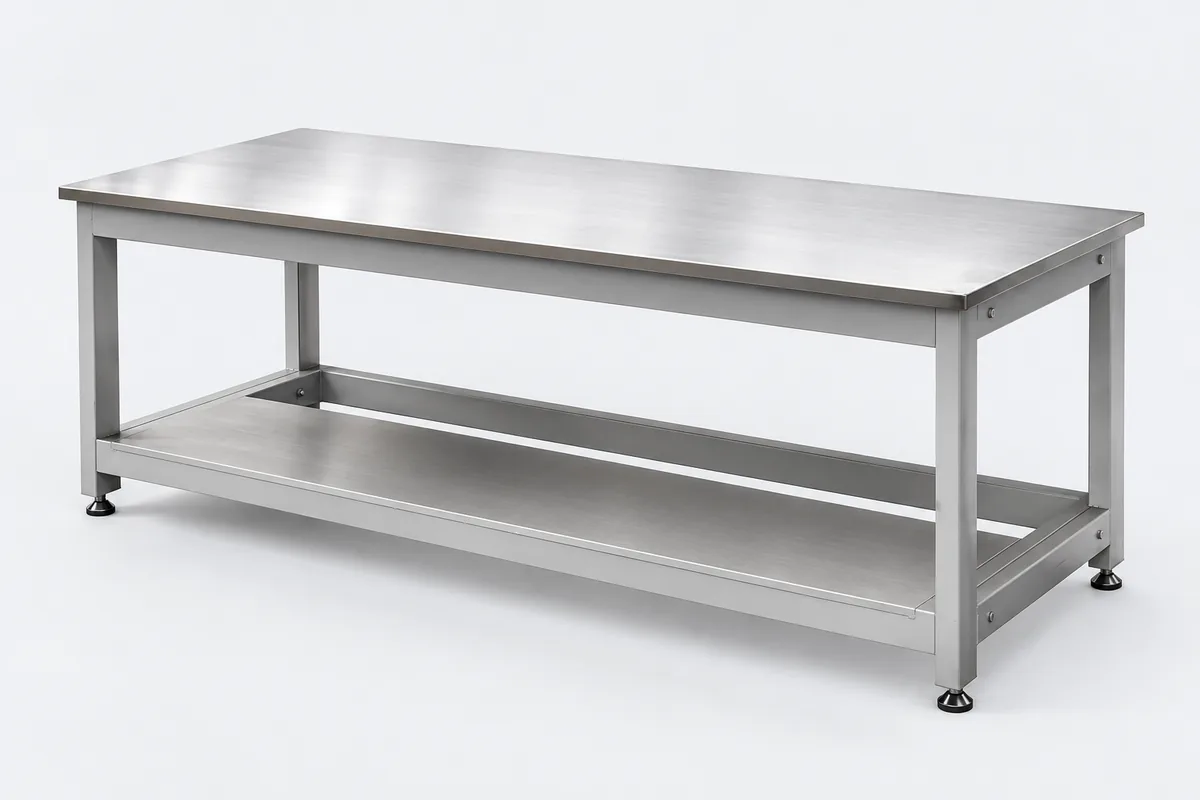
Cleanroom Worktable
Product Overview
Features & Specifications



Detailed Description
Working back from the GMP surface clauses to the details of a worktable
EU GMP Annex 1 (2022) §4.5 requires surfaces in clean areas to be smooth, impervious and unbroken, to minimise the shedding and accumulation of particles, and to withstand repeated cleaning and disinfection; §4.6 requires recesses that are difficult to clean to be avoided and projecting ledges, shelves, cupboards and equipment to be kept to a minimum; §4.7 requires materials that generate little particulate and resist cleaning agents and disinfectants. The FDA 2004 aseptic processing guidance IV.E likewise requires surfaces that are smooth, hard and easy to clean. None of these clauses says directly what a worktable should look like, but applied to a table they turn into a few very concrete checkpoints: Sealed tube ends: if the opening left after cutting a square or round tube is not sealed, the inside becomes a cavity that cannot be wiped, and cleaning liquid that runs in cannot run out again. Folded edges and stiffening ribs under the top: the inside of the folded edge of the top panel and the gaps between the stiffening ribs and the top are the places most often missed when wiping. Welding and grinding them flush lasts longer than sealing them with sealant. Wiring routed inside the tubes: if lights, sockets and data cables are tied to the outside of the legs with cable ties, every cable becomes a dust-collecting surface. Fit only the add-ons that are really needed: every extra hanger, storage box or hook is one more surface to wipe, which is exactly why §4.6 asks for projections to be kept to a minimum.Choosing the top material
| Top | Advantages | Limitations | Suitable work |
|---|---|---|---|
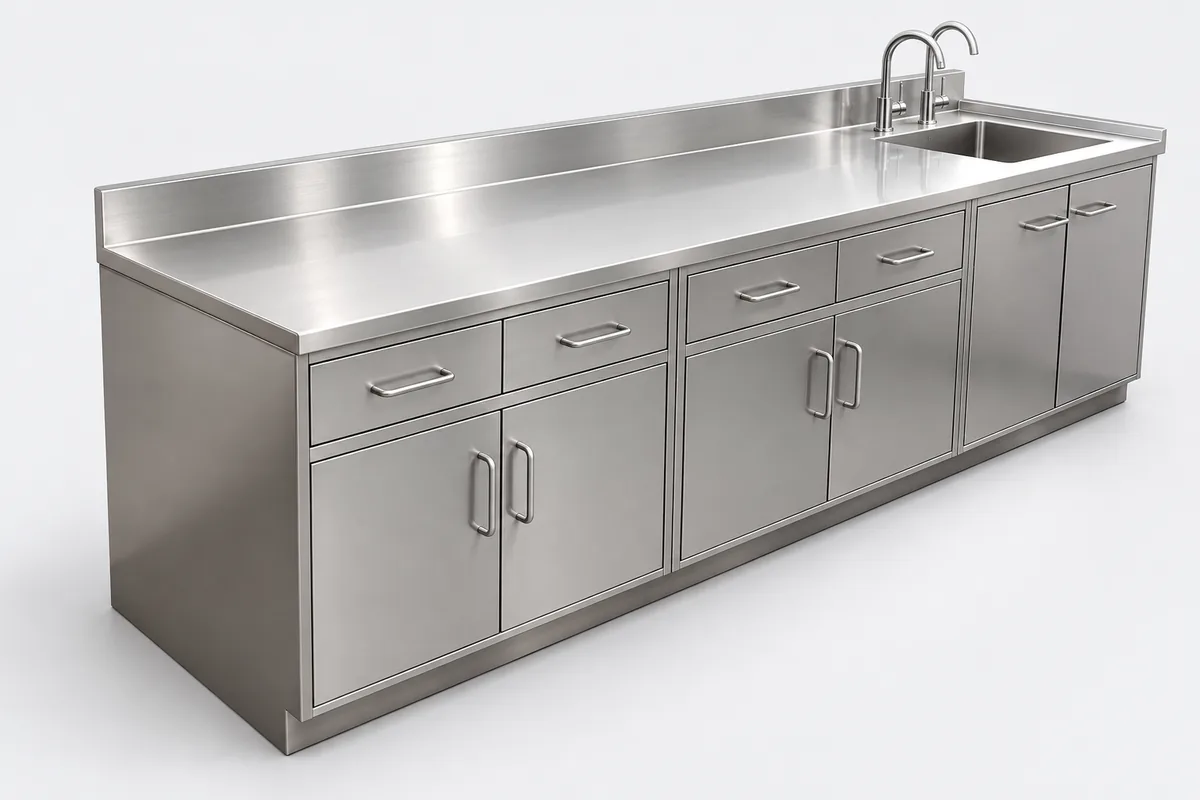
| Stainless steel | Durable, resists disinfectants, easy to clean | Hard and reflective; long periods of visual inspection cause fatigue | General assembly, packaging, work needing frequent disinfection |
| Marble | Best flatness; can serve as a measurement reference surface | Heavy, costly, not acid resistant | Measurement, calibration, inspection needing a stable reference surface |
| Antistatic panel | Dissipates static electricity | The conductive layer degrades with use; surface resistance must be measured regularly | Electronic assembly with ESD requirements |
Lipped edges, round corners and two tiers
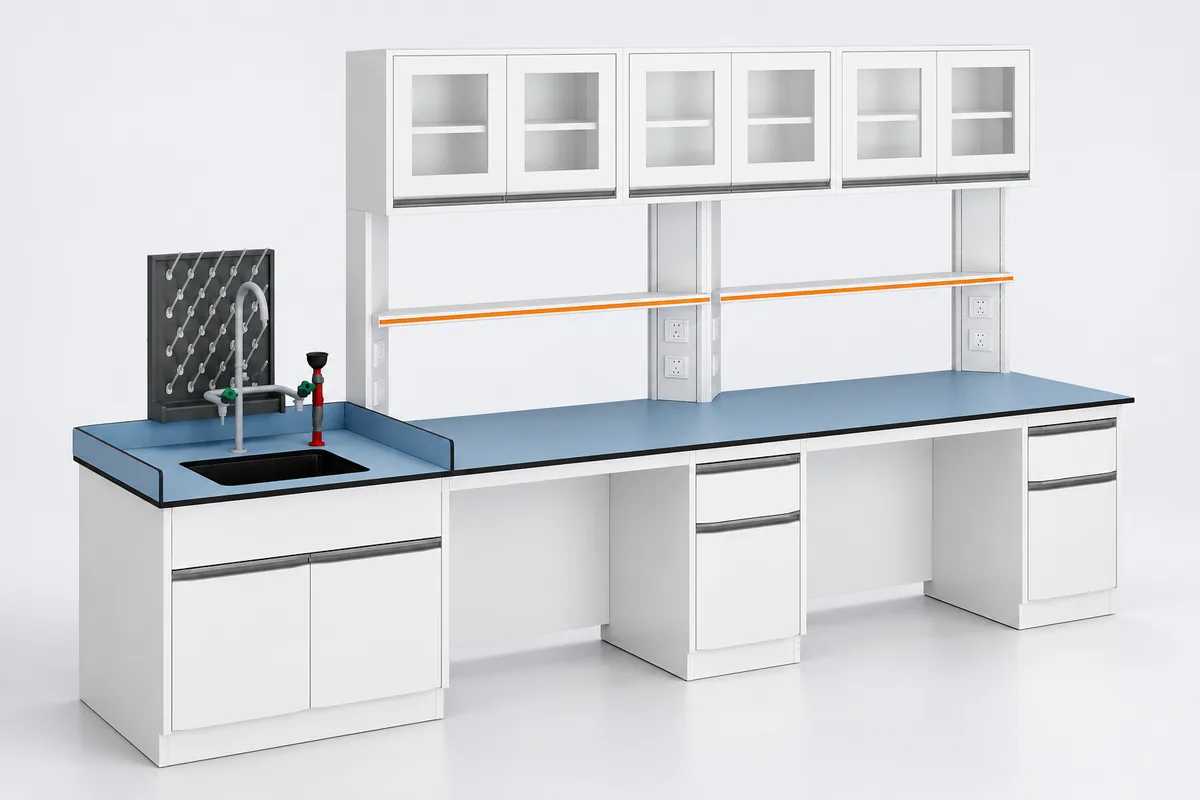
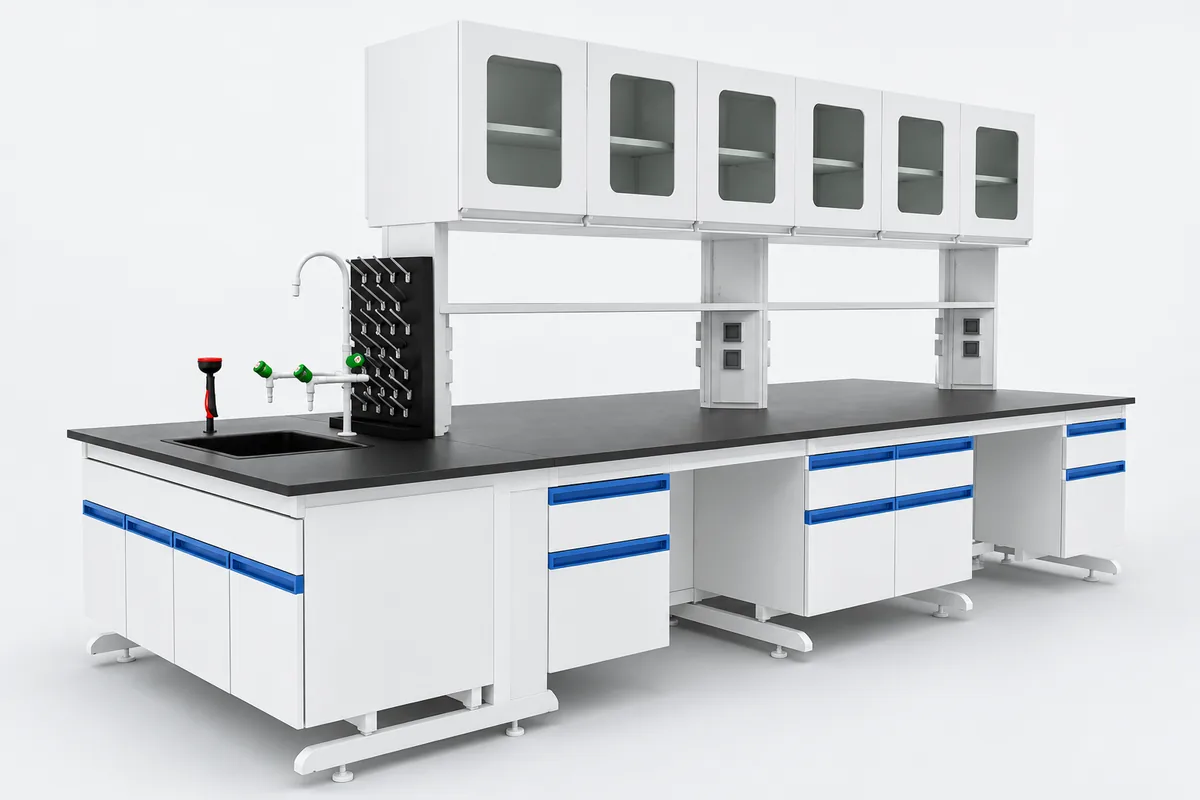
Lipped-edge type: upstands around the top keep small parts from rolling off and small amounts of liquid from reaching the floor, but the inside corner between the upstand and the top collects dust and needs an extra step when wiping. Round-corner type: the corners of the table are radiused, so they are less likely to snag cleanroom garments as people walk past, and there are no sharp corners to collect dust. Two-tier worktable: the lower tier holds workpieces or tools waiting to be used and work is done on the upper tier; a solid lower shelf blocks the downward airflow, so it can be changed to perforated sheet depending on the cleanliness requirement.Computer stands: putting the computer in the right place
Computers are a necessity of cleanroom work, but the computer fan is both a heat source and a source of air disturbance. The point of a computer stand design is to house the computer in a controlled position so that its exhaust does not blow straight at the work surface. Cabinet type: the computer is enclosed, and its exhaust can be directed in a chosen direction or connected to extract, suiting areas with higher cleanliness classes; enough cooling space must be left inside the cabinet, because an over-sealed enclosure makes the computer overheat and throttle. Open-frame and single-column types: good cooling and low cost, but the fan blows straight into the room, suiting ISO 7 or less stringent areas, or non-critical areas. The Class 10,000 often written in older catalogues is a term from Fed-Std-209E, withdrawn in 2001, and corresponds roughly to ISO 7 under the FDA 2004 comparison. Upright computer stand and upright computer desk: operated standing, with a small footprint, suiting look-up and data entry beside the production line. The common principle is to keep the computer off the floor: the area near the floor is the height where people walking and carts moving stir up the most particles, and a computer on the floor draws those particles into its casing and blows them back out.Plan the maintenance route as well
Annex 1 §5.3 requires equipment to be designed, as far as possible, so that it can be maintained from outside the cleanroom. Applied to a worktable, this means the power box and lights can be removed and replaced from the side, the shelves can be taken off for cleaning, and space is left under the table for mopping and wiping, so the whole table does not have to be carried out of the clean area for every repair.Frequently Asked Questions
What does "double-sided Class 100 worktable" mean? Can the table itself achieve Class 100?
No. Class 100 is a term from the withdrawn Fed-Std-209E and corresponds roughly to ISO 5 under the FDA 2004 comparison (3,520 particles ≥0.5 µm per cubic metre). Cleanliness is set by the room or by the unidirectional airflow supplied from above; the worktable itself produces no clean air. The name means that work can be done from both sides and that the construction details (sealed ends, full welds, no recesses) suit placement in an ISO 5 area. At acceptance, measure the particle count of the room or the work position rather than relying on the model name of the table.
Will a cabinet computer stand make the computer overheat?
Yes, if the cabinet is too airtight. The purpose of a cabinet computer stand is to control the direction of the computer exhaust, not to smother the computer: the cabinet needs inlet and outlet openings, the exhaust should be directed towards a return air grille or away from the work surface, and cooling space must be left around the computer. If the computer gives off a lot of heat (for example an image inspection workstation), an open-frame or single-column type can be used instead, or the computer can be placed outside the clean area with only the monitor and keyboard kept inside.
How do I choose between a lipped-edge and a round-corner worktable?
It depends on what goes on the table. If the work involves small parts, screws or small amounts of liquid, choose the lipped-edge type: the upstand stops things rolling onto the floor; the trade-off is that the inside corner of the upstand collects dust and needs particular attention when cleaning. If the work is mainly large-part assembly or paperwork and people often walk past the table, choose the round-corner type: the corners will not snag cleanroom garments, and there is one less sharp corner to collect dust. The two can also be combined: a round-corner top with a low upstand.
Selection References
Before ordering, verify the efficiency grade, media type, and whether the operating environment fits your requirements.