Stainless Steel Emergency Shower and Eyewash
Product Overview
Features & Specifications



Detailed Description
Why an enclosure design
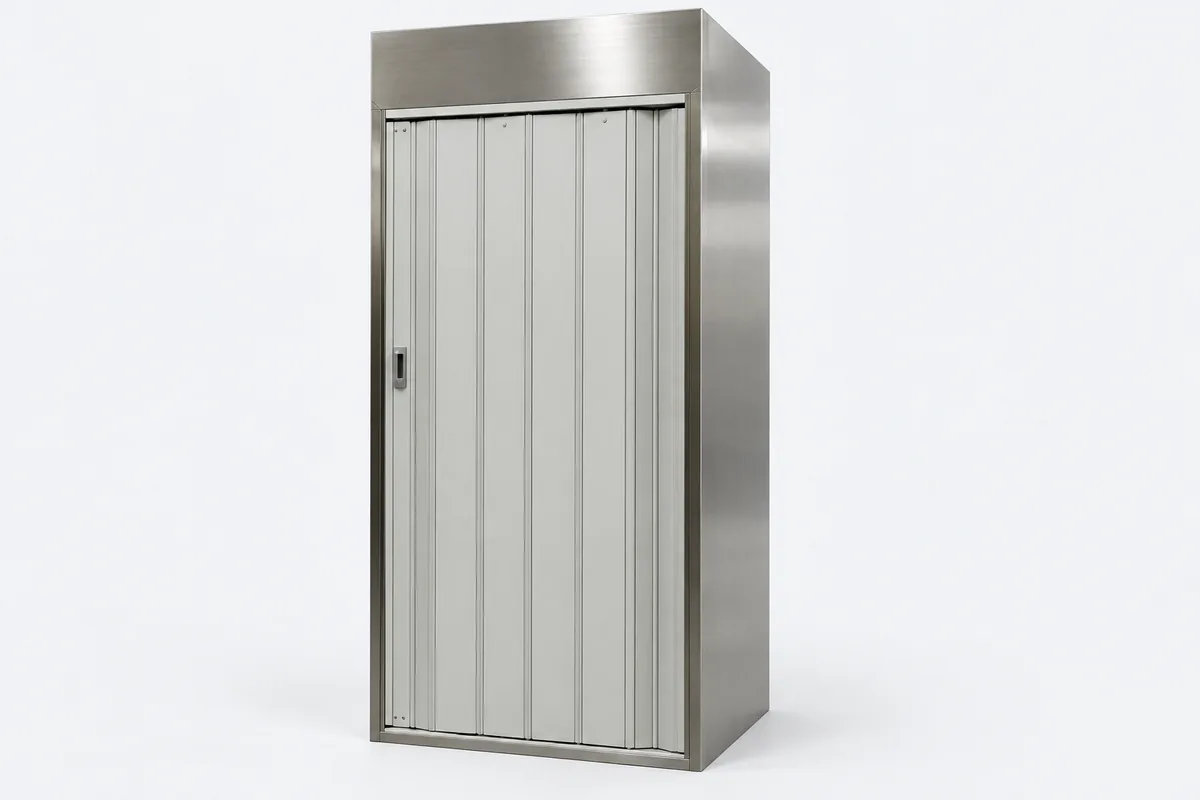
An ordinary pedestal safety shower and eyewash is open: during showering, water splashes in all directions, carrying the chemicals washed off the body onto nearby equipment and people, and water pools on the floor. The enclosure design surrounds the shower area and collects the waste water, so the surroundings are not affected. Another often overlooked reason is privacy. When chemicals splash onto the body, the correct response is to remove contaminated clothing while flushing; in an open space, many people shorten the flushing time or keep their clothes on out of embarrassment, leaving the chemical in contact with the skin. An enclosure lets the user concentrate on flushing.Who requires it, and under which standards
In the US, OSHA 1910.151(c) requires facilities for immediate flushing within the work area where a person's eyes or body may be exposed to corrosive materials. For the performance of the equipment itself, the most widely cited US standard is ANSI/ISEA Z358.1-2014 (reaffirmed in 2020); in Europe it is the EN 15154 series, with new editions of parts -1 and -2 published in 2025. In mainland China, the mandatory national standard GB 38144-2025 took effect on 2026-09-01, and the former recommended standards GB/T 38144.1-2019 and GB/T 38144.2-2019 were withdrawn at the same time. Equipment for plants in China or shipped to China should follow GB 38144-2025.Values commonly cited from ANSI Z358.1
The table below follows US university health and safety offices' summaries of ANSI/ISEA Z358.1 and is for planning and acceptance reference; for formal acceptance, the original standard governs.| Item | Eyewash | Safety shower |
|---|---|---|
| Minimum flow | 1.5 L/min (0.4 gpm) | 75.7 L/min (20 gpm) |
| Flushing duration | 15 minutes | 15 minutes |
| Time to reach | Within 10 seconds | Within 10 seconds |
| Water temperature | Tepid, about 16–38°C | Tepid, about 16–38°C |
| Activation test | Weekly | Weekly |
| Full inspection | Annually | Annually |
Water pressure, quality and temperature
Water pressure: with too little pressure, the shower flow falls short of the requirement; with too much, the eyewash stream is too strong and can cause further injury to the eyes. 0.2–0.8 MPa is the design range; if the site pressure falls outside it, a pressure-regulating valve must be added. Water quality: use a clean or filtered water source. Flushing eyes with unfiltered industrial water drives the particles in the water straight onto the cornea. Water temperature: the tepid range in the table is there so that people can bear to keep flushing: if the water is too cold, users will leave before reaching 15 minutes. Outdoor or cold winter locations can add the freeze protection option, and the piping should be insulated as well.Acceptance and routine maintenance
Installation acceptance: measure the eyewash and shower flows, the site water pressure and the outlet temperature, and walk the route once from the farthest work position to confirm the time to reach the unit and that no doors or obstacles block the way. Weekly activation: run water to flush out water standing in the pipes, and confirm the valves open freely. Annual inspection: carry out a full functional inspection according to the standard and keep records. Drainage: flushing waste water contains the chemicals washed off, so the bowl and enclosure drains must connect to the corresponding waste water system in the plant, not directly to stormwater drains.Frequently Asked Questions
The specification says maximum flow 114 L/min. Is the shower flow always sufficient?
Not necessarily; it depends on the site water pressure. 114 L/min is the maximum within the 0.2–0.8 MPa design pressure range; according to US university summaries of ANSI/ISEA Z358.1, the minimum safety shower flow is 75.7 L/min (20 gpm) for 15 minutes. If the supply pipe is too small, or other outlets on the same line are opened at the same time, the actual flow may fall below the requirement. At acceptance, measure the shower and eyewash flows on site and confirm that the pressure does not drop over the full 15 minutes.
Where should the waste water from an enclosed eyewash be connected?
To the corresponding chemical waste water system in the plant, not to stormwater drains or ordinary domestic sewage. What is washed off during showering is exactly the chemical that splashed onto the body; at 75.7 L/min for 15 minutes, one incident produces about 1,100 litres of waste water. During planning, confirm that the drain pipe size can keep up with the shower flow so that the bowl does not overflow; if the work area has incompatible chemicals, also assess the risk of the waste water mixing in the pipework.
Our plant is in mainland China. Which standard applies to the safety shower and eyewash?
GB 38144-2025. This is a mandatory national standard in force from 2026-09-01, and the former recommended standards GB/T 38144.1-2019 and GB/T 38144.2-2019 were withdrawn at the same time; old specifications or acceptance forms that still cite the 2019 editions need updating. Equipment exported to the US is commonly accepted against ANSI/ISEA Z358.1-2014 (reaffirmed 2020), and in Europe against the EN 15154 series; where one unit must meet several regions at once, plan to the most stringent requirement for each item.
Selection References
Before ordering, verify the efficiency grade, media type, and whether the operating environment fits your requirements.