PVC Softwall Partition (Cleanroom Softwall Enclosure / Anti-Static Grid Curtain)
Product Overview
Features & Specifications



Detailed Description
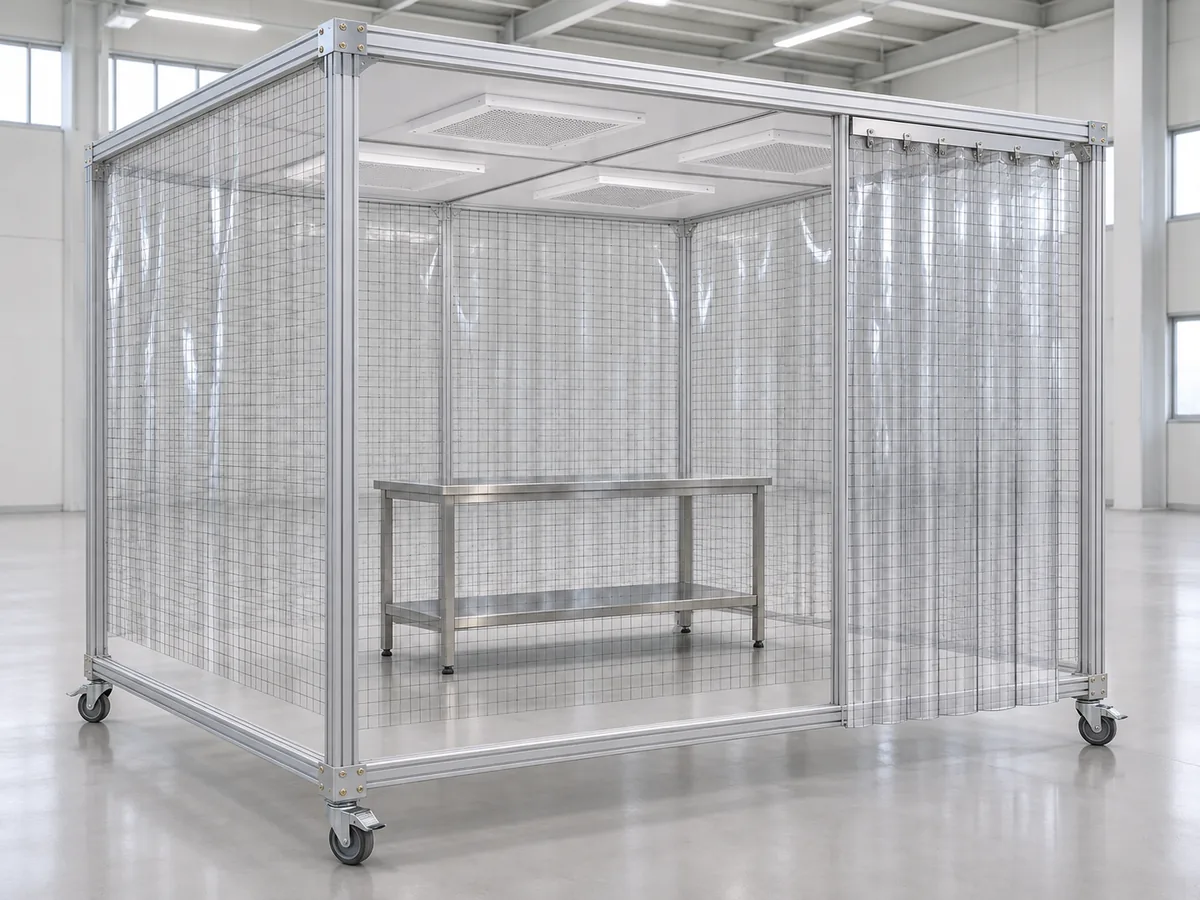
How to choose a softwall partition: floor-standing, ceiling-hung and frame material
First decide whether the frame stands on the floor or hangs from the ceiling, then choose the material according to how it will be cleaned. The table below shows the differences between the three models.| Model | Frame | Advantages | Suitable for |
|---|---|---|---|
| BS-SW-A | Aluminium extrusion 40×40 mm / 40×80 mm | Light, easy to assemble, castors can be added for moving | Electronics assembly and test areas that are often reconfigured |
| BS-SW-S | SUS304 square tube | Withstands repeated wiping and disinfection, rust-free | Biotech, pharmaceutical and food clean areas |
| BS-SW-H | Curtains hung from ceiling rails | Floor kept clear, no floor space used | Area separation and equipment enclosures inside large cleanrooms |
Anti-static grid curtain specifications: thickness, grid and surface resistance
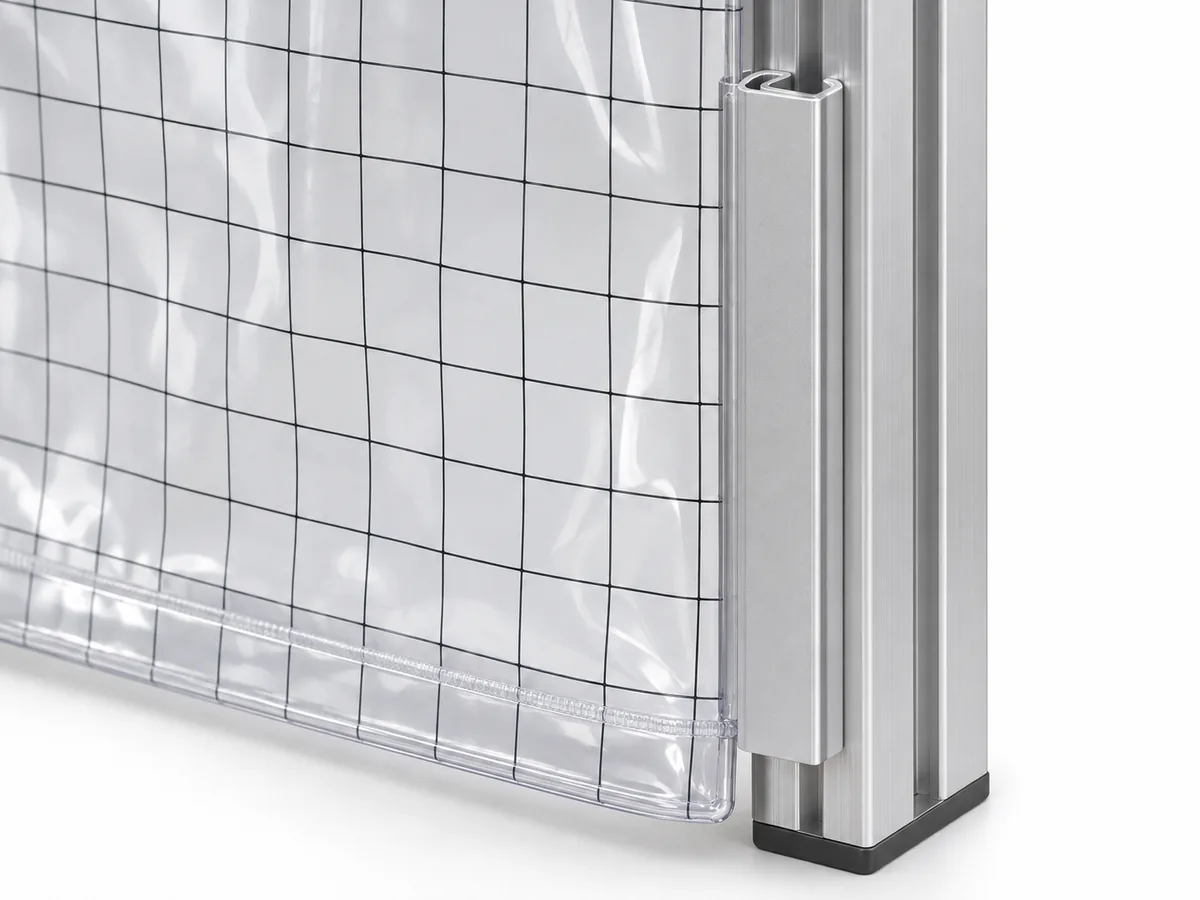
The curtain comes in two thicknesses, 0.3 mm and 0.5 mm, with a roll width of 1.37 m; 0.5 mm is stiffer and less easily moved by airflow, and is recommended for large enclosures. The black conductive carbon ink grid is printed on one side, the grid side has lower resistance than the non-grid side, and charge drains through the grounded frame.| Item | Anti-static grid curtain | Clear curtain without grid |
|---|---|---|
| Thickness | 0.3 mm / 0.5 mm | 0.3 mm / 0.5 mm |
| Surface resistance | Grid side 1×10⁶–1×10⁹ Ω, non-grid side 1×10⁹–1×10¹¹ Ω | Depends on formulation; specify the anti-static type separately |
| Visibility | See-through, grid lines visible | Clearest view |
| Applications | Electronics, semiconductor, ESD protected areas | Food, pharmaceutical, general area separation |
Softwall partition with FFUs: what class can a softwall clean booth reach?
With FFUs installed on top, a softwall partition becomes a softwall clean booth, and its class depends on both the number of FFUs and the tightness of the curtains. With FFUs covering the whole ceiling and an outlet face velocity of 0.45 m/s ±20%, ISO 5 can be planned; with only a few units used for local air exchange, ISO 7–ISO 8 is typical.| Target class (ISO 14644-1) | FFU layout | Curtains |
|---|---|---|
| ISO 5 | FFUs cover the whole ceiling, vertical unidirectional flow | Enclosed on four sides, overlapping strip curtain at the entrance |
| ISO 6–ISO 7 | FFUs cover about half the ceiling or more | Enclosed on four sides |
| ISO 8 | A few FFUs for air exchange, maintaining positive pressure | Curtains can stop higher above the floor |
Softwall partition vs hard partition and Clean Booth
A softwall partition is low cost, quick to install and relocatable, but its sound insulation, thermal insulation and impact resistance are all inferior to a hard partition. For a complete local clean unit with FFUs and a workbench, see Baisheng's Clean Booth; if you only need enclosure and separation, a softwall partition is enough.| Comparison | PVC softwall partition | Light-gauge steel / sandwich panel hard partition |
|---|---|---|
| Installation | Frame bolted together and curtains fixed, done in a few days | Requires setting out, construction and finishing |
| Moving and modification | Can be dismantled and reassembled; aluminium frames can have castors | Scrapped when removed |
| Sealing and sound insulation | Relies on overlap and clamping strips; limited sound insulation | Better sealing, sound and thermal insulation |
| Suitable for | Local clean areas, equipment enclosures, frequently changed lines | Long-term fixed cleanrooms |
Frequently Asked Questions
Can a PVC softwall partition be used without FFUs?
Yes. When you only need area separation to block dust and air exchange, a softwall partition can be used without FFUs; the ceiling-hung BS-SW-H is often used to enclose equipment or maintenance areas inside large cleanrooms. FFUs on top are needed only to create a clean area, with the class planned according to FFU coverage and curtain tightness.
Should I choose a 0.3 mm or 0.5 mm anti-static grid curtain?
Choose 0.5 mm for large enclosures, heights over 2.5 m, or locations near air-conditioning outlets, as it is stiffer and less easily blown about; 0.3 mm suits small work areas or positions where the curtain is rolled up for storage. For both thicknesses, the grid side has a surface resistance of 1×10⁶–1×10⁹ Ω.
Should the softwall curtain touch the floor?
A softwall partition with FFUs should not touch the floor: leave an exhaust gap of about 50–150 mm at the bottom edge so air inside flows out and positive pressure is maintained. Without FFUs, used only for separation, the curtain can come down close to the floor to reduce dust flow underneath.
Selection References
Before ordering, verify the efficiency grade, media type, and whether the operating environment fits your requirements.