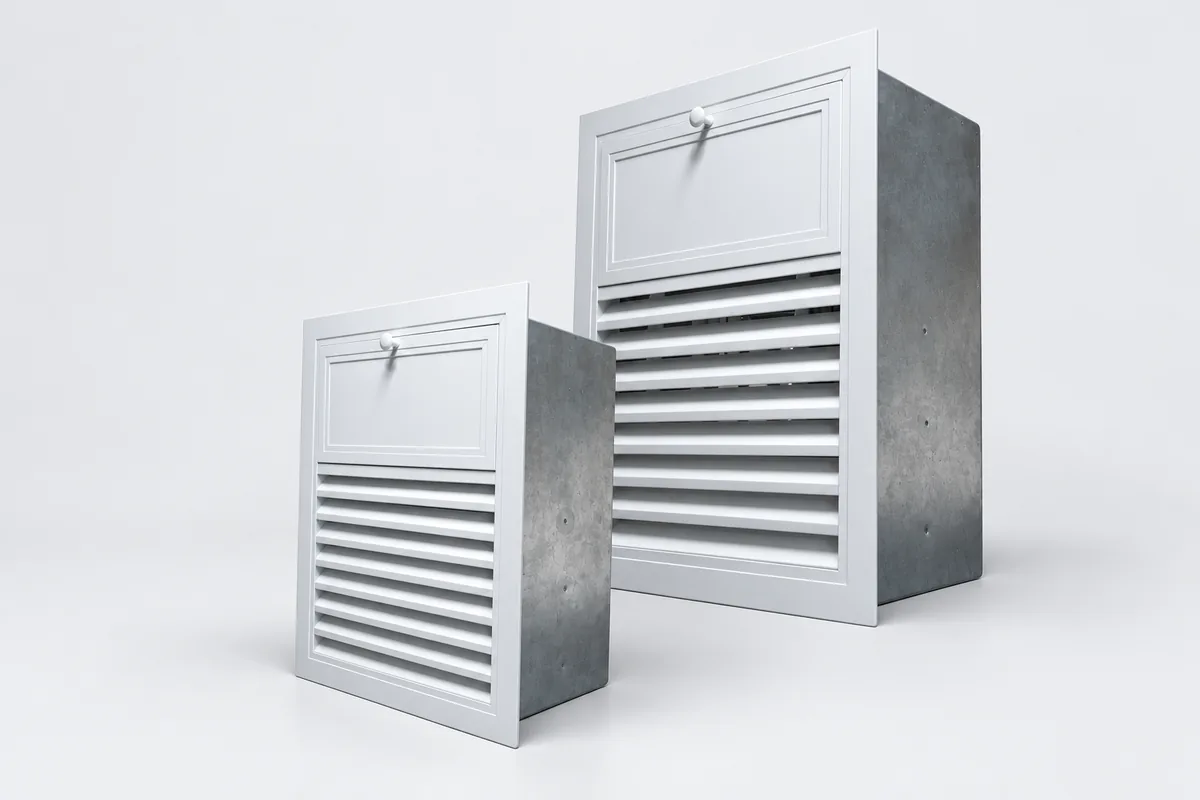
Pressure Relief Damper
Product Overview
Key Specifications
- Opening Pressure
- 10–50 Pa adjustable, set to suit the room pressure design
- Structure
- Gravity-balanced or spring-balanced
- Power Supply
- No power required (passive)
- Mounting Orientation
- Horizontal or vertical (must be specified)



Specifications
- Blade Material
- Aluminum alloy or stainless steel
- Frame
- Extruded aluminum / stainless steel SUS304 / galvanized steel
- Gasket
- EPDM or silicone (food/pharmaceutical grade)
- Structure
- Gravity-balanced or spring-balanced
- Opening Pressure
- 10–50 Pa adjustable, set to suit the room pressure design
- Leakage Rate
- Specified at inquiry as an EN 1751:2024 leakage class (1–4)
- Power Supply
- No power required (passive)
- Standard Dimensions
- From 200×200 mm up to 1000×1000 mm (custom available)
- Mounting Orientation
- Horizontal or vertical (must be specified)
- Certification
- Test methods: AMCA 500-D-18 / EN 1751:2024
Detailed Description
Pressure design comes first, then the relief damper
The damper setting comes from the room's pressure differential design. Regulatory requirements for pressure differentials between adjacent rooms are as follows:| Source | Requirement |
|---|---|
| EU GMP Annex 1 (2022) §4.14 | At least 10 Pa between adjacent rooms of different grades (guidance value) |
| US FDA 2004 aseptic processing guidance | 10–15 Pa; at least 12.5 Pa when adjacent to unclassified areas |
| China GMP (2010 revision) Article 48 | Not less than 10 Pa between clean areas of different grades |
How to set the opening pressure
The principle is: above the design differential in normal operation, below the differential that would cause problems. Set too low, the damper is pushed open in normal operation and the room never builds up its design differential; set too high, it is as if it were not installed at all. For example, for a room with a design differential of 15 Pa, the opening pressure should be set above 15 Pa with a margin for normal fluctuations, so that the damper opens only when an adjacent door is shut, the air conditioning switches over or the exhaust suddenly stops. This product's opening pressure is adjustable between 10 and 50 Pa; in a cascade of rooms, each damper must be set individually according to the design differential across its own wall, not all to the same value.Gravity type and spring type
Gravity-balanced: uses counterweights to keep the blades closed; simple and stable in operation, but the counterweight is calculated for the mounting orientation, so the versions for a wall (vertical) and for a ceiling or horizontal duct section differ, and if it is mounted the wrong way it will not open at the set point. Spring-balanced: uses spring tension; the set point is adjusted with the spring. Both are passive and need no power, so the mounting orientation must be specified when ordering and the airflow direction marking confirmed: dampers on positive-pressure rooms open outward, while dampers on negative-pressure isolation rooms open from outside inward when the room becomes excessively negative.Closed leakage should be discussed in terms of class
Leakage through a closed damper counts toward the room's total leakage and directly affects the supply airflow needed to maintain the pressure differential. When comparing products, note that AMCA 500-D-18 is a laboratory test method for dampers and sets no pass threshold itself, while the European EN 1751:2024 divides leakage into class 1–4. A single percentage without a test method, test pressure and size cannot be compared. At enquiry, specify the leakage class and test method required and ask for the corresponding test data.How to determine the size
Sizes run from 200×200 mm up to a maximum of 1000×1000 mm, and the size chosen depends on how much air must be relieved: at the set opening pressure, the damper must pass the excess airflow in the worst case, for example the moment an adjacent door is shut or an exhaust fan suddenly stops and all the supply air stays in the room. At enquiry please provide four items: the room design differential, the estimated maximum airflow to be relieved, the mounting orientation, and the environment on each side of the damper (clean area, corridor or return air plenum); size and blade configuration are calculated from these. If one opening is not enough, several dampers can be installed in parallel.Materials and routine inspection
In cleanroom locations that are frequently wiped and disinfected, choose SUS 304 for frame and blades; extruded aluminium or galvanised steel can be used in general air-conditioned areas. Seals are available in EPDM or silicone, with silicone suited to applications requiring food and pharmaceutical grade materials. The most common problem with passive components is "sticking": blades jammed by dust, tape or debris from later construction work, which is not noticeable in normal operation and is discovered only when the pressure differential goes abnormal and the damper fails to act. It is advisable to check visually that the blades swing freely and the seals are intact during routine pressure differential checks.Frequently Asked Questions
What opening pressure should a pressure relief damper be set to?
It depends on the room's pressure design; there is no fixed value. The principle is to set it above the design differential in normal operation with a margin for fluctuation, so the damper stays closed normally and opens only when the differential momentarily gets too high, such as when a door is shut or the air conditioning switches over. For the basis of the design differential itself, see EU GMP Annex 1 §4.14 (at least 10 Pa), FDA 2004 (10–15 Pa) or China GMP Article 48 (not less than 10 Pa). This product's opening pressure is adjustable between 10 and 50 Pa.
What should I look at when comparing the leakage rates of pressure relief dampers?
Look at the test method, test pressure and size, not a single percentage. AMCA 500-D-18 is a laboratory test method for dampers and sets no pass threshold itself; the European EN 1751:2024 divides closed leakage into class 1–4. Leakage figures that do not state the method and conditions cannot be compared. At enquiry, specify the required leakage class and test method and ask for test data according to that method.
Can a gravity-type pressure relief damper be mounted horizontally in a ceiling?
Yes, but you must order the horizontal-mounting version. A gravity-balanced damper uses counterweights to keep the blades closed below the set pressure, and the counterweight is calculated for the mounting orientation; if a vertical version is mounted horizontally, the opening pressure will deviate from the set value, and the damper may not even close again. The mounting orientation (horizontal or vertical) must therefore be specified when ordering; if the installation position may change later, confirm with the supplier at the time of ordering whether the model can be reoriented and its set point readjusted.
Selection References
Before ordering, verify the efficiency grade, media type, and whether the operating environment fits your requirements.