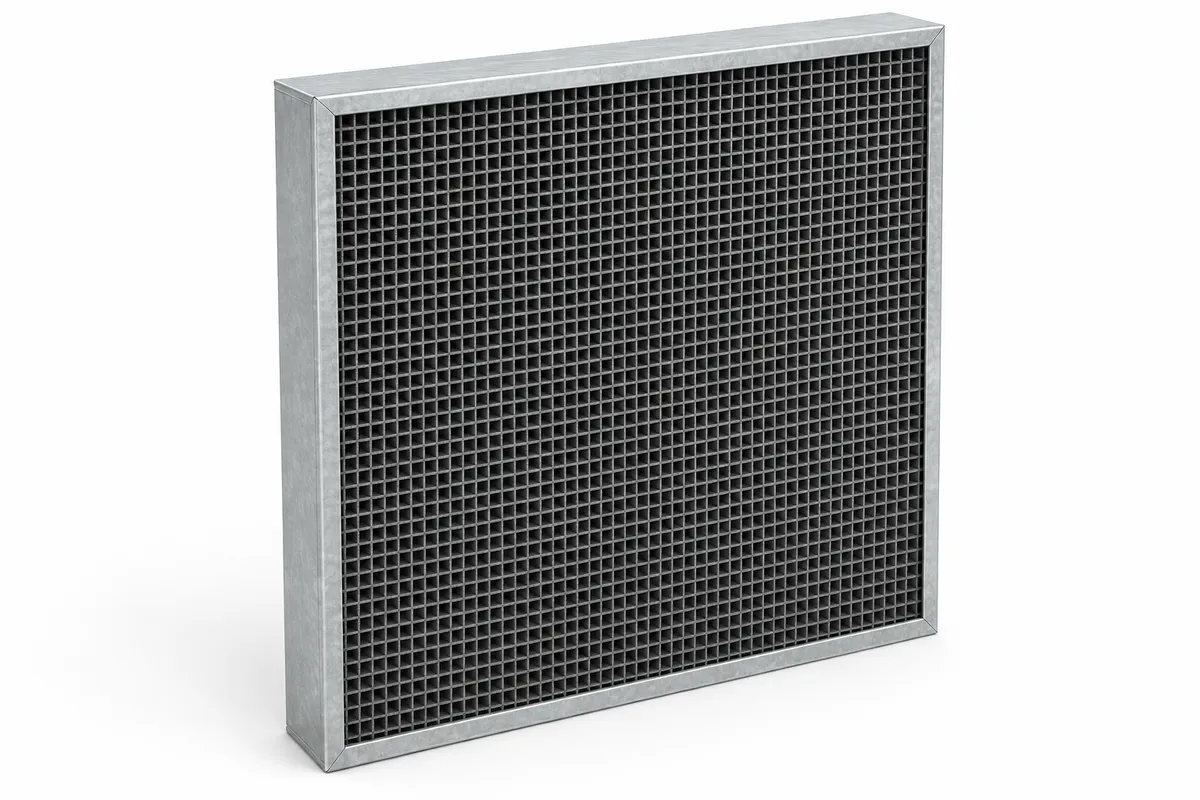
Extruded Honeycomb Block Chemical Filter (2", 4", 6")
Product Overview
Features & Specifications



Detailed Description
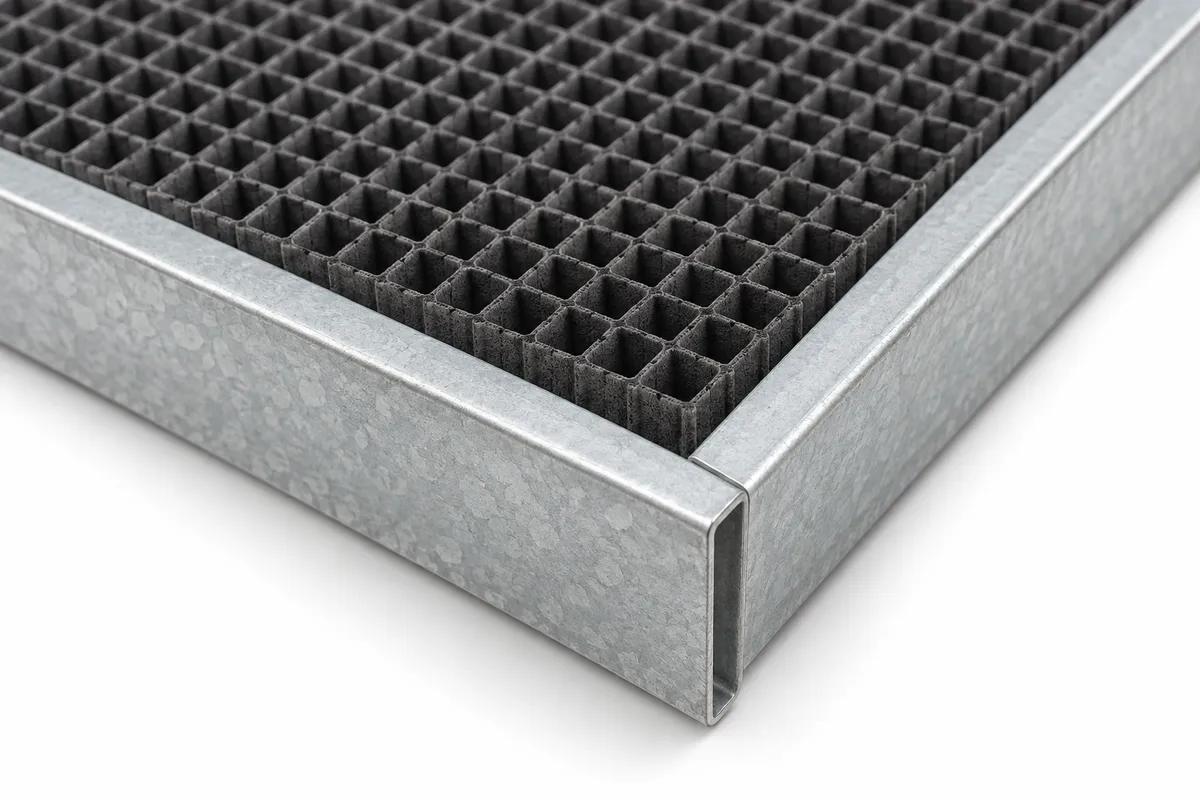
How does a honeycomb block differ from a paper honeycomb packed with carbon?
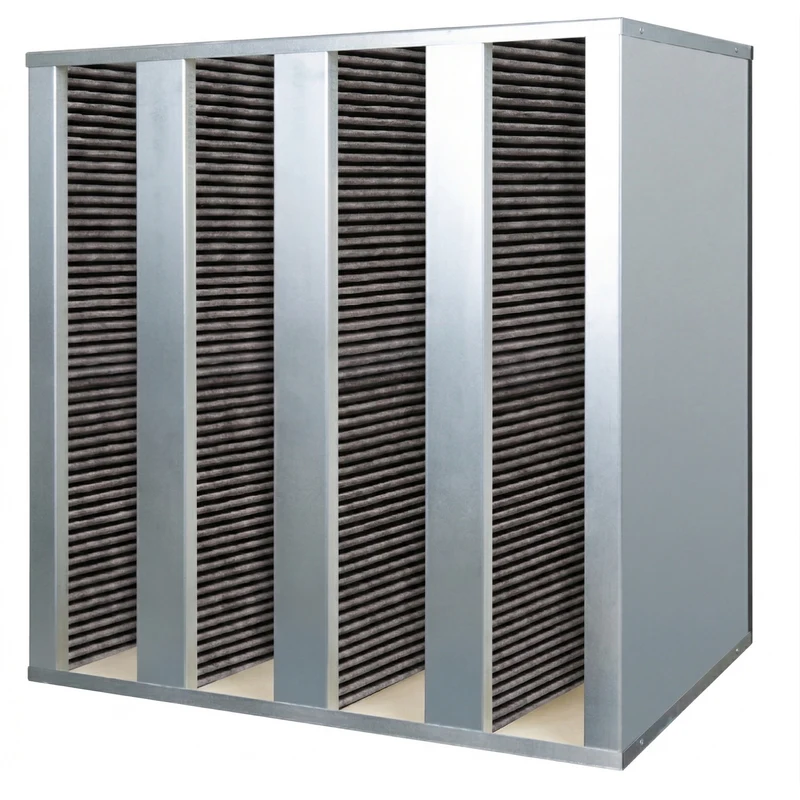
The difference is the media itself: in the block type the honeycomb walls are the adsorbent, whereas in the packed type the paper cells are only a container for carbon granules. The block type has no settling or dust shedding and its straight channels give a low pressure drop; the packed type offers more flexible formulations at lower cost. Choose the block type where low pressure drop and no shedding matter (data centres, archives, downstream of FFUs); for general exhaust deodorising, the packed "honeycomb activated carbon / CPZ filter" is sufficient.Standard sizes and airflow
Standard sizes follow North American pleated-filter dimensions: five face sizes in 2 in and 4 in depth, and one in 6 in depth; other sizes can be made to order. Rated face velocity is 2.5 m/s, and airflow scales with face area. The table shows approximate values at 2.5 m/s.| Nominal size (in) | Approx. size (mm) | Airflow at 2.5 m/s (m³/h) |
|---|---|---|
| 24×24 | 610×610 | 3,400 |
| 20×25 | 508×635 | 2,950 |
| 20×20 | 508×508 | 2,360 |
| 16×20 | 406×508 | 1,890 |
| 12×24 | 305×610 | 1,700 |
| 14×14 (6 in only) | 356×356 | 1,160 |
2 in, 4 in or 6 in: which depth?
Deeper means more media and longer life, but also higher pressure drop. If the existing track is 2 in, choose BS-HCF-2 as an upgrade of the particulate filter slot; with a 4 in track or higher contaminant levels choose BS-HCF-4; BS-HCF-6 is for small housings and laboratory exhaust where a long residence time is needed. The pressure drops below are typical values for same-class honeycomb block filters at 2.5 m/s; measured values for this product are given in the shipping data sheet.| Model | Typical initial pressure drop at 2.5 m/s | Recommended use |
|---|---|---|
| BS-HCF-2 (2 in) | about 70 Pa | Upgrade of existing 2 in tracks, FFUs, office and hospital IAQ |
| BS-HCF-4 (4 in) | about 145 Pa | 4 in tracks, data centres and control rooms, higher-concentration outdoor air |
| BS-HCF-6 (6 in) | about 240 Pa | Small housings, laboratory exhaust, applications needing long residence time |
Which media can be specified?
Select the formulation by the target gas: plain activated carbon for VOCs, ozone and general odours, impregnated media for acid gases or ammonia, and blends for several gases at once. The usual operating envelope for dry chemical media is ≤ 50°C and ≤ 90% RH (non-condensing); for unusual conditions, send us the details before selection.| Media option | Target gases | Typical locations |
|---|---|---|
| Plain activated carbon | VOCs, ozone, odours | Offices, hospitals, copy and print areas, FFUs |
| Impregnated (acid gases) | H₂S, SO₂, NO₂ | Data centres, control rooms, outdoor air near traffic or industry |
| Impregnated (alkaline gases) | NH₃, amines | Semiconductor facilities, laboratories, livestock and wastewater surroundings |
| Blended | Mixed gases | Museums and archives, general indoor air quality improvement |
Where is it used?
Data centres and control rooms use it to bring corrosive gases down to ISA-71.04-2013 class G1 (copper corrosion <300 Å, silver <200 Å per 30 days) to protect circuit boards; museums and archives use it to block acid gases and ozone that age artefacts and paper; semiconductor facilities and FFU downstream positions use it as a low-pressure-drop AMC chemical stage; offices, hospitals and copy or print areas use it for ozone and odour removal. For high-concentration exhaust or where a large, refillable carbon mass is needed, see the packed activated carbon filter instead.Frequently Asked Questions
My AHU has 2-inch filter tracks. Do I need to modify the housing?
No. BS-HCF-2 has the same outer dimensions as a standard 2-inch pleated filter (for example 24×24×2 in), so you simply pull the particulate filter and slide this one in. Note that a chemical filter does not capture particles, so keep a prefilter upstream.
How much higher is the pressure drop than my pleated filter?
A same-class 2-inch honeycomb block filter typically has an initial pressure drop of about 70 Pa at 2.5 m/s, and a 4-inch about 145 Pa, which is higher than a typical prefilter but lower than a packed activated carbon filter. Check fan reserve before retrofitting; measured values for this product are given in the shipping data sheet.
How is it different from your honeycomb activated carbon / CPZ filter?
The CPZ filter packs carbon granules into paper honeycomb cells, which allows flexible formulations at lower cost; this product is one extruded adsorbent block with no loose granules, so there is no settling or shedding and the pressure drop is lower. Choose the block type where shedding or pressure drop matters, and CPZ for general exhaust deodorising.
Can it directly replace an overseas brand honeycomb block filter?
Standard sizes, rated face velocity and depth ratings correspond to international same-class products, so match the model by the nominal size and depth of the existing filter. Send us the existing filter dimensions and the target gases, and we will confirm the formulation and provide a data sheet.
How often does it need replacing?
Service life depends on contaminant concentration, airflow and depth, so there is no fixed number of months. Common practice is to sample the media periodically for remaining capacity, or in data centres to pair it with corrosion coupons and a real-time corrosion monitor and replace when readings approach the limit.
Selection References
Before ordering, verify the efficiency grade, media type, and whether the operating environment fits your requirements.