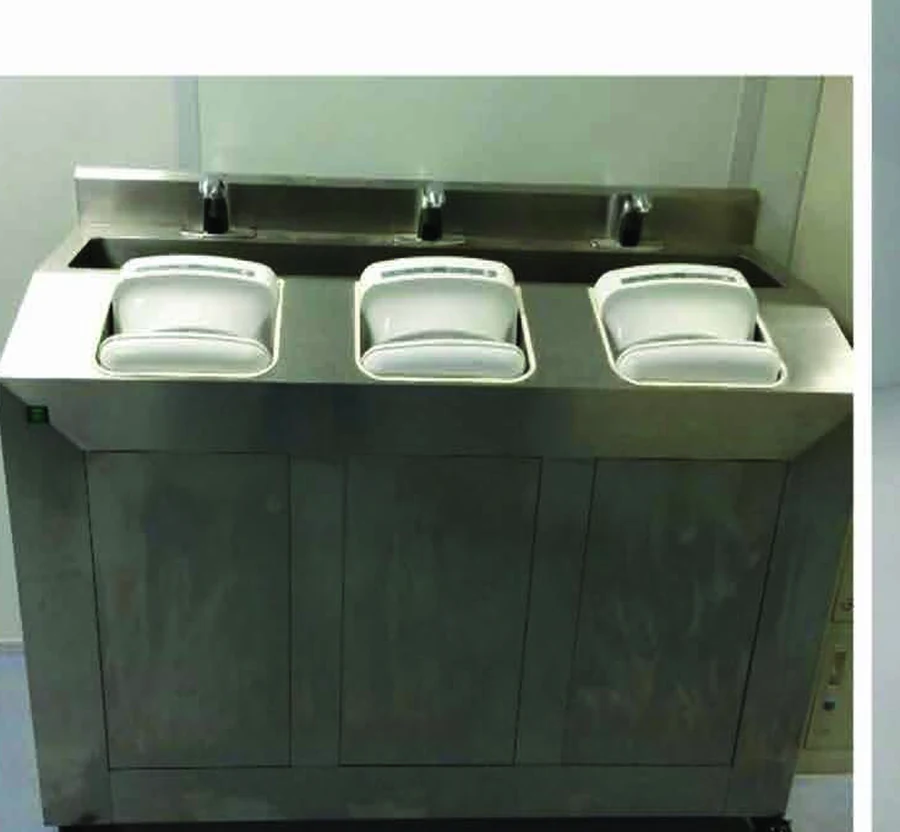
Cleanroom Equipment
Automatic Hand Wash and Dryer Unit
Product Overview
The automatic hand wash and dryer unit combines washing and drying in one machine installed at the entrance to the cleanroom gowning area. It supplies purified water and detergent for operators to wash their hands, then dries them with a temperature-controlled high-velocity air stream filtered through a HEPA filter, so that neither moisture nor contamination is carried onto cleanroom garments or into the cleanroom.
Water is released by photoelectric sensor and the sequence is fully programmed by microprocessor, so no switch has to be touched at any point. That is the fundamental difference from a washbasin plus a hand dryer: once the hands are clean they never touch a surface that the previous person handled.
Features & Specifications
►Overall dimensions: W520 × D500 × H1700 mm
►Material: SUS 304 stainless steel, 1.2mm hairline finish
►Cleanliness: CLASS 100 (ISO CLASS 5)
►Filtration efficiency: ≥99.99% (dust ≥0.3μm)
►Air velocity: ≥27 m/s
►Warm air temperature: 40~60℃
►Control: fully automatic microprocessor sequence
►Water supply: photoelectric sensor
►Drying system: electrically heated warm air
►Power supply: 220V/50Hz (380V/50Hz also available)|Rating: 2KW
►Option: automatic soap dispenser



Detailed Description
Why the drying air is filtered
An ordinary hand dryer blows unfiltered room air. Hands that have just been washed are still wet, and blowing unfiltered air onto them deposits airborne particles straight onto the wettest surface available. Here the drying air passes through a HEPA filter to Class 100 before it leaves the nozzle, so hands come away dry and clean. Hand washing is the first step of the gowning sequence, before anyone enters the gowning area; if that step is compromised, everything achieved afterwards by gowning is discounted. The ≥27 m/s velocity exists to shorten drying time. Gowning areas queue up at shift change, and slow drying is a direct cause of people skipping the procedure.What touch-free actually buys
Water comes on by photoelectric sensor and the cycle runs under microprocessor control, so there is no switch anywhere in the sequence that has to be pressed. This is a contamination-control decision rather than a convenience one. If a drying button had to be pressed after washing, that button would be the dirtiest point in the whole sequence, because every unwashed hand has touched it. Touch-free removes the cross-contamination point entirely. The same logic applies to the automatic soap dispenser option: the lever of a manual dispenser is another surface contacted with unwashed hands.Selection References
Before ordering, verify the efficiency grade, media type, and whether the operating environment fits your requirements.