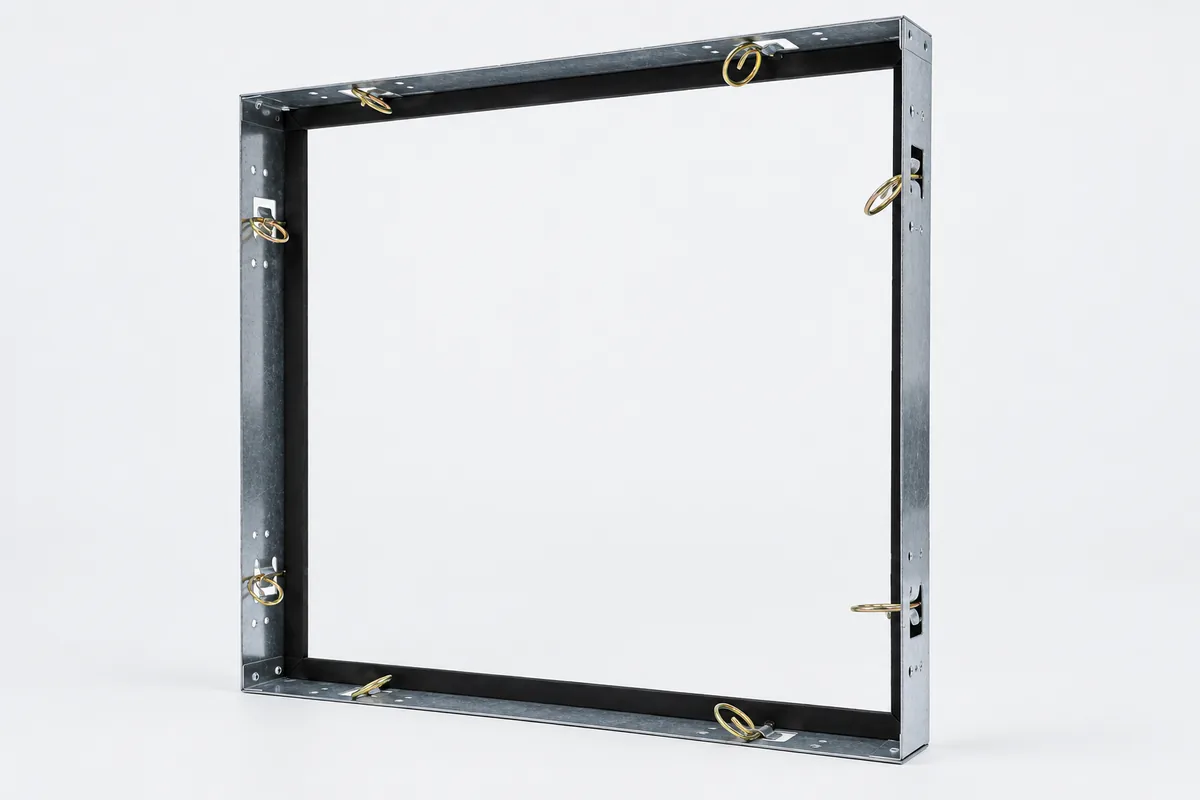
Air Filter Holding Frame
Product Overview
Key Specifications
- Compatible Filters
- HEPA H13 / H14、ULPA U15 / U16 / U17
- Sealing Type
- Gel seal / gasket / knife edge
- Depth
- 50 / 66 / 90 / 150 mm (custom available)
- Max. Operating Temperature
- Standard type ≤ 80°C; high-temperature type up to 250°C with high-temperature sealant



Specifications
- Frame
- Aluminum alloy / stainless steel SUS304 / SUS316 / galvanized steel
- Surface Finish
- Powder coating / electropolished (BA) / anodized
- Sealing Type
- Gel seal / gasket / knife edge
- Structure
- Clamp, bolted or spring-clip fastening
- Compatible Filters
- HEPA H13 / H14、ULPA U15 / U16 / U17
- Standard Dimensions
- 610×610, 610×1220, 1220×1220 mm (custom available)
- Depth
- 50 / 66 / 90 / 150 mm (custom available)
- Max. Operating Temperature
- Standard type ≤ 80°C; high-temperature type up to 250°C with high-temperature sealant
- Mounting Orientation
- Upstream or downstream face (must be specified)
- Lead Time
- 2–3 weeks for custom builds
Detailed Description
Filter efficiency is only realised with a sound edge seal
Grades such as H13, H14 and U15–U17 come from the European EN 1822-1:2019 and are measured on the filter itself. Once the filter is installed in a system, the downstream side is also affected by edge bypass: air always takes the path of least resistance, the resistance of the media is far higher than that of a gap, and if the edge is not properly sealed, part of the airflow bypasses the media and goes straight downstream. A 2022 technical bulletin from the US NIH puts it bluntly: a gel seal can eliminate bypass at the filter edge; the leak limit after installation is 0.01% of the upstream concentration, and under IEST-RP-CC034.5 the total repaired area must not exceed 3% of the filter area. The quality of a holding frame ultimately comes down to whether the installed filter passes this scan.Choosing between gasket, gel and knife edge
The US Department of Energy's DOE-HDBK-1169-2003 §6.2.1 notes that a gasket seal is reliable only when compressed sufficiently and evenly; a gel seal inserts a knife edge into non-flowing silicone gel, with far less demanding requirements for clamping force and tolerance.| Seal type | How it seals | Frame flatness and clamping force | Suitable for |
|---|---|---|---|
| Gasket | The compressed gasket fills the gap | Demanding; leaks if compression is insufficient or uneven | General air handling units, cost priority, infrequent replacement |
| Gel channel | Knife edge inserted into non-flowing silicone in the channel | Less demanding | Applications with leak scanning and periodic retesting |
| Knife edge | Knife edge on the frame inserted into the gel channel on the filter | Less demanding | Systems where the filter itself carries the gel channel |
Frame material and surface treatment follow the environment
The NIH bulletin recommends fully welded stainless steel or aluminium filter housings. The frame material depends on the environment: Aluminium alloy: light and easy to fabricate, the most common choice for ceilings and air handling units; can be anodised. SUS 304: corrosion-resistant and withstands repeated wiping and disinfection; suits pharmaceutical and food clean areas. SUS 316: contains 2–3% more molybdenum than 304, giving better resistance to chloride pitting; suits applications using chlorine-based disinfectants or exposed to coastal salt spray. Galvanised steel: lowest cost, suits dry general air handling units; can be powder-coated. Electropolishing (BA) is an optional surface treatment, but there is currently no authoritative specification requiring cleanroom components to be electropolished; whether it is needed should be decided by the cleaning method and the user's specification.Upstream or downstream face
Whether the holding frame is mounted on the upstream (air inlet) side or the downstream (air outlet) side of the filter determines the clamp positions, the direction the sealing face points and from which side the filter is changed, so it must be specified when ordering. When planning, first decide where the person changing filters will stand, on the clean area side or on the air handling unit or plenum side, and then work back to the mounting orientation.Size and thickness must match the filter
The standard sizes of 610×610, 610×1220 and 1220×1220 mm correspond to common filter frame sizes, and the thicknesses of 50 / 66 / 90 / 150 mm correspond to filter frame depths. The holding frame is made to suit the filter, not the other way round, so confirm the filter's frame size, frame depth and seal end type first, then order the holding frame. High-airflow air handling sections combine several holding frames into a filter bank; in that case the joints between frames, and the perimeter seal between the whole bank and the duct wall, are also leak paths and must be included in design and testing.Limits of the high-temperature type
The standard type is rated for ≤80°C, and the high-temperature type with high-temperature sealant can reach 250°C. Note that the temperature rating of the assembly is set by its weakest component: if the holding frame withstands 250°C, the filter frame, media and adhesive also need a matching temperature rating. At enquiry, please provide both the continuous operating temperature and the maximum temperature that may occur.Frequently Asked Questions
Should a filter holding frame use a gasket seal or a gel seal?
It depends on whether leak scanning will be done. DOE-HDBK-1169-2003 §6.2.1 notes that a gasket must be compressed sufficiently and evenly to be reliable, and frame flatness, clamp torque and gasket ageing all affect the result; a gel seal inserts a knife edge into non-flowing silicone and is far less demanding on clamping force and tolerance, and the NIH 2022 technical bulletin also notes that it can eliminate edge bypass. Choose gel for clean areas with leak scanning and periodic retesting; choose gasket for general air handling units where cost comes first.
Does the filter need a leak test once it is fitted in the holding frame? What is the criterion?
Testing is recommended. Under IEST-RP-CC034.5, as cited in the NIH 2022 technical bulletin, the leak limit for post-installation scanning is 0.01% of the upstream concentration, and the total repaired area must not exceed 3% of the filter area. Leaks often occur between the holding frame and the filter, so this test is really verifying the frame and seal; if a leak is found all the way around the frame, check the gasket compression or gel channel first rather than replacing the filter straight away.
Can a high-temperature holding frame be used with an ordinary HEPA filter?
No. A high-temperature holding frame with high-temperature sealant can be used up to 250°C, but the temperature rating of the assembly is set by its weakest component, and the frame, media bonding and sealing materials of an ordinary HEPA filter are not designed for high temperatures. A high-temperature section needs a filter with the same temperature rating; if the operating temperature is below 80°C, the standard type is sufficient and there is no need to pay extra for the high-temperature type.
Selection References
Before ordering, verify the efficiency grade, media type, and whether the operating environment fits your requirements.