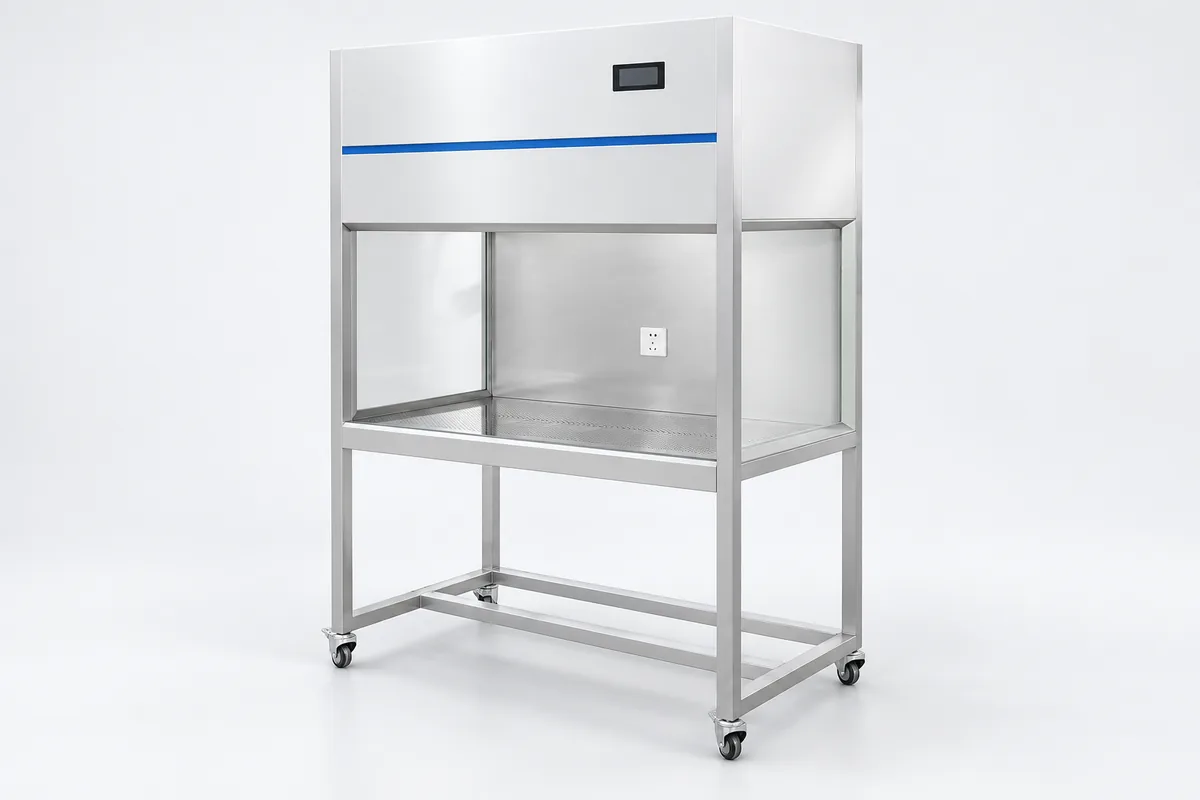
Clean Bench
Product Overview
Key Specifications
- Cleanliness Class
- ISO 5 @ ≥0.5 μm (ISO 14644-1; formerly Class 100)
- Face Velocity
- 0.3–0.6 m/s, eight-step push-button adjustment (equipment range)
- Noise Level
- ≤ 62 dB
- Power Supply
- AC 220V / 50Hz



Specifications
- Body Material
- Mirror-finish stainless steel worktop; cold-rolled steel housing with electrostatic powder coating
- Cleanliness Class
- ISO 5 @ ≥0.5 μm (ISO 14644-1; formerly Class 100)
- Filter Configuration
- 820 × 600 × 100 mm
- Face Velocity
- 0.3–0.6 m/s, eight-step push-button adjustment (equipment range)
- Power Supply
- AC 220V / 50Hz
- Noise Level
- ≤ 62 dB
- Illuminance
- ≥ 300 LX
- Features & Accessories
- Independently switched lighting and UV germicidal lamp, power-failure memory with auto-restore; vibration half-peak ≤3μm on X, Y and Z axes
Model Reference
| Model | Work Area (mm) | Overall Size (mm) | Max. Power (kW) | Weight (kg) |
|---|---|---|---|---|
| 單人雙面垂直流 | 870*700*520 | 990*700*1650 | 0.15 | 110 |
| 雙人單面垂直流 | 1300*700*520 | 1460*700*1650 | 0.3 | 200 |
| 雙人雙面垂直流 | 1300*700*520 | 1460*700*1650 | 0.3 | 200 |
| 單人單面水平流 | 910*480*570 | 910*790*1380 | 0.15 | 110 |
| 雙人單面水平流 | 1570*480*570 | 1570*790*1380 | 0.3 | 200 |
Detailed Description
First, be clear about who is being protected
A clean bench delivers clean air to protect the product on the work surface. The US CDC / NIH BMBL, 6th edition, Appendix A states clearly that horizontal and vertical flow clean benches are not biological safety cabinets; they protect only the product and should not be used for handling cell culture materials, drug formulations or potentially infectious materials. To protect the operator and the environment as well, use a biological safety cabinet designed and tested to NSF/ANSI 49 or EN 12469-2:2025; for chemical fumes, use a fume hood. On the premise of "protecting the product only", the trade-off between the two airflow types is: Horizontal flow: air is supplied from the rear and blows out toward the operator; the sample is always upstream of the clean air, giving the best sample protection, but the air ultimately blows toward the operator, so any dust or solvent vapour is blown straight into their face. Vertical flow: air blows from top to bottom and leaves downward at the front edge of the work surface; the operator does not face the airflow directly, which suits shared use by several people or work where items of varying heights would block horizontal airflow.0.3–0.6 m/s and 0.2–0.5 m/s are not the same thing
This unit's 0.3–0.6 m/s with eight adjustable steps is the range the equipment can be set to. The average work-zone velocity of 0.2–0.5 m/s in Table 1 of China's JJF 2053-2023 (Calibration Specification for Performance Parameters of Clean Benches) is a reference range for calibration, and the specification notes that these values are not used for pass/fail judgement and are for reference only. The two should be read separately: the equipment's adjustable range should cover the operating velocity the user needs and leave room to turn it up as the filter loads with dust; the actual operating velocity is determined by measurement in the work zone during calibration or validation.What is measured during calibration
| Item | JJF 2053-2023 reference value | Catalogue value for this unit |
|---|---|---|
| Average work-zone air velocity | 0.2–0.5 m/s | 0.3–0.6 m/s, eight-step adjustable |
| Air velocity non-uniformity | ≤20% | Measured at acceptance |
| HEPA filter leak test | Downstream penetration ≤0.05% | Measured at acceptance |
| Cleanliness | ISO 5 | ISO 5 (formerly Class 100) |
| Illuminance | ≥300 lx | ≥300 lx |
| Noise | ≤65 dB(A) | ≤62 dB |
| Vibration | ≤5 µm (RMS) | ≤3 μm (half-peak) |
| Settle plate count | ≤0.5 CFU/plate·30 min | Measured at acceptance |
Using the speed setting to judge filter life
A new unit can usually reach the required operating velocity at a low to medium setting; as the filter loads with dust and resistance rises, the setting is raised step by step. Whether it "can still be turned up" is itself an indicator of filter life: when the speed is already at the highest setting and the work zone still cannot reach the velocity set during validation, the HEPA filter has reached its final resistance and should be replaced.Frequently Asked Questions
Can a clean bench be used for cell culture or preparing drugs?
Not recommended. The US CDC / NIH BMBL, 6th edition, Appendix A states that horizontal and vertical flow clean benches are not biological safety cabinets; they protect only the product and should not be used for handling cell culture materials, drug formulations or potentially infectious materials. Such work requires a biological safety cabinet designed and tested to NSF/ANSI 49 or EN 12469-2:2025; a clean bench suits work that only needs product protection, such as assembling electronic components and optical parts, or dispensing non-hazardous samples.
The catalogue says 0.3–0.6 m/s and the calibration specification says 0.2–0.5 m/s: which is right?
Both are right; they describe different things. 0.3–0.6 m/s with eight adjustable steps is the range this unit can be set to; the 0.2–0.5 m/s in Table 1 of JJF 2053-2023 is the reference range for average work-zone velocity during calibration, and the specification notes it is not used for pass/fail judgement. In practice, the equipment's adjustable range should cover the operating velocity you need and leave room to turn it up as the filter loads with dust; the actual setting is determined by measurement in the work zone during validation.
How do I choose between a single-person double-sided and a two-person single-sided clean bench?
"Double-sided" means work can be done from both sides, suitable for placing in the middle of a room with one person seated on each side facing each other; "single-sided" means work from one side only, so it can stand against a wall. The single-person double-sided model has a work zone 870 mm wide, power 0.15 kW and weight approx. 110 kg; the two-person single-sided model has a work zone 1300 mm wide, power 0.3 kW and weight approx. 200 kg. If choosing a double-sided model, confirm there is room for working and passage on both sides; otherwise you pay for two sides and use only one.
Selection References
Before ordering, verify the efficiency grade, media type, and whether the operating environment fits your requirements.