An anti-static PVC strip curtain is a soft door curtain made of overlapping strips, also called an ESD strip door curtain or conductive strip curtain. It blocks air exchange, dust and temperature differences between the two sides of a doorway, while people and carts pass straight through without opening a door. The anti-static agent is compounded into the strip body and charge drains through the grounded rail, so static does not build up on the strips and attract particles.
Standard sizes come in three thicknesses, 2 mm, 3 mm and 4 mm, matched to widths of 200 mm, 300 mm and 400 mm; choose by doorway height. Colours are clear grey, clear, and amber for yellow-light rooms.
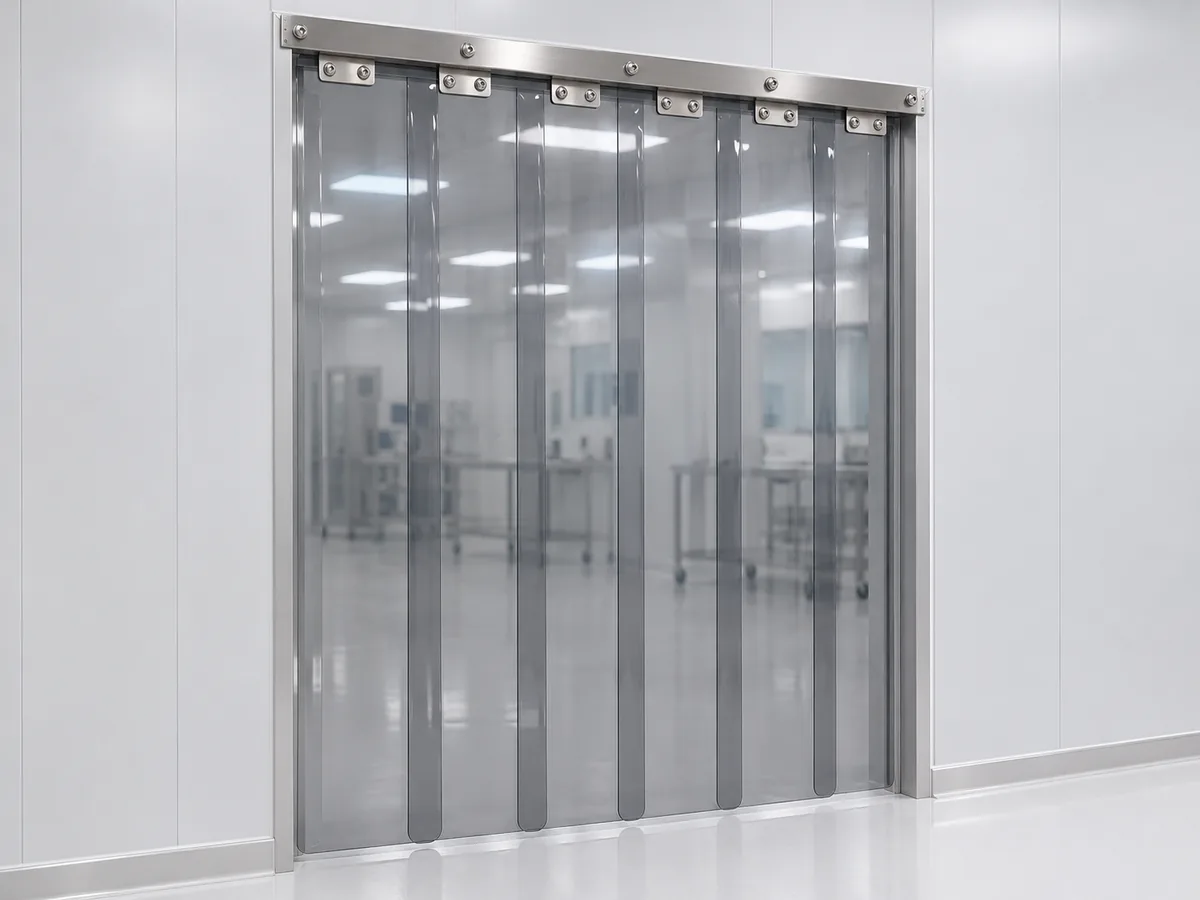
How to choose an anti-static strip curtain: strip thickness and width by doorway height
The taller the doorway, the longer and heavier the strips, so thicker and wider strips are needed to keep them from being blown open or twisted by airflow. The table below is a common selection guide; for extra-wide doorways, or where there is a pressure difference or strong wind, go up one size. | Doorway height | Recommended model | Strip thickness × width | Recommended overlap |
|---|
| Up to 2.5 m | BS-ESC-2200 | 2 mm × 200 mm | 1/2 |
| 2.5–4.5 m | BS-ESC-3300 | 3 mm × 300 mm | 1/2–2/3 |
| Over 4.5 m | BS-ESC-4400 | 4 mm × 400 mm | 2/3 |
The greater the overlap, the better the seal, but the more resistance when passing through. Cleanroom entrances with a pressure difference need at least 2/3 overlap; between areas of the same class where only airflow and line of sight need separating, 1/2 overlap is enough.
What surface resistance should an anti-static strip curtain have?
ESD protective materials fall into three classes by surface resistance, and an anti-static strip curtain must sit in the middle, static dissipative range. Baisheng strips have a surface resistance of 1×10⁶–1×10⁹ Ω: charge drains away gradually, without the instant discharge of conductive materials that can damage components.| Class (ANSI/ESD S541) | Surface resistance | Characteristics |
|---|
| Conductive | Less than 1×10⁴ Ω | Drains charge fastest; may discharge instantly on contact with a charged object |
| Static dissipative | 1×10⁴ to less than 1×10¹¹ Ω | Drains charge in a controlled way; most common in ESD protected areas |
| Insulative | 1×10¹¹ Ω or more | Charge stays on the surface; ordinary PVC strip curtains fall in this class |
Surface resistance is measured by the method in IEC 61340-2-3 or ANSI/ESD STM11.11. The strips must be grounded through the clamp plates and rail to drain charge; if the rail is not grounded, even a low resistance value is useless.
Anti-static strip curtain methods compared: compounded, surface coated and printed conductive grid
Curtains sold as "anti-static" use one of three methods, and their durability differs widely. Baisheng strip curtains are compounded: the anti-static agent is mixed into the PVC during extrusion, so it does not wipe off.| Method | Principle | Durability | Note |
|---|
| Compounded into the body (Baisheng standard) | Anti-static agent mixed into the PVC body during extrusion | Does not wipe off | Less effective at very low humidity |
| Surface coating | A conductive coating applied to the surface | Fails on contact with solvents or when worn | Must be grounded; cleaning methods are restricted |
| Printed conductive grid | Black conductive carbon ink grid printed on clear PVC | Low resistance on the grid side, higher on the non-grid side | Mostly used on full-sheet grid curtains |
All three methods work only when grounded through the rail. For full-sheet anti-static grid curtains, see Baisheng's PVC softwall partition.
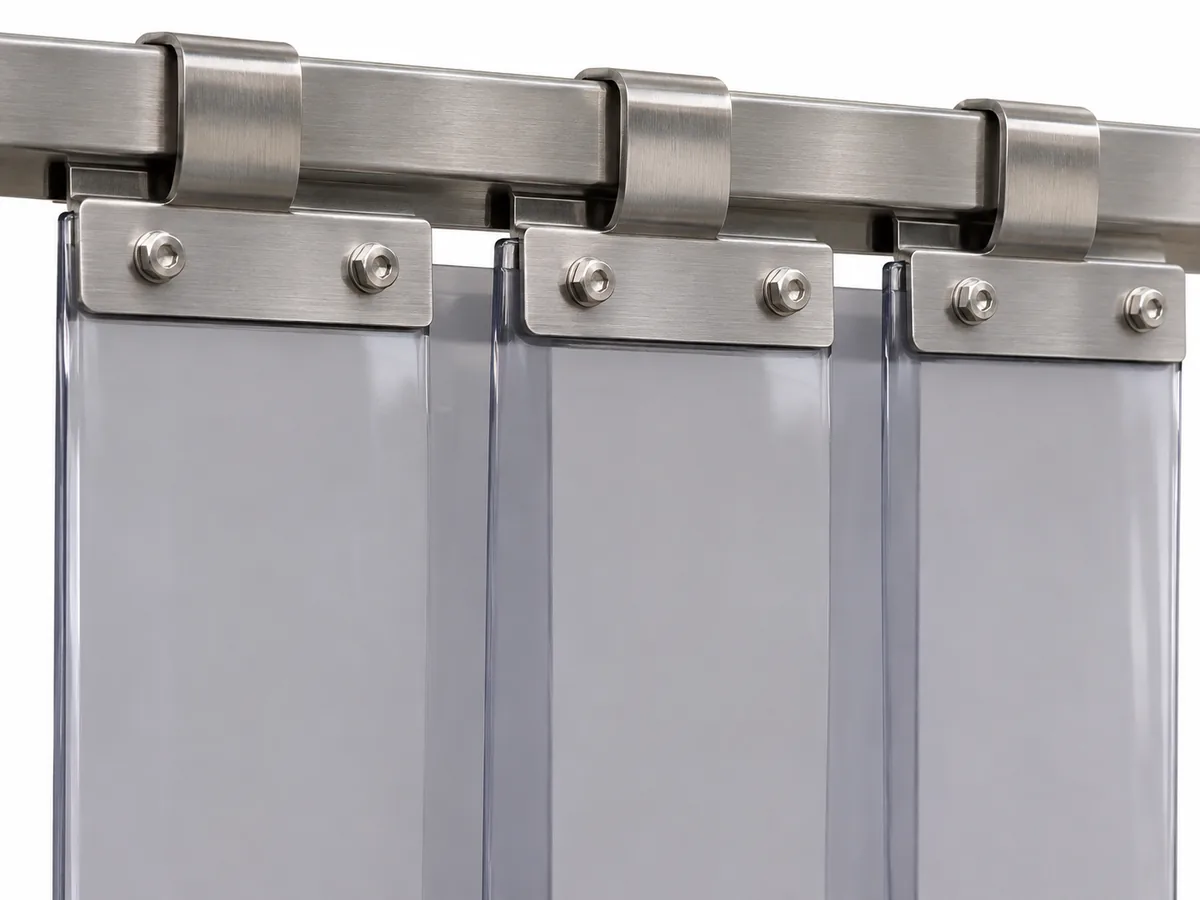
Amber anti-UV strip curtain for yellow-light rooms
Yellow-light rooms (lithography areas) must keep blue and ultraviolet light from exposing photoresist prematurely, so their entrances need amber anti-UV strip curtains. Amber strips block short-wavelength light below about 500 nm; add -Y to the model, for example BS-ESC-3300-Y. They use the same anti-static formulation. | Colour | Application | Notes |
|---|
| Clear grey (standard) | General cleanrooms, electronics plants | Good light transmission, anti-static, people on the other side are visible |
| Clear | Separation of food and pharmaceutical clean areas | Best light transmission, clearest view |
| Amber (-Y) | Yellow-light rooms, lithography areas, photoresist coating areas | Blocks short-wavelength light below about 500 nm |
Strip curtain installation and replacement: rail, floor clearance and grounding
The bottom edge of the strips should be 5–10 mm above the floor: too short leaks air, while dragging on the floor wears the strips and stirs up floor dust. Rails and clamp plates are SUS304, with an optional quick-release type, so a single damaged strip can be replaced without removing the whole set.| Item | Method | Reason |
|---|
| Rail grounding | Connect the rail to the building grounding system with a ground wire | Charge on the strips needs a path to drain |
| Floor clearance | Bottom edge 5–10 mm above the floor | Less air leakage, no dust raised by dragging |
| Cleaning | Wipe with neutral detergent | Aromatic hydrocarbon solvents leach out the plasticiser, making PVC hard and cloudy |
| When to replace | When strips turn white, stiffen or are badly scratched | Both light transmission and sealing deteriorate |