Anti-Static Packaging Film (ESD Bag / Static Shielding Bag / Anti-Static PET Film)
Product Overview
Features & Specifications



Detailed Description
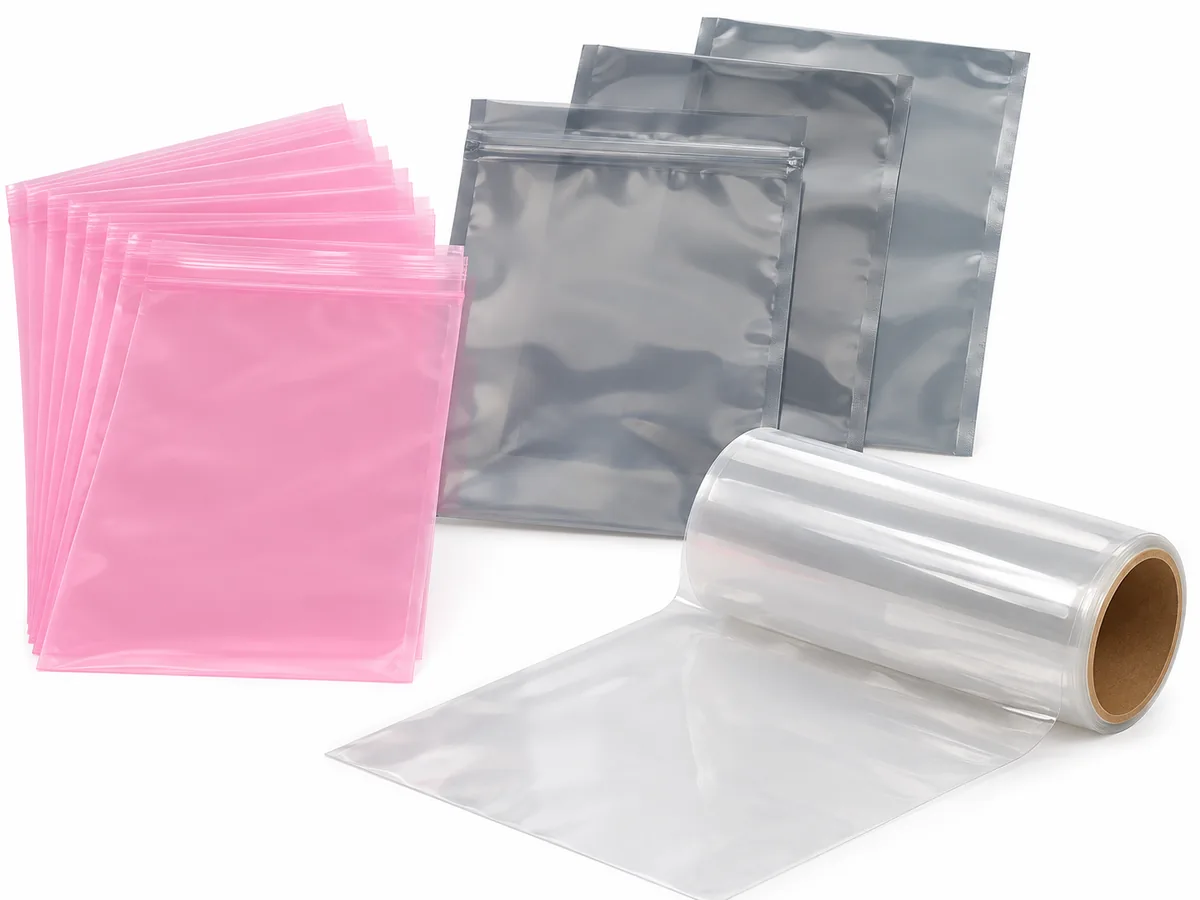
How to choose an ESD bag: anti-static, shielding and moisture barrier
Choose by the component's ESD sensitivity and the shipping environment. Anti-static bags are enough for short-term handling inside an EPA (ESD protected area); once leaving the EPA or shipping, always use shielding bags; for moisture-sensitive devices (MSL 2 and above), add a moisture barrier foil bag.| Model | Type | Appearance | Protection | Applications |
|---|---|---|---|---|
| BS-ESP-PE | Anti-static PE bag | Pink, translucent | The bag itself does not charge | Handling inside an EPA, non-sensitive parts |
| BS-ESP-SH | Static shielding bag | Translucent silver-grey | Does not charge, and blocks external discharge | IC and PCB shipping and transport |
| BS-ESP-MB | Moisture barrier foil bag | Opaque silver | Shields external discharge, and blocks moisture | Moisture-sensitive ICs, BGA vacuum packing |
| BS-ESP-PET | Anti-static PET film | Clear | Film surface does not charge or attract particles | Covering panels, optics and cleanroom materials |
Surface resistance and shielding standards for anti-static packaging
The ESD performance of packaging is classified by ANSI/ESD S541: materials with a surface resistance of 1×10⁴ to less than 1×10¹¹ Ω are static dissipative. Shielding bags must additionally pass a discharge penetration test, with less than 20 nJ of energy reaching the inside of the bag; this is the threshold after S541-2019 and IEC 61340-5-3:2022 tightened it from the earlier 50 nJ.| Property | Criterion | Test method |
|---|---|---|
| Conductive | Surface resistance less than 1×10⁴ Ω | ANSI/ESD STM11.11 |
| Static dissipative | Surface resistance 1×10⁴ to less than 1×10¹¹ Ω | ANSI/ESD STM11.11 |
| Insulative | Surface resistance 1×10¹¹ Ω or more | ANSI/ESD STM11.11 |
| Electrostatic discharge shielding | Penetration energy less than 20 nJ | ANSI/ESD STM11.31 |
Anti-static bags in semiconductor fabs: amine agents bleed out
Cheap pink anti-static bags mostly rely on amine anti-static agents, which slowly volatilise and bleed out onto the bag surface, and can also corrode metal contacts; the volatilised amines are basic AMC (MB) in the SEMI F21 classification and a contamination source for wafers, photomasks and optical lenses. For wafer fab, photomask and optics packaging, specify amine-free cleanroom-grade packaging, marked "amine-free" on the model.| Item | Standard anti-static bag | Cleanroom grade (amine-free) |
|---|---|---|
| Anti-static mechanism | Amine agents bleed out and attract moisture | Permanent anti-static formulation or conductive layer |
| Humidity dependence | Less effective when dry | Less affected by humidity |
| Bleed-out | Amines transfer to the surface of the contents | Low bleed-out |
| Applications | General electronic components | Wafers, photomasks, optics, cleanroom materials |
Using and storing anti-static bags
Shielding bags only shield when fully sealed; bags with folded-corner openings or punctures should be discarded. Store anti-static bags in a cool, dry place away from sunlight, first in, first out; typical shelf life is about 2–3 years. After a moisture barrier bag is opened, control component exposure time according to IPC/JEDEC J-STD-033.| Item | Recommendation |
|---|---|
| Sealing | Seal shielding bags completely with the zip or a heat seal |
| Reuse | Do not reuse if creased, punctured or the shielding layer is scratched |
| Storage | Cool and dry, away from sunlight, first in, first out |
| Moisture-sensitive devices | Use with desiccant and a humidity indicator card, controlled per J-STD-033 |
Frequently Asked Questions
Can pink anti-static bags be used to ship ICs?
Not recommended. A pink anti-static PE bag (BS-ESP-PE) only keeps the bag itself from charging and cannot block electrostatic discharge from outside the bag. When ICs and PCBs leave the EPA for shipping, use a static shielding bag (BS-ESP-SH) that passes the ANSI/ESD STM11.31 test with a penetration energy less than 20 nJ; add a moisture barrier foil bag (BS-ESP-MB) for moisture-sensitive devices.
Why are static shielding bags translucent?
A shielding bag is a multilayer laminated film with a very thin metallised layer in the middle, thin enough to let light through (light transmission about 40%), so it looks translucent silver-grey and the contents and labels can be seen without opening the bag. A fully opaque silver bag is usually a moisture barrier bag containing aluminium foil, which blocks moisture as well as shielding.
What packaging should be used for wafers or photomasks?
Specify cleanroom-grade packaging free of amine anti-static agents. Ordinary anti-static bags rely on amine agents bleeding out to attract moisture, and the bleed-out transfers to wafer and photomask surfaces, becoming an AMC source. Baisheng can supply amine-free shielding bags and anti-static PET film, packed in a clean environment.
Selection References
Before ordering, verify the efficiency grade, media type, and whether the operating environment fits your requirements.