NIPPON MUKI
ATMV/ATMVC Binder-Free Low-Shedding Heat-Resistant HEPA Filter (350°C)
Product Overview
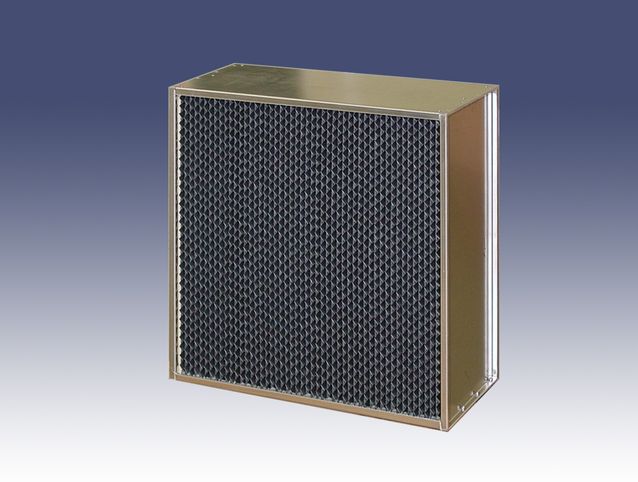
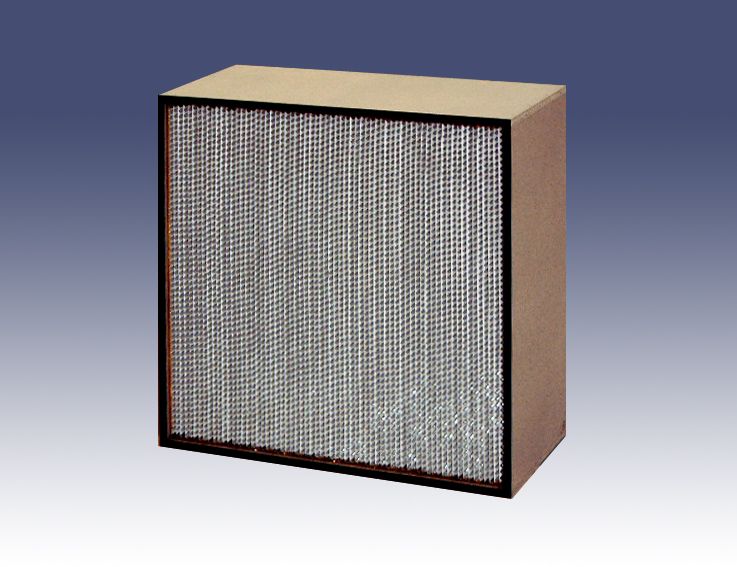
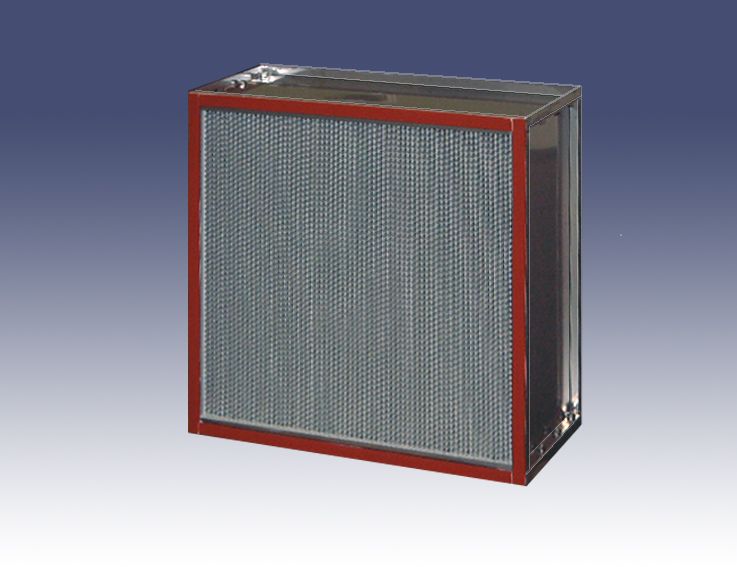
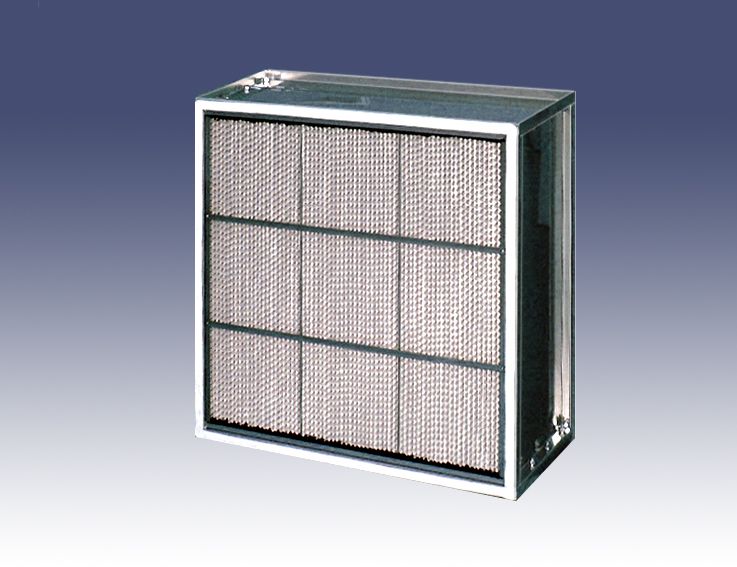
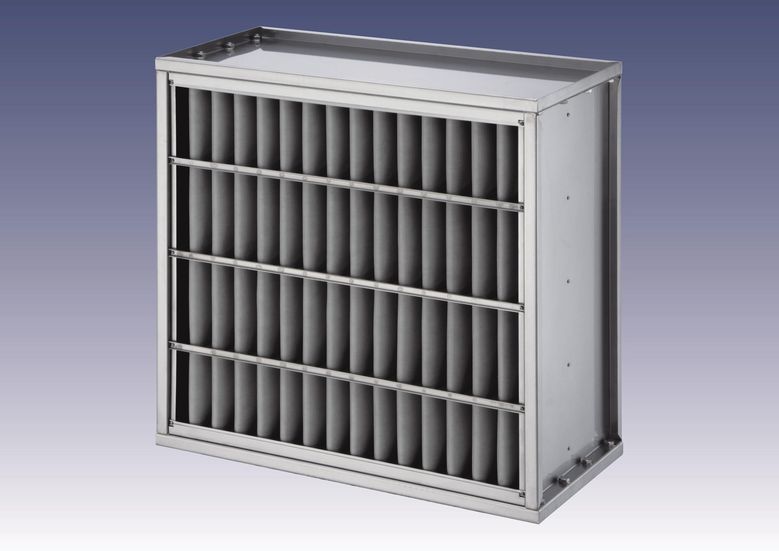
ATMV/ATMVC is a heat-resistant HEPA filter for continuous 350°C service (peak 400°C × 1h), with 99.99% efficiency @ 0.3 μm. Built on a stainless-steel separator-type frame and reinforced with stainless-steel mesh for higher mechanical strength than ATMCU — ideal for applications with elevated face velocity or vibration.
Key features
・Continuous operation up to 350°C, peak 400°C × 1h
・99.99% @ 0.3 μm filtration efficiency
・Reinforced build (glass fiber + stainless-steel mesh)
・All-stainless separator-type construction
・Binder-free construction: no organic adhesive in media or seal — low particle shedding, no siloxane outgassing
Target industries:Medical, Pharmaceutical, Electronics, Power generation, Nuclear power
Key Specifications
- Filtration Efficiency
- 99.97%@0.3μm / 99.99%@0.3μm
- Rated Airflow
- 1 – 28 CMM (60 – 1680 CMH)
- Initial Pressure Drop
- 245 – 350 Pa
- Max. Operating Temperature
- 350°C



Specifications
- Filtration Efficiency
- 99.97%@0.3μm / 99.99%@0.3μm
- Rated Airflow
- 1 – 28 CMM (60 – 1680 CMH)
- Initial Pressure Drop
- 245 – 350 Pa
- Standard Dimensions
- W 305–915 × H 305–762 × D 150–290 mm
- Max. Operating Temperature
- 350°C
Model Reference
| No. | Model | Efficiency | W (mm) | H (mm) | D (mm) | Airflow (CMM) | Airflow (CMH) | Initial ΔP (Pa) |
|---|---|---|---|---|---|---|---|---|
| 1 | ATMV-Z-Q-FS4 | 99.97%@0.3μm | 305 | 305 | 150 | 1.0 | 60 | 245 |
| 2 | ATMV-Z-Q-FS4 | 99.97%@0.3μm | 305 | 610 | 150 | 3.0 | 180 | 245 |
| 3 | ATMV-Z-Q-FS4 | 99.97%@0.3μm | 457 | 457 | 150 | 3.5 | 210 | 245 |
| 4 | ATMV-7-Q-FS4 | 99.97%@0.3μm | 610 | 610 | 150 | 7.0 | 420 | 245 |
| 5 | ATMV-Z-Q-FS4 | 99.97%@0.3μm | 762 | 610 | 150 | 9.0 | 540 | 245 |
| 6 | ATMV-Z-Q-FS4 | 99.97%@0.3μm | 915 | 610 | 150 | 11.0 | 660 | 245 |
| 7 | ATMV-Z-Q-FS4 | 99.97%@0.3μm | 915 | 760 | 150 | 14.0 | 840 | 245 |
| 8 | ATMV-Z-P-FS4 | 99.97%@0.3μm | 305 | 305 | 290 | 1.5 | 90 | 245 |
| 9 | ATMV-Z-P-FS5 | 99.97%@0.3μm | 305 | 610 | 290 | 4.0 | 240 | 245 |
| 10 | ATMV-Z-P-FS6 | 99.97%@0.3μm | 457 | 610 | 290 | 7.0 | 420 | 245 |
| 11 | ATMV-10-P-FS7 | 99.97%@0.3μm | 610 | 610 | 290 | 10.0 | 599 | 245 |
| 12 | ATMV-Z-P-FS8 | 99.97%@0.3μm | 760 | 760 | 290 | 16.0 | 960 | 245 |
| ATMVC-1 | ATMVC-Z-Q-FS4 | 99.97%@0.3μm | 305 | 305 | 150 | 2.5 | 150 | 300 |
| ATMVC-2 | ATMVC-Z-Q-FS4 | 99.97%@0.3μm | 305 | 610 | 150 | 6.0 | 360 | 300 |
| ATMVC-3 | ATMVC-Z-Q-FS4 | 99.97%@0.3μm | 457 | 457 | 150 | 7.0 | 420 | 300 |
| ATMVC-4 | ATMVC-14-Q-FS4 | 99.99%@0.3μm | 610 | 610 | 150 | 14.0 | 840 | 300 |
| ATMVC-5 | ATMVC-Z-Q-FS4 | 99.99%@0.3μm | 762 | 610 | 150 | 18.0 | 1080 | 300 |
| ATMVC-6 | ATMVC-Z-Q-FS4 | 99.99%@0.3μm | 915 | 610 | 150 | 22.0 | 1320 | 300 |
| ATMVC-7 | ATMVC-Z-Q-FS4 | 99.99%@0.3μm | 915 | 762 | 150 | 28.0 | 1680 | 350 |
| ATMVC-8 | ATMVC-Z-P-FS4 | 99.99%@0.3μm | 305 | 305 | 290 | 3.5 | 210 | 350 |
| ATMVC-9 | ATMVC-Z-P-FS4 | 99.99%@0.3μm | 305 | 610 | 290 | 9.0 | 540 | 350 |
| ATMVC-10 | ATMVC-Z-P-FS4 | 99.99%@0.3μm | 457 | 610 | 290 | 14.5 | 870 | 350 |
| ATMVC-11 | ATMVC-20-P-FS4 | 99.99%@0.3μm | 610 | 610 | 290 | 20.0 | 1200 | 350 |
| ATMVC-12 | ATMVC-Z-P-FS4 | 99.99%@0.3μm | 762 | 610 | 290 | 25.5 | 1530 | 350 |
Detailed Description
ATMV/ATMVC adds stainless-steel mesh reinforcement on top of the ATMCU platform. Choose this strengthened version when the application involves mechanical vibration or high face velocity — for example, downstream of blower units in nuclear ventilation systems.
Materials & Construction
| Property | Specification |
|---|---|
| Filter frame | STAINLESS STEEL |
| Media | GLASS FIBER (Held by wire net) |
| Max. temperature | 350°C (Max. 400°C/1h) |
| Separator | STAINLESS STEEL |
| Gasket | GLASS PAPER |
| Grille (downstream) | - |
| Grille (upstream) | - |
| Sealant | GLASS FIBER |
| Max airflow | Can be calculated on request |
| Max final PD (Pa) | 490 / 500 |
Airflow vs Pressure Drop (representative)
Binder-Free, Low-Shedding Construction
A conventional HEPA bonds and seals its media and frame with polyurethane (PU) or silicone, and those sealants are generally rated for long-term service somewhere in the 100–200°C range. Above that, the adhesive first softens and cracks, releasing organic molecules, then embrittles and flakes under repeated thermal cycling — at which point the filter itself becomes a particle source. ATMV/ATMVC uses no organic adhesive anywhere: sealing is done with glass fiber, the frame and separators are stainless steel, and the entire assembly is metal and glass only.| Component | Conventional adhesive HEPA | ATMV/ATMVC (binder-free) |
|---|---|---|
| Sealant | Polyurethane / silicone | GLASS FIBER |
| Media bonding | Organic binder | None (glass fiber held by wire net) |
| Separator | Aluminium foil + hot-melt | STAINLESS STEEL |
| Outgassing at temperature | Organic molecules, siloxane | None |
| Shedding after thermal cycling | Rises as adhesive degrades | Stays stable |
With no organic adhesive there is nothing to thermally decompose. Two practical consequences follow:
- Low particle shedding — degrading, flaking adhesive is the most common source of self-generated particles in high-temperature filters. A binder-free build keeps downstream particle counts from creeping back up as the filter ages through repeated heat-up and cool-down cycles.
- No siloxane contamination — silicone seals release siloxane at elevated temperature, and siloxane deposited on wafers, optical surfaces or coated substrates causes hazing and yield loss. Semiconductor, optical coating and OLED processes are particularly sensitive to this.
ATMV/ATMVC is typically installed where vibration is present — downstream of blowers, or in high-velocity ducting. Vibration accelerates fatigue and flaking of any adhesive layer, so shedding shows up earlier than in static installations. That is precisely why binder-free matters more on the reinforced models: the wire-net reinforcement handles mechanical strength while the binder-free build handles cleanliness, with neither traded off against the other.
Applications
- HEPA downstream of nuclear ventilation blowers - Terminal filtration on vibrating high-temperature equipment - Power-plant high-temperature high-velocity airflowSelection Notes
- For static depyrogenation tunnels, ATMCU is more economical. - For vibrating or high-velocity applications, choose ATMV/ATMVC. - 150 mm (Q) / 290 mm (P) — select by airflow demand.Selection References
Before ordering, verify the efficiency grade, media type, and whether the operating environment fits your requirements.