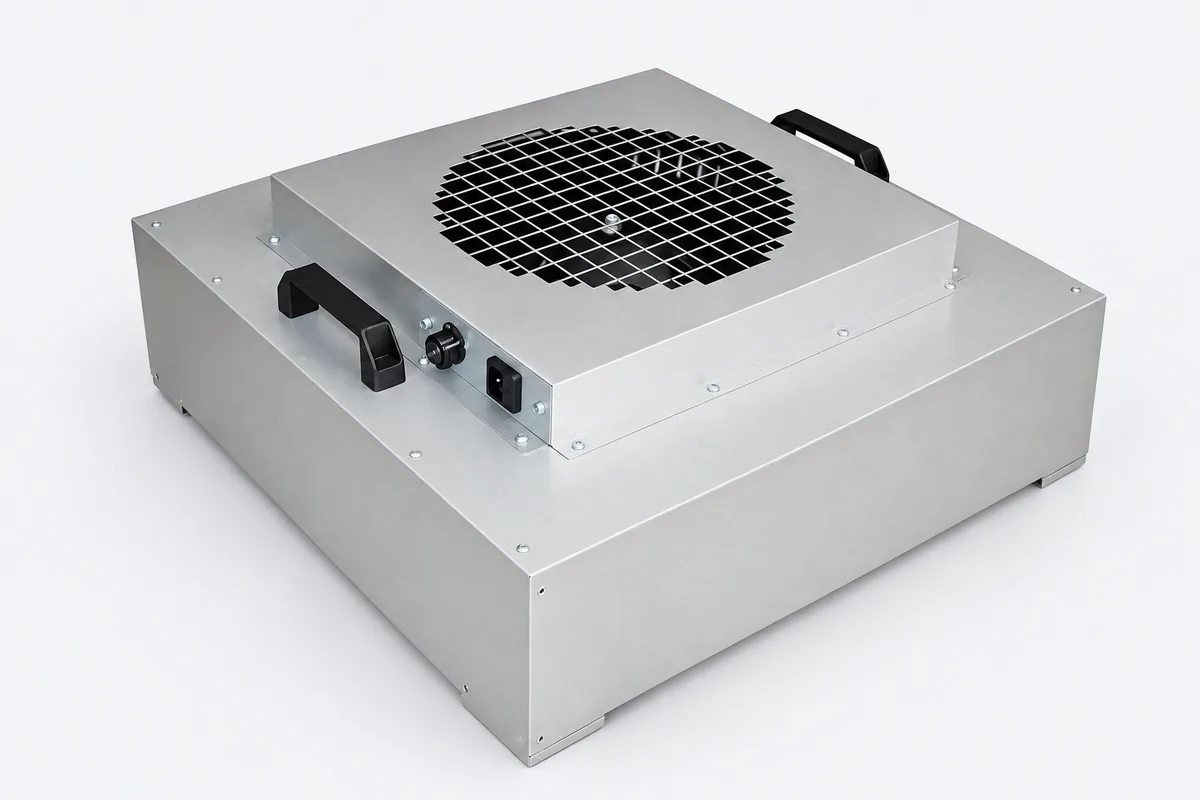
FFU 팬 필터 유닛
제품 개요
주요 규격
- 여과 효율
- ≥99.99~99.999% @0.3 μm(장착 HEPA / ULPA 필터에 따름)
- 팬 형식
- 수입 외전형 원심팬, 모터 출력 80 W
- 전원 사양
- AC 220~240V 50Hz
- 제어 방식
- 고속 / 중속 / 저속 3단 조절, FFU 군 제어 시스템 연결 가능(허브당 32회로)



규격 총표
- 본체 재질
- 알루미늄아연 도금강판 / 스테인리스 / 냉연강판 도장 / PP 폴리프로필렌
- 구조 형식
- 건식 여과 FFU / 액조식 여과 FFU. 임펠러는 알루미늄 / 스테인리스 / 나일론
- 여과 효율
- ≥99.99~99.999% @0.3 μm(장착 HEPA / ULPA 필터에 따름)
- 팬 형식
- 수입 외전형 원심팬, 모터 출력 80 W
- 전원 사양
- AC 220~240V 50Hz
- 제어 방식
- 고속 / 중속 / 저속 3단 조절, FFU 군 제어 시스템 연결 가능(허브당 32회로)
모델 대조표
| 모델 | 모듈 치수 (mm) | 필터 치수 (mm) | 풍량 (m³/min) | 면풍속 (m/s) | 소비 전류 (A) | 소음 (dB) |
|---|---|---|---|---|---|---|
| 4′×4′ | 1175×1175×320 | 1170×1170×70 | 45 | 0.55 | 1.3 | ≤58 |
| 2′×4′ | 1175×575×320 | 1170×570×70 | 18 | 0.45 | 1.0 | ≤52 |
| 2′×2′ | 575×575×320 | 570×570×70 | 6.8 | 0.35 | 0.8 | ≤46 |
풍량은 면풍속 × 필터 면적으로 환산, 실제 풍량은 기외 정압과 장착 필터 등급에 따라 달라짐
상세 설명
자체 동력을 갖고, 정압 챔버는 음압이 됩니다
기존 덕트식 급기는 한 번 시공하면 토출 위치가 고정되어, 라인을 개편할 때마다 덕트를 손봐야 합니다. FFU는 송풍기를 모듈 안에 넣어 한 대 한 대가 독립된 급기 유닛입니다. 바람을 보낼 곳에 달면 되고, 라인을 개편할 때는 떼어 내 위치만 바꾸면 되며 천장 그리드는 손대지 않아도 됩니다. FFU는 운전할 때 위쪽 정압 챔버를 청정 구역에 대해 음압으로 만듭니다. 혹시 정압 챔버에 틈이 있어도 공기는 청정 구역에서 정압 챔버 쪽으로 새는 것이지, 챔버 안에 쌓인 분진이 청정 구역으로 밀려 들어오는 것이 아닙니다. 양압 덕트 시스템은 정반대여서, 이음매 시공이 부실하면 관 안에 쌓인 입자가 압력에 밀려 나옵니다.사양표의 면풍속은 작업 위치의 풍속이 아닙니다
자주 인용되는 0.36–0.54 m/s는 EU GMP Annex 1(2022) §4.30에서 나온 값으로, A 등급 단방향류의 작업 위치에서의 guidance value이며 오염 관리 전략(CCS) 안에서 과학적 근거가 있으면 벗어날 수 있습니다. 미국 FDA 2004년 무균 공정 지침의 권장값은 0.45 m/s(90 fpm) ±20%입니다. 둘 다 청정 구역에 대한 요구이지 FFU의 제품 사양이 아닙니다. 필터 토출면의 풍속은 작업 높이까지 내려가는 동안 천장의 FFU 설치 비율, 환기 위치, 장비에 의한 가림의 영향을 받습니다. 따라서 대수와 회전 속도는 사양표의 면풍속을 그대로 인수 기준으로 삼지 말고, 작업 위치에서 실측한 풍속과 균일도로 정해야 합니다.비교와 인수 시 봐야 할 데이터
IEST-RP-CC036.1은 FFU의 시험 항목으로 풍량, 소비 전력, 기외 정압, 소음, 토출 풍속 균일도, 진동을 제시합니다. 중국의 제품 표준은 JG/T 388-2012 『팬 필터 유닛』입니다. 두 업체의 FFU를 비교할 때는 풍량과 소비 전력을 반드시 같은 기외 정압에서 비교해야 하며, 그렇지 않으면 수치에 의미가 없습니다. ULPA를 조합하면 필터 저항이 높아 같은 송풍기로 보낼 수 있는 풍량이 줄어들므로, 선정할 때는 실제로 조합하는 필터 등급으로 확인해야 합니다.건식과 젤 씰식
건식 FFU는 개스킷으로 실링하여 설치가 빠르고 비용이 낮아 대부분의 전자 공장에서 쓰는 방식입니다. 젤 씰식은 그리드 위에 젤 홈을 한 바퀴 두르고 필터 테두리의 나이프 에지를 홈에 꽂아 연속된 실링면을 만듭니다. 설치 후 필터 누설 시험을 하고 정기적으로 재시험해야 하는 제약 및 고등급 청정 구역에 적합하며, 대신 그리드 시스템이 복잡해집니다.군제어: 수백 대의 FFU를 어떻게 관리하나
클린룸 하나에 FFU가 수백 대에 이르는 일은 흔합니다. 군제어 시스템은 1:2 스마트 유닛, 허브(대당 최대 32회로 연결), FFU 제어 호스트, PC 집중 감시, 저압 제어반으로 구성되며, 속도 조절 방식으로는 콘덴서, 변압기 전압 조정, 모터 탭을 쓸 수 있습니다. 기능은 구역별 기동·정지, 집중 속도 조절, 고장 경보, 이력 기록이며, PC를 꺼도 제어 호스트가 독립적으로 종일 감시를 계속합니다. 이를 통해 세 가지가 가능해집니다. 스케줄 감속: 비생산 시간대에는 저속으로 낮출 수 있어 사람이 사다리에 오를 필요가 없습니다. 고장 가시화: 한 대가 멈추면 위치를 표시하며 바로 경보가 울리므로, 청정도 측정에서 불합격이 나온 뒤에야 원인을 찾는 일이 없습니다. 추적성: 이력 기록으로 특정 제품 로트를 생산할 때의 급기 상태를 조회할 수 있습니다. 통신선과 전원선은 모두 천장 속으로 지나가므로 구역 구분, 허브와 제어반의 위치는 그리드 시공 전에 정해야 하며, 나중에 배선을 추가하면 비용이 훨씬 많이 듭니다.자주 묻는 질문
FFU 면풍속이 0.45 m/s이면 GMP A 등급 요구를 충족합니까?
그대로 같다고 볼 수는 없습니다. EU GMP Annex 1(2022) §4.30의 0.36–0.54 m/s와 FDA 2004의 0.45 m/s ±20%는 모두 A 등급 단방향류의 작업 위치 풍속을 측정한 것이며, FFU 필터 토출면의 사양값이 아닙니다. 같은 FFU라도 토출 기류가 작업 높이에 이르기까지 천장 설치 비율, 환기 위치, 장비에 의한 가림의 영향을 받습니다. 작업 위치에서 실측한 풍속과 균일도로 확인한 다음, FFU 대수와 회전 속도 단계를 조정해야 합니다.
FFU 군제어 허브 하나에 몇 대를 연결할 수 있습니까? PC를 끄면 멈춥니까?
허브 한 대에 32회로를 연결할 수 있으며, 1:2 스마트 유닛으로 확장합니다. 수백 대 이상인 공장에서는 여러 대의 허브로 구역을 나누어 FFU 제어 호스트에 연결합니다. PC 쪽은 집중 감시와 기록만 담당하고 제어 호스트 자체는 독립적으로 동작하므로, PC를 꺼도 종일 감시와 경보가 유지되며 그 때문에 멈추지 않습니다. 구역 수, 구역별 대수, 허브 위치는 천장 그리드 시공 전에 확정해야 합니다.
두 업체의 FFU 풍량과 소비 전력을 비교할 때 무엇에 주의해야 합니까?
같은 기외 정압에서 비교해야 합니다. FFU의 풍량은 기외 정압과 필터 저항에 따라 줄어들기 때문에, 한 업체는 0 Pa에서의 풍량을, 다른 업체는 부하 상태의 풍량을 표기했다면 수치가 크게 달라 보여도 실제로는 비교할 수 없습니다. IEST-RP-CC036.1의 시험 항목에는 풍량, 소비 전력, 기외 정압, 소음, 풍속 균일도, 진동이 포함되며, 견적을 요청할 때 지정한 정압과 지정한 필터 등급에서의 시험 데이터를 요구할 수 있습니다.