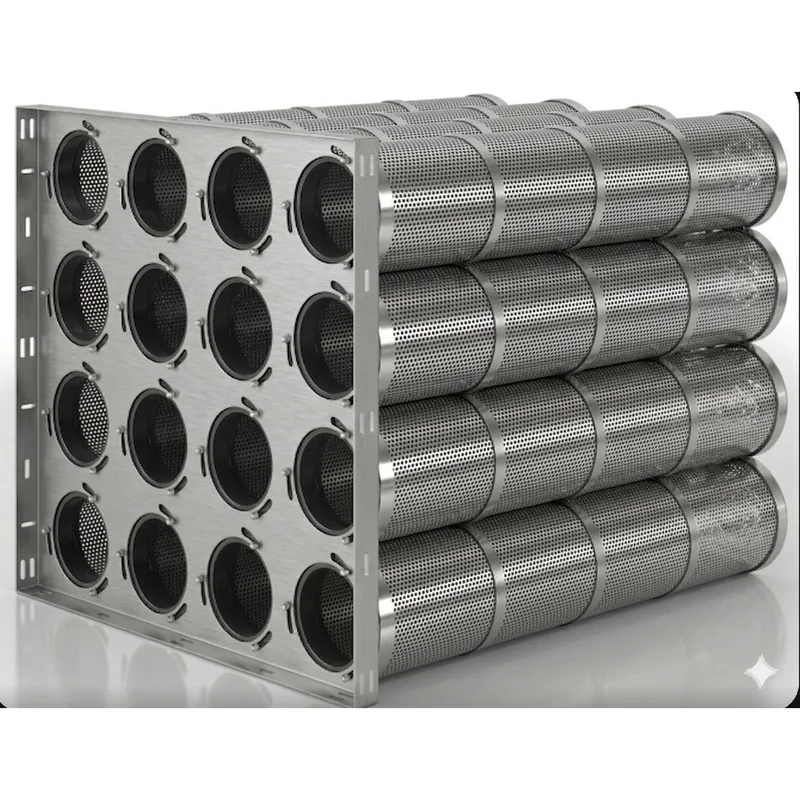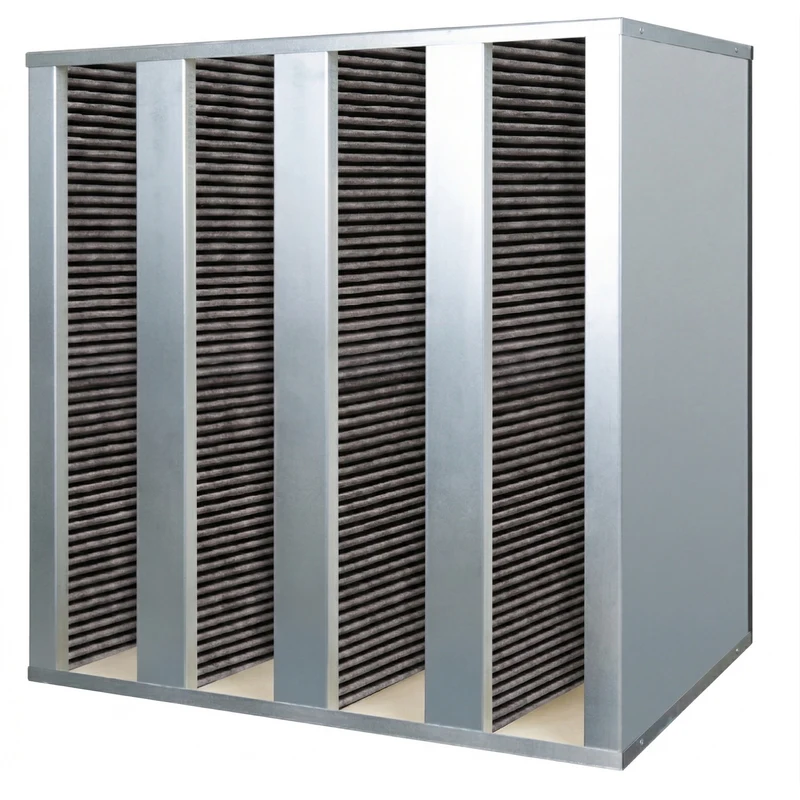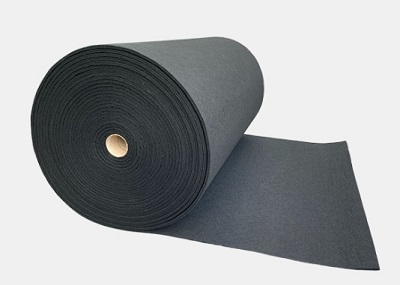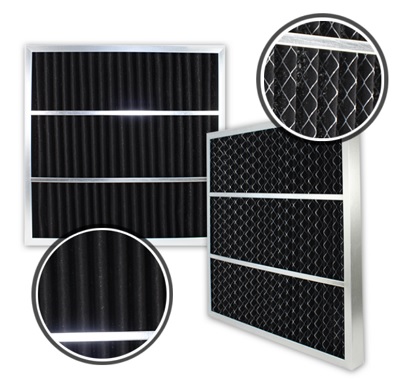
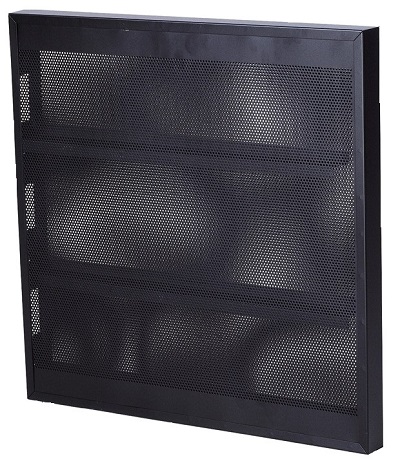
Packed Bed Activated Carbon Filter (Granular Carbon Panel)
Product Overview
Key Specifications
- Adsorbent
- 4×8 mesh granular activated carbon: virgin extruded pellet (Ø3–4 mm), crushed coconut shell or reactivated; impregnation available by target gas
- Frame
- Galvanized steel or stainless steel (SUS304, SUS316 optional)
- Face Velocity
- 0.25–0.5 m/s (50–100 fpm)
- Initial Pressure Drop
- 1″ panel 18–59 Pa, 2″ panel 37–122 Pa (face velocity 0.25–0.5 m/s)



Specifications
- Adsorbent
- 4×8 mesh granular activated carbon: virgin extruded pellet (Ø3–4 mm), crushed coconut shell or reactivated; impregnation available by target gas
- Structure
- Flat packed bed sealed by perforated plates on both faces; air passes straight through the bed
- Frame
- Galvanized steel or stainless steel (SUS304, SUS316 optional)
- Target Gases
- Odors (hydrogen sulfide, mercaptans, ammonia), VOCs and solvent vapors, kitchen exhaust odor, process exhaust
- Adsorbent Weight
- Approx. 1.4–2.8 kg per 1″ panel, 2.8–5.7 kg per 2″ panel (by size)
- Residence Time
- 1″ panel 0.04–0.09 s, 2″ panel 0.09–0.18 s (face velocity 0.5–0.25 m/s)
- Face Velocity
- 0.25–0.5 m/s (50–100 fpm)
- Initial Pressure Drop
- 1″ panel 18–59 Pa, 2″ panel 37–122 Pa (face velocity 0.25–0.5 m/s)
- Depth
- 22 mm (1″) / 45 mm (2″)
- Custom Sizes
- Made to order; standard sizes available
- Max. Operating Temperature
- ≤ 60°C
- Max. Relative Humidity
- ≤ 80% RH
- Regeneration
- Frame is refillable; spent carbon can be thermally reactivated
- Service Life
- Depends on gas concentration at site; judged by outlet breakthrough
- Applications
- High-concentration, low-velocity duty: wastewater odor, kitchen and lab exhaust, VOC exhaust, MAU pre-treatment
Some values are typical ranges for this product class; the shipped datasheet governs.
Standard sizes and single-panel ratings
| Nominal size | Actual size | Bed depth | Airflow @0.25 m/s | ΔP @0.25 m/s | Airflow @0.5 m/s | ΔP @0.5 m/s | Carbon charge |
|---|---|---|---|---|---|---|---|
| 12×24×1″ | 290×595×22 mm | 22 mm | 155 m³/h (91 CFM) | 18 Pa | 311 m³/h (183 CFM) | 59 Pa | ≈ 1.4 kg |
| 24×24×1″ | 595×595×22 mm | 22 mm | 318 m³/h (187 CFM) | 18 Pa | 637 m³/h (375 CFM) | 59 Pa | ≈ 2.8 kg |
| 12×24×2″ | 290×595×45 mm | 45 mm | 155 m³/h (91 CFM) | 37 Pa | 311 m³/h (183 CFM) | 122 Pa | ≈ 2.8 kg |
| 24×24×2″ | 595×595×45 mm | 45 mm | 318 m³/h (187 CFM) | 37 Pa | 637 m³/h (375 CFM) | 122 Pa | ≈ 5.7 kg |
Airflow and pressure drop are typical values for a single flat panel with 4×8 mesh granular carbon; for high airflow, split the velocity across multiple panels in a V-bank. Non-standard sizes are made to order.
Model Reference
| Model | Description | Size |
|---|---|---|
| ACF-24-24-1-GA-PURE | Galvanized frame packed activated carbon filter 24X24X1" (virgin carbon) | 24 × 24 × 1″ |
| ACF-24-24-2-GA | Galvanized frame packed activated carbon filter 24X24X2" (regenerated carbon) | 24 × 24 × 2″ |
| ACF-595-595-45-S | Stainless steel frame packed activated carbon filter 595X595X45mm (virgin carbon) | 595 × 595 × 45 mm |
| ACF-610-305-290-GA-PURE | Galvanized frame packed activated carbon filter 610X305X290mm (virgin carbon) | 610 × 305 × 290 mm |
| ACF-495-495-45-SUS | Stainless steel frame packed activated carbon filter 495X495X45mm (virgin carbon) | 495 × 495 × 45 mm |
| ACF-305-305-290-GA-PURE | Galvanized frame packed activated carbon filter 305X305X290mm (virgin carbon) | 305 × 305 × 290 mm |
| ACF-290-595-45 | Stainless steel frame packed activated carbon filter 290X595X45mm (virgin carbon) | 290 × 595 × 45 mm |
| ACF-595-895-22-GA | Galvanized frame packed activated carbon filter 595X895X22mm regenerated carbon | 595 × 895 × 22 mm |
Common sizes are listed above. Other sizes, frame materials and efficiency grades can be made to order — please quote the model or size when requesting a quotation.
Detailed Description
What a packed bed carbon filter is
A packed bed activated carbon filter pours granular activated carbon directly into a metal frame, closes both faces with perforated plates or mesh, and passes the air straight through the full depth of the carbon bed. The industry also calls it a granular carbon panel, carbon tray, loose-fill panel or refillable carbon panel. Compared with carbon non-woven, foam or honeycomb filters it holds by far the most carbon: a 24×24×1-inch panel carries about 2.8 kg and a 2-inch panel about 5.7 kg. More carbon means higher adsorption capacity and longer life, but a granular bed also resists airflow, so its place is "high concentration, low velocity" duty — wastewater plants, kitchen exhaust, laboratory fume exhaust, paint and printing VOC exhaust — rather than high-volume, low-resistance HVAC return air.Choosing between the three carbon types
| Carbon | Shape / size | Iodine (mg/g) | CTC (%) | Hardness (%) | Character and typical use |
|---|---|---|---|---|---|
| Virgin extruded pellet | Coal-based extruded pellet Ø3–4 mm | ≥ 900–1,000 | ≥ 50–60 | ≥ 95 | Uniform particles, lowest pressure drop and least dust; general odor, VOCs, HVAC exhaust running continuously for long periods |
| Crushed coconut shell | Coconut shell 4×8 mesh (2.4–4.8 mm) | ≥ 1,100 | ≥ 58 | ≥ 97 | Highest micropore fraction and the largest capacity for small-molecule odors and low-concentration VOCs; same grade as our BS-GAC1100 |
| Reactivated carbon | Thermally reactivated recycled granules, 4×8 mesh | approx. 800–900 | approx. 45–50 | ≥ 90 | Clearly cheaper than virgin carbon; suited to low-concentration odor control, general exhaust and sites that change media often |
Frame: galvanized or stainless steel
Galvanized steel frame: dry environments without corrosive gases — general HVAC return air, office and plant odor control, kitchen exhaust — at the lowest cost. Stainless steel frame (SUS304, SUS316 optional): hydrogen sulfide exhaust at wastewater plants and pump stations, acid or alkaline gas discharge, humid or condensing ducts, food and pharmaceutical sites that wash frames regularly, and coastal salt-spray environments. Both frames use perforated plates on both faces with welded corners and are reusable. Fit a pre-filter upstream: dust otherwise coats the bed surface and raises pressure drop far faster than carbon saturation does.Face velocity, pressure drop and residence time
Face Velocity vs Initial Pressure Drop
4×8 mesh granular carbon bed, 1″ (22 mm) and 2″ (45 mm) panels
Derived from generic packed-bed pressure drop curves for granular carbon; actual values vary with carbon type, particle size distribution and packing density. The shipped datasheet governs.
| Face velocity | 1″ panel (22 mm) ΔP | 1″ residence time | 2″ panel (45 mm) ΔP | 2″ residence time | Recommended duty |
|---|---|---|---|---|---|
| 0.25 m/s (50 fpm) | 18 Pa | 0.09 s | 37 Pa | 0.18 s | High-concentration VOCs, process exhaust, low outlet limits |
| 0.5 m/s (100 fpm) | 59 Pa | 0.04 s | 122 Pa | 0.09 s | General odor control, HVAC return air, light loads |
Replacement interval and reactivation
Life is judged by breakthrough, not pressure drop: the resistance of a carbon bed barely changes as it saturates, but the odor or TVOC reading at the outlet does. Typical intervals are 6–12 months for HVAC odor control, 3–6 months for wastewater and kitchen exhaust, and as little as 1–3 months for high-concentration solvent exhaust, depending on inlet concentration, airflow and humidity (above 70% RH, water vapor competes with VOCs for adsorption sites). When the carbon is spent, open the frame, pour out the old carbon and refill — the panel is not scrapped, and spent carbon can go to a reactivation plant. Use a handheld TVOC meter to compare inlet and outlet, or replace when odor appears at the outlet.Typical applications
Odor control at wastewater plants, pump stations and waste facilities (hydrogen sulfide, mercaptans, ammonia); commercial kitchen and food plant exhaust; laboratory fume hoods and pharmaceutical exhaust; VOC exhaust from painting, printing and coating; make-up air unit (MAU) pre-treatment at semiconductor and display fabs; electronics plant and data center return air; odor control in hospitals, office buildings, museums and car parks.Frequently Asked Questions
How do I choose between virgin extruded pellet, crushed coconut shell and reactivated carbon?
Start with the target gas, then the budget. Crushed coconut shell has the highest iodine number (≥1,100 mg/g) and the most micropores, giving the largest capacity for small-molecule odors such as hydrogen sulfide and ammonia and for low-concentration VOCs — the first choice for odor control. Virgin extruded pellets are uniform, hard and low-dusting with slightly lower pressure drop than crushed carbon, suited to HVAC exhaust that runs continuously and to solvent VOCs. Reactivated carbon is recycled carbon thermally regenerated to an iodine number of roughly 800–900; capacity is 20–30% lower but the price is clearly lower, which suits low-concentration odor control or sites that already change media often. All three can be impregnated with alkali or potassium iodide for acid gases and mercury vapor.
How much airflow can one 24×24×1-inch carbon panel handle, and why not connect it straight to 2,000 CFM?
A single flat panel should run at 0.25–0.5 m/s face velocity, which for a 24×24-inch panel is about 320–640 m³/h (190–375 CFM) at 18–59 Pa initial pressure drop. Forcing 2,000 CFM through one 24×24 panel would push face velocity to 2.7 m/s: the pressure drop across a granular bed would approach 900 Pa and the gas would spend only 0.008 seconds in the carbon, far too short to adsorb. The correct approach is to mount 6–12 one-inch panels in a V-bank housing so the total media area grows and each panel returns to the recommended range, or to switch to 2-inch panels to double the residence time.
When should I specify a stainless steel frame instead of galvanized?
A galvanized frame lasts for years in dry air without corrosive gases, so it is enough for general HVAC return air, office and plant odor control and kitchen exhaust. Switch to stainless steel if any of these apply: the exhaust contains hydrogen sulfide, acid or alkaline gases (wastewater plants, pump stations, pickling lines); the duct condenses or relative humidity stays above 80%; a food or pharmaceutical site washes the frames regularly; or the site is coastal with salt spray. SUS304 covers most cases; choose SUS316 where chloride is high, such as seawater or chlorinated cleaning agents.
Can I refill the carbon without replacing the frame, and how do I know when it is spent?
Yes. The frame is a welded metal tray: open one perforated plate, pour out the old carbon and refill. Spent carbon can go to a reactivation plant, which is why packed panels are more economical than non-woven or honeycomb filters. Do not judge replacement by pressure drop — a carbon bed barely changes resistance as it saturates; what changes is breakthrough. Measure the inlet-to-outlet TVOC difference with a handheld meter and change the carbon when the difference shrinks noticeably or odor appears downstream. Rules of thumb: 6–12 months for HVAC odor control, 3–6 months for wastewater and kitchen exhaust, 1–3 months for high-concentration solvent exhaust. If pressure drop rises instead, upstream dust has usually coated the bed surface and the pre-filter needs attention.
Selection References
Before ordering, verify the efficiency grade, media type, and whether the operating environment fits your requirements.