Corrosion Classification Coupon (Copper/Silver Coupon)
Product Overview
Features & Specifications



Detailed Description
How are ISA-71.04 corrosion classes G1 to GX determined?
ANSI/ISA-71.04-2013 divides air corrosivity into four classes, G1, G2, G3 and GX, by the reaction thickness on copper and silver strips over 30 days, and the more severe of the copper and silver results sets the class. Data centres and control rooms usually aim for G1.| Class | Severity | Copper reactivity | Silver reactivity | Meaning |
|---|---|---|---|---|
| G1 | Mild | < 300 Å/30 days | < 200 Å/30 days | Well-controlled environment; corrosion is not a factor in equipment reliability |
| G2 | Moderate | < 1000 Å/30 days | < 1000 Å/30 days | Corrosion is measurable and may be a factor in equipment reliability |
| G3 | Harsh | < 2000 Å/30 days | < 2000 Å/30 days | Corrosion is already occurring and the risk of damage is high |
| GX | Severe | > 2000 Å/30 days | > 2000 Å/30 days | Severe corrosion; electronic equipment in the environment cannot operate normally |
Museums and conservation: C1 to C5 / S1 to S5 classes
Storage and display environments for artefacts and artworks use a stricter set of classes: C1–C5 for copper and S1–S5 for silver, five levels each. Collections of paper, textiles and metal objects need the highest level, C1 and S1.| Copper class | Copper corrosion | Silver class | Silver corrosion | Air quality | Suitability |
|---|---|---|---|---|---|
| C1 | < 90 Å/30 days | S1 | < 40 Å/30 days | Extremely pure | Collections of paper, textiles and metal objects |
| C2 | < 150 Å/30 days | S2 | < 100 Å/30 days | Pure | Museum, archive and library stores |
| C3 | < 250 Å/30 days | S3 | < 200 Å/30 days | Clean | Historic buildings |
| C4 | < 350 Å/30 days | S4 | < 300 Å/30 days | Slightly polluted | Acceptable short term |
| C5 | ≥ 350 Å/30 days | S5 | ≥ 300 Å/30 days | Polluted | Unacceptable |
Reference gas concentrations for each corrosion class
The table below gives reference concentrations of reactive gases (in ppb) for each corrosion class, which help trace the likely contaminants on site. The actual class is still set by coupon measurement, because high humidity or several gases acting together speed up corrosion.| Gas | Group | G1 | G2 | G3 | GX |
|---|---|---|---|---|---|
| H₂S | Group A | < 3 | < 10 | < 50 | ≥ 50 |
| SO₂, SO₃ | Group A | < 10 | < 100 | < 300 | ≥ 300 |
| Cl₂ | Group A | < 1 | < 2 | < 10 | ≥ 10 |
| NOx | Group A | < 50 | < 125 | < 1250 | ≥ 1250 |
| HF | Group B | < 1 | < 2 | < 10 | ≥ 10 |
| NH₃ | Group B | < 500 | < 10000 | < 25000 | ≥ 25000 |
| O₃ | Group B | < 2 | < 25 | < 100 | ≥ 100 |
Corrosion coupon models and specifications
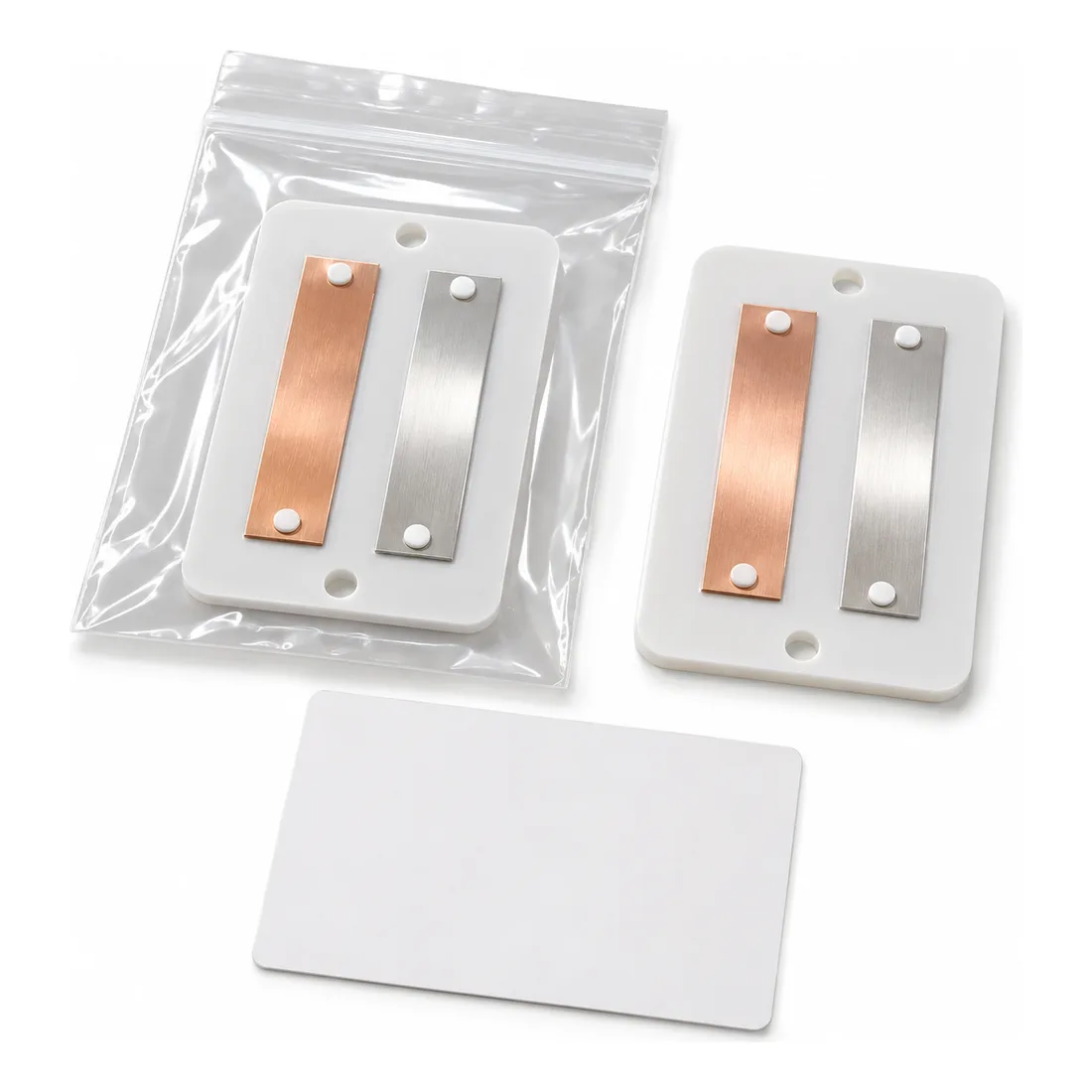
The BS-CCC series has four versions that differ in the number of strips and the metal thickness; the 3-strip versions add a lead strip to the copper and silver pair.| Model | Dimensions | Strips | Metals | Metal thickness |
|---|---|---|---|---|
| BS-CCC | 120×108 mm | 2 | Copper, silver | 4000 Å |
| BS-CCC-3 | 120×108 mm | 3 | Copper, silver, lead | 4000 Å |
| BS-CCC-P | 134×108 mm | 2 | Copper, silver | 500 µm |
| BS-CCC-P3 | 150×108 mm | 3 | Copper, silver, lead | 500 µm |
How is a corrosion coupon used, and how does it differ from an online monitor?
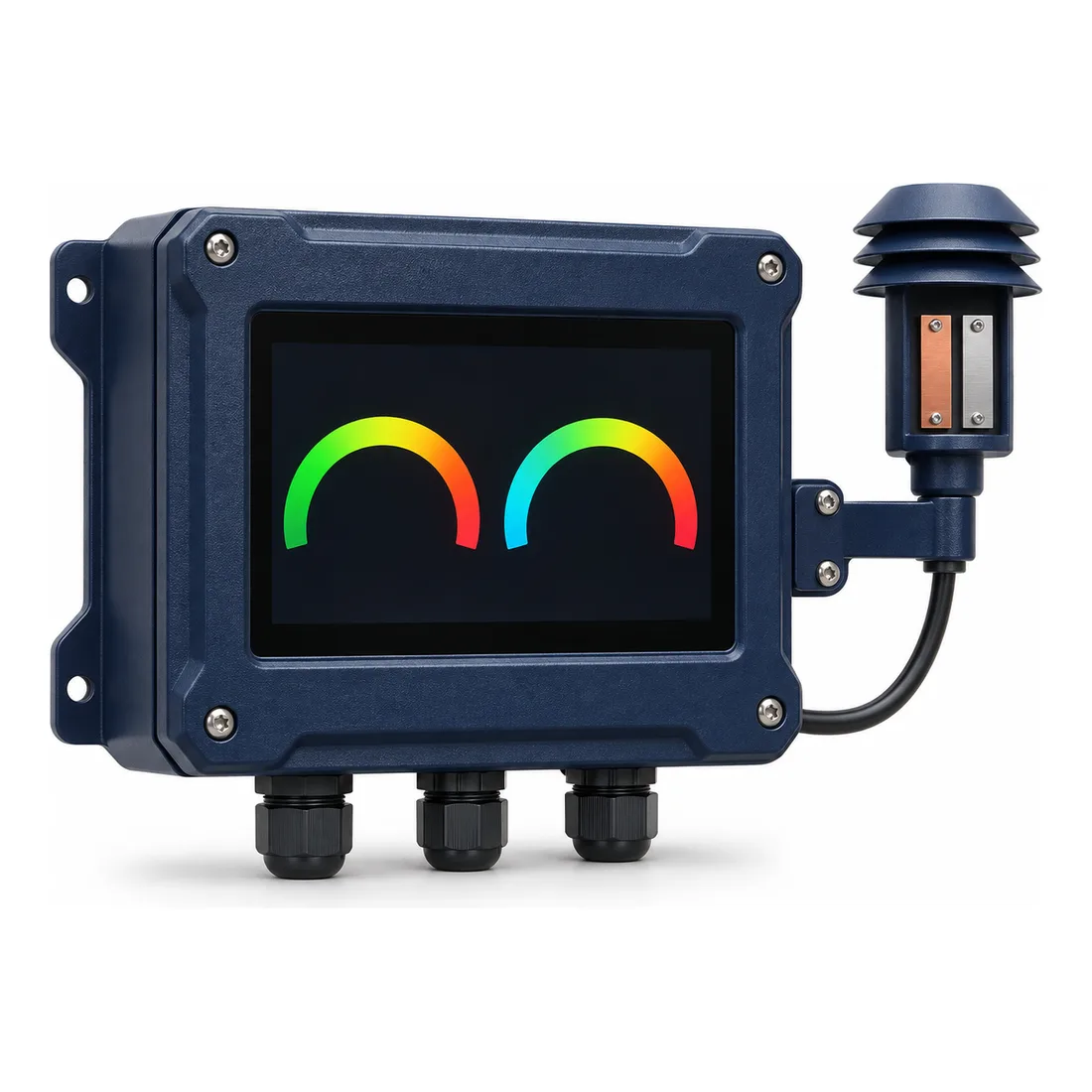
The coupon is placed in the server room, control room or display case to be assessed for 30–90 days, then retrieved, analysed in a laboratory and reported. A coupon gives a cumulative result and the film composition for a period; to see changes in corrosion rate in real time with alarms on exceedance, use the atmospheric corrosion monitor BS-ACM instead.| Item | Corrosion classification coupon | Atmospheric corrosion monitor BS-ACM |
|---|---|---|
| Data obtained | Cumulative corrosion over 30–90 days and film composition | Real-time corrosion rate, temperature, relative humidity, differential pressure |
| Power | None needed | 24 V DC or less |
| How results are read | Retrieved, analysed in a laboratory and reported | Live on the unit display, output over Ethernet or 4–20 mA |
| Best for | Periodic surveys, multi-point comparison, display cases | Critical points that need real-time alarms |
Frequently Asked Questions
How long should a coupon stay out, and why are results given "per 30 days"?
Usually 30–90 days. Both the ISA-71.04 G1–GX limits and the conservation C1–C5 / S1–S5 limits are defined as corrosion film thickness over 30 days, so a coupon exposed for longer is normalised to 30 days before it is classified.
Copper reads G1 and silver reads G2. Which class applies?
The more severe one, so G2. The report lists the film composition for copper and silver separately; a high silver chloride (AgCl) share, for example, means chlorine-bearing gases should be tackled first.
Which table applies to a museum display case?
The C1–C5 / S1–S5 conservation classes. Collections of paper, textiles and metal objects require C1 and S1 (copper < 90 Å and silver < 40 Å per 30 days), and general stores C2 and S2, far stricter than the G1 used for data centres.
The result is G2 or worse. What next?
Use the film composition in the report to find the main gas (sulphide films usually come from H₂S or SO₂, chloride films from chlorine-bearing gases), choose chemical media or AMC chemical filtration equipment for that gas, and after the fix place a fresh set of coupons to confirm the target class is reached again.
Selection References
Before ordering, verify the efficiency grade, media type, and whether the operating environment fits your requirements.