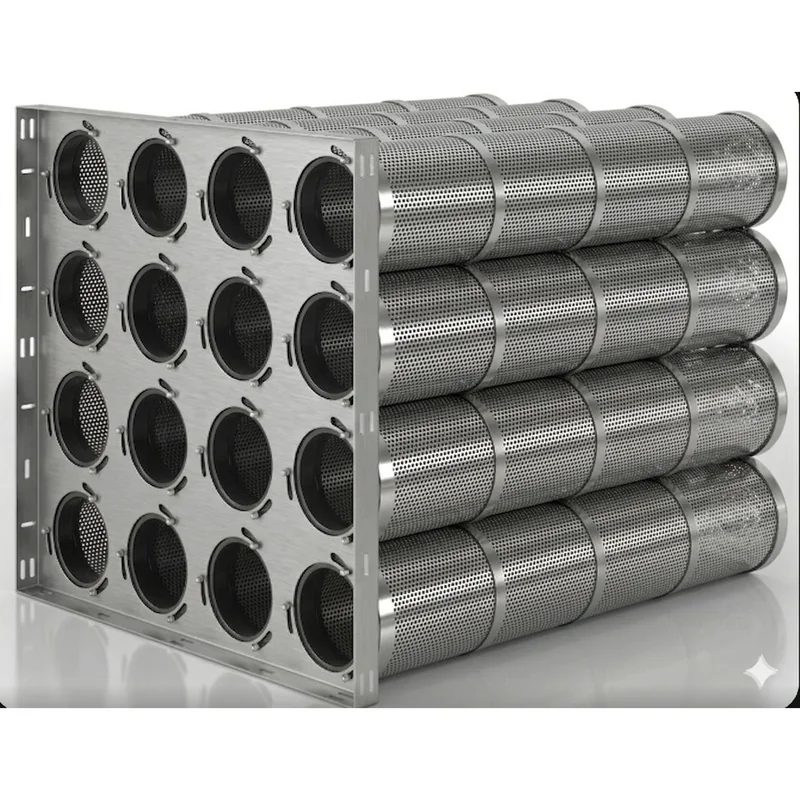
MOF Chemical Filter (Metal-Organic Framework AMC Filter)
Product Overview
Features & Specifications



Detailed Description
What is a MOF, and how large is its surface area?
As a class of materials, MOFs can exceed 7000 m²/g of specific surface area; this is a property of the material (a literature value), not a measurement of a single filter. Acidic and basic gases are held by hydrogen bonding, Lewis acid–base, electrostatic and van der Waals interactions; VOCs are held by hydrogen bonding and π-π interactions.How does a MOF chemical filter differ from conventional impregnated carbon?
The difference lies in how gases are removed and in the pore structure. A conventional chemical filter relies on activated carbon adsorption plus an oxidising or acid–base reaction from an impregnant; MOF media relies on capture in specific pores plus functional groups in the material itself.| Aspect | Conventional impregnated carbon | MOF media |
|---|---|---|
| Removal mechanism | Adsorption plus an oxidising or acid–base reaction from the impregnant (e.g. potassium permanganate, sodium hydroxide) | Capture in specific pores plus the material's own functional groups, for targeted removal and breakdown |
| Target contaminants | Acidic and basic gases and organics | Acidic and basic gases and organics |
| Pore structure | Micropores, mesopores and macropores mixed, pore size not adjustable | Stable framework, uniform pores of designable size |
| Source of reactivity | Impregnant is consumed as it reacts | Functional groups are part of the material structure |
V-bank and box-type MOF chemical filter specifications
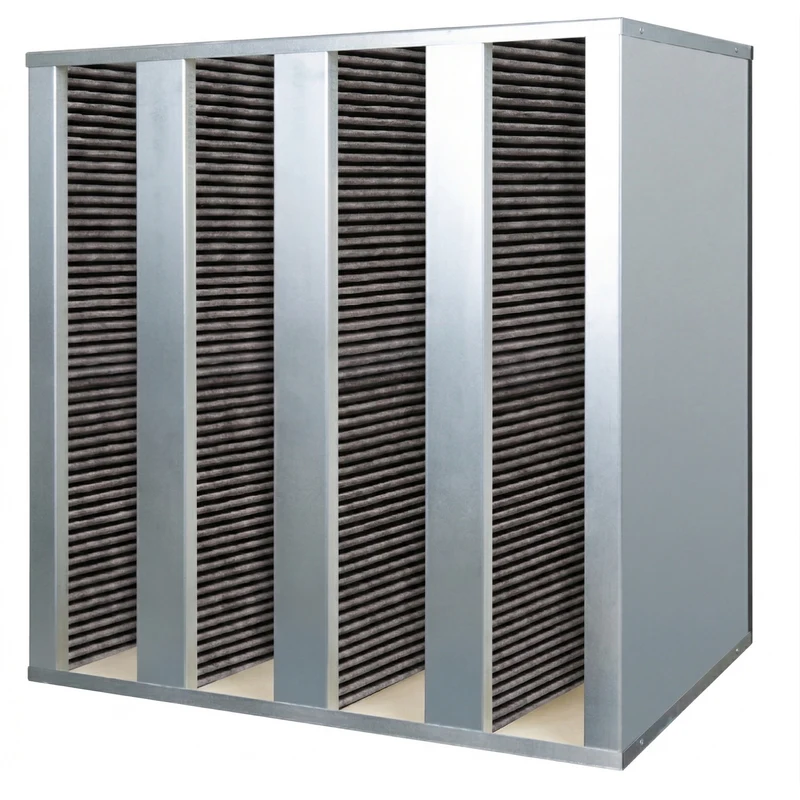
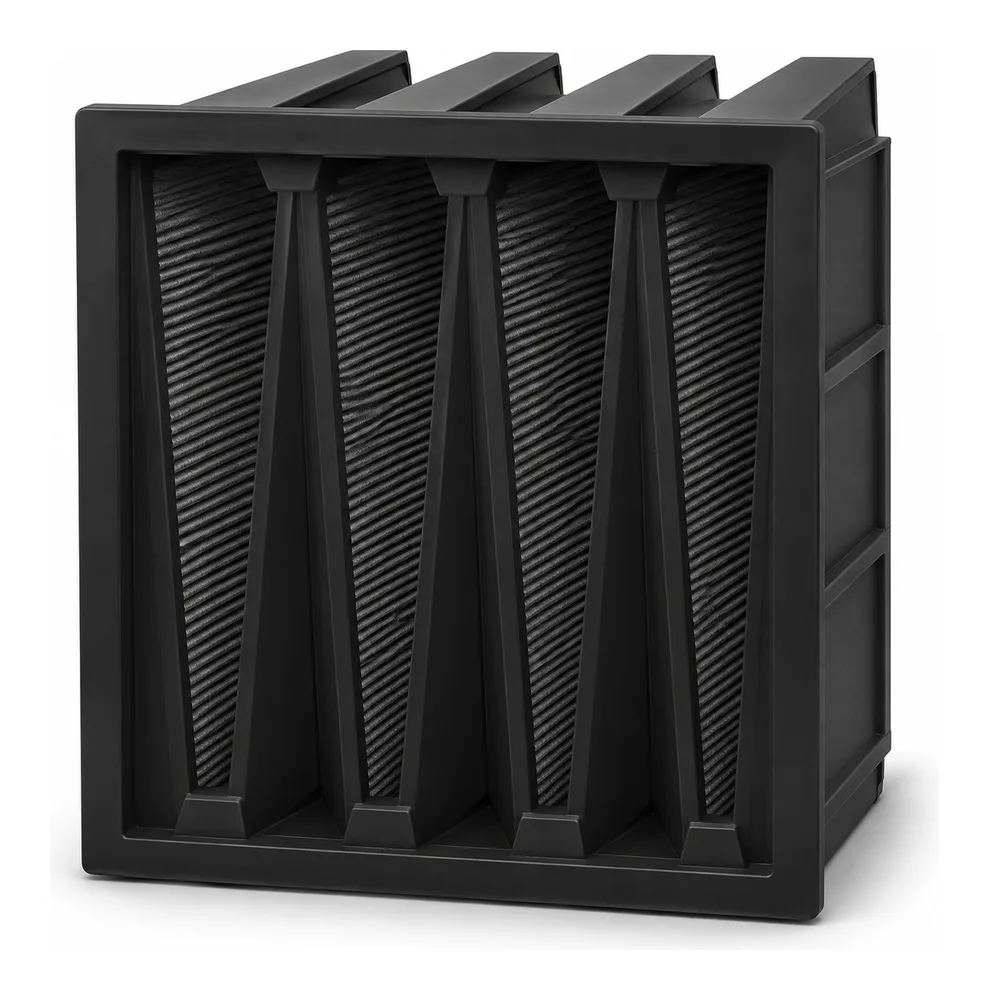
Both have the same outer size and drop straight into a 24×24×12 in filter frame; they differ in construction and frame material. Under the SEMI F21 AMC classification, the MA version targets acidic molecules, the MB version basic molecules, and the VOC version condensable molecules (MC).| Model | Construction | Dimensions (mm) | Frame | Core media area | Target contaminants |
|---|---|---|---|---|---|
| BS-MOF-V-MA | V-bank, single layer of fine pleats | 592×592×292 | Plastic | Per selection | Acid gases (SO₂, H₂S, NOₓ, acid mist) |
| BS-MOF-V-MB | V-bank, single layer of fine pleats | 592×592×292 | Plastic | Per selection | Basic gases (NH₃, amines) |
| BS-MOF-V-VOC | V-bank, single layer of fine pleats | 592×592×292 | Plastic | Per selection | Condensable organics (VOC) |
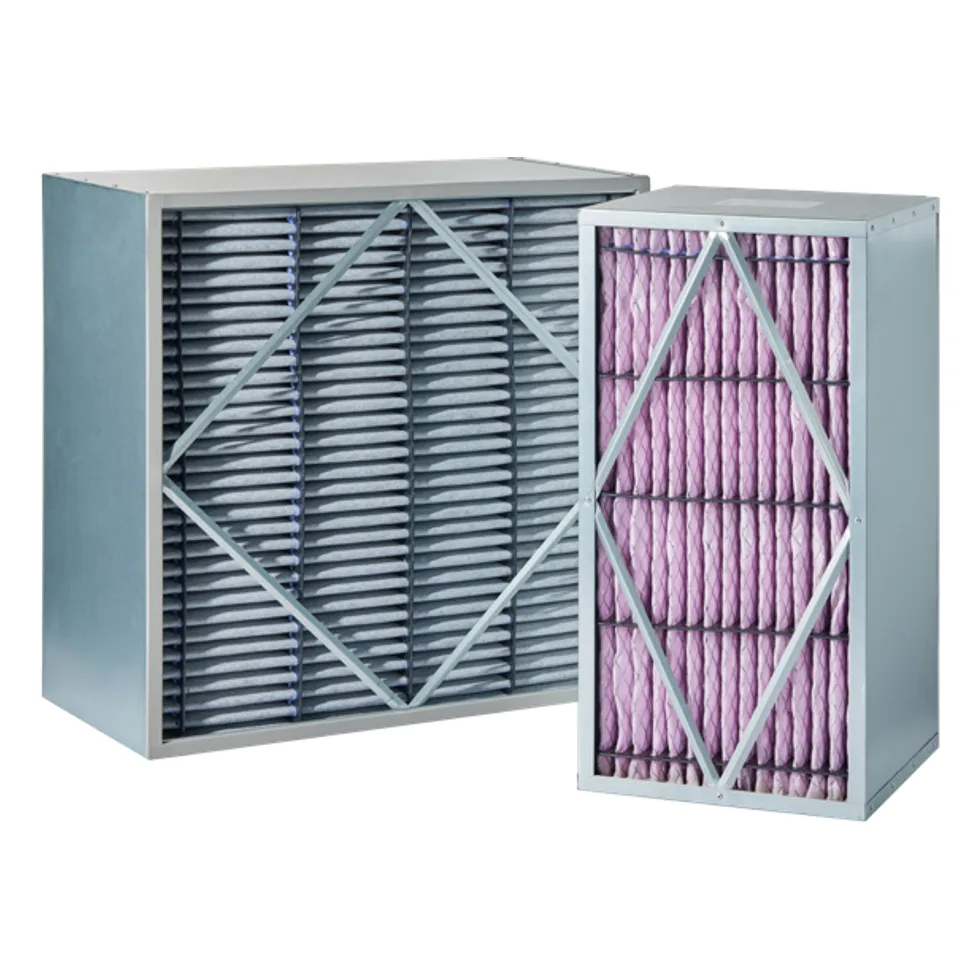
| BS-MOF-X-MA | Deep-pleat box | 592×592×292 | Galvanized steel or aluminium | 11.5 m² | Acid gases (SO₂, H₂S, NOₓ, acid mist) |
| BS-MOF-X-MB | Deep-pleat box | 592×592×292 | Galvanized steel or aluminium | 11.5 m² | Basic gases (NH₃, amines) |
| BS-MOF-X-VOC | Deep-pleat box | 592×592×292 | Galvanized steel or aluminium | 11.5 m² | Condensable organics (VOC) |
MOF chemical filter efficiency curves (SO₂, NH₃, toluene)
The supplier's laboratory tested at 2 m/s face velocity, 23°C, 50% RH and 10 ppm: initial removal efficiency was about 98%–99%, and at 300 minutes the V-bank type was at 85.4%–89.1% and the box type at 86.0%–87.7%. This is a high-concentration accelerated test for comparing models and gases; real service life has to be estimated from the site's concentration and airflow.MOF chemical filter removal efficiency vs time
V-bank and box type, each tested with SO₂, NH₃ and toluene
Supplier laboratory data: 2 m/s face velocity, 23°C, 50% RH, 10 ppm. Curves redrawn from the coordinates of the original graphics; values are readings (about ±0.5%). The vertical axis starts at 70%.
| Type | FFU service condition | MAU service condition |
|---|---|---|
| V-bank (BS-MOF-V) | about 14 Pa | about 85 Pa |
| Box type (BS-MOF-X) | about 13 Pa | about 115 Pa |
Third-party laboratory test results
Samples of the MOF chemical filter were also sent to third-party laboratories for long-duration tests; results for three gases are below.| Test gas | Test conditions | Result |
|---|---|---|
| SO₂ | Airflow 1137 m³/h, about 10 ppm | Initial 99.6%; 94.1% at 360 minutes, 91.0% at 720 minutes, 78.2% at 1440 minutes; 762.2 g adsorbed in total when it fell to 70.4% at 1633 minutes |
| Toluene | 9.92 ppm, face velocity 0.5 m/s (600×600 mm cross-section) | Fell to 74.2% at 720 minutes, 265.0 g adsorbed in total |
| NH₃ | 10.07 ppm, face velocity 0.5 m/s (600×600 mm cross-section) | Still 98.2% at 720 minutes, 53.8 g adsorbed in total |
MOF granular media and carbon cloth specifications
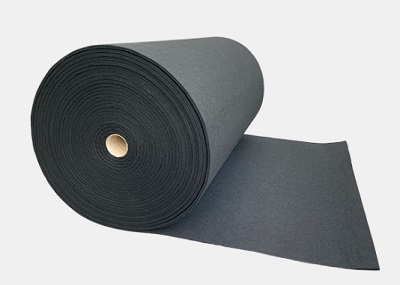
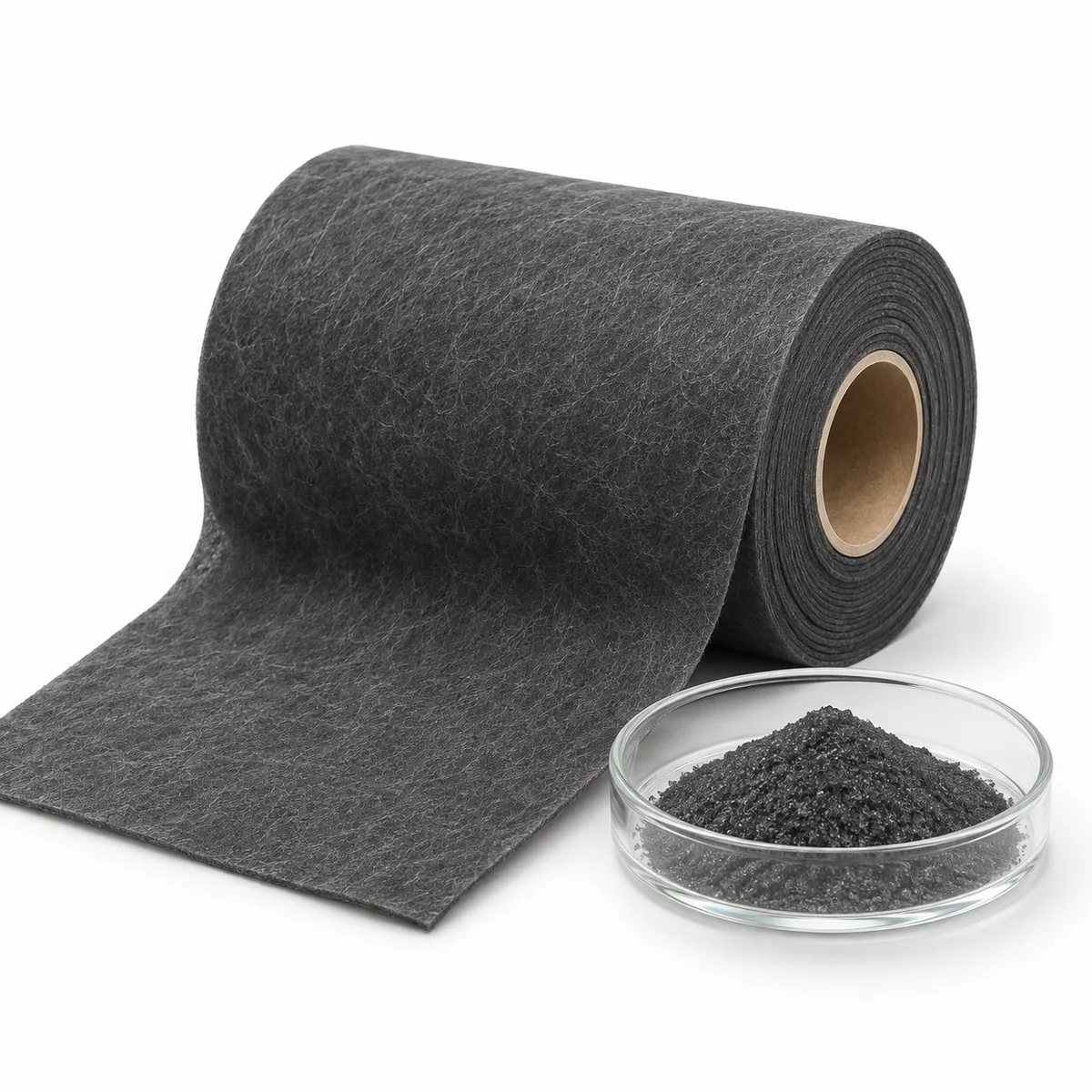
BS-MOF-M is a MOF granular media made by a binder-free process, in acid-removal, base-removal and VOC-removal versions; BS-MOF-C is a MOF carbon cloth for pleating into chemical filters. The tables give the values in the supplier's specification sheet, and each model is governed by its shipping data sheet; remaining-life analysis of the media is also available.| Model | Use | Mass adsorption ratio |
|---|---|---|
| BS-MOF-M-MA | Acid removal | 4%–12% |
| BS-MOF-M-MB | Base removal | 1%–3% |
| BS-MOF-M-MC | VOC removal | 8%–12% |
| Media property | Test method | Specified value |
|---|---|---|
| Adsorption efficiency | ASTM D5742/D3467 | 60% |
| Apparent density | ASTM D2854 | 0.5 g/cc |
| Moisture content | ASTM D2867 | 20% |
| Total ash | ASTM D2866 | 10% |
| Hardness | ASTM D3802 | 98% |
| Particle size | ASTM D2862 | 30×60 mesh 90%; >30 mesh 5%; <60 mesh 5% |
| Iodine number | ASTM | 800 mg/g |
| Impregnant content | — | 5% |
| pH | ASTM | 10–12 |
| Adsorption ratio | ISO 10121 | ≥ 4% (g/g) |
| Carbon cloth property (BS-MOF-C) | Specification |
|---|---|
| Composition | PET, activated carbon, PP |
| Basis weight | 950 g/m² ±10% (carbon content 800 g/m² ±10%) |
| Thickness | 2–2.5 mm |
| Resistance | ≤ 18 Pa (32 L/min, TSI 8130) or 50 Pa (0.2 m/s) |
| Particle filtration efficiency | ≥ 35% @0.4 μm (EN 779) |
| Function | Acid removal (SO₂, H₂S, etc.) |
| SO₂ uptake | 4% (w/w, average); a 50 mm disc falls to 70% efficiency only after adsorbing more than 30 mg |
| Test conditions | 25±2°C, humidity 50±3%, with reference to ISO 10121-1 |
Frequently Asked Questions
Can a MOF chemical filter go straight into my existing 24×24×12 in chemical filter frame?
Yes. Both the V-bank (BS-MOF-V series) and the box type (BS-MOF-X series) measure 592×592×292 mm, the actual size of a standard 24×24×12 in filter, so they fit an air handler or MAU frame of the same size without duct changes. Other sizes can be made to order; send us the inside frame dimensions and the airflow.
How do I choose between the V-bank and box-type MOF chemical filter?
The V-bank type has a plastic frame with a single layer of fine pleats arranged in V banks; the box type is a deep-pleat construction in a galvanized steel or aluminium frame with 11.5 m² of core media. In the supplier's pressure-drop data the two are close under the FFU service condition (about 14 Pa and about 13 Pa), while under the MAU condition the V-bank is about 85 Pa and the box type about 115 Pa; for systems with little fan reserve, look at the V-bank first, and choose the box type where a metal frame is required.
The efficiency curves were measured at 10 ppm, and our plant runs far lower. Can I scale the service life directly?
Not directly. The curves come from an accelerated test at 2 m/s face velocity and 10 ppm, intended for comparing models and gases; real service life has to be estimated from the contaminant species, concentration and airflow on site. Send us your AMC measurements and we will recommend a model; during service, media samples can also be drawn for remaining-life analysis.
Can I buy the MOF granular media and carbon cloth on their own and build my own filters?
Yes. BS-MOF-M is a 30×60 mesh MOF granular media in acid-removal MA, base-removal MB and VOC-removal MC versions, with mass adsorption ratios of 4%–12%, 1%–3% and 8%–12% respectively; the BS-MOF-C carbon cloth weighs 950 g/m² and is 2–2.5 mm thick, and can be pleated into chemical filters.
Selection References
Before ordering, verify the efficiency grade, media type, and whether the operating environment fits your requirements.