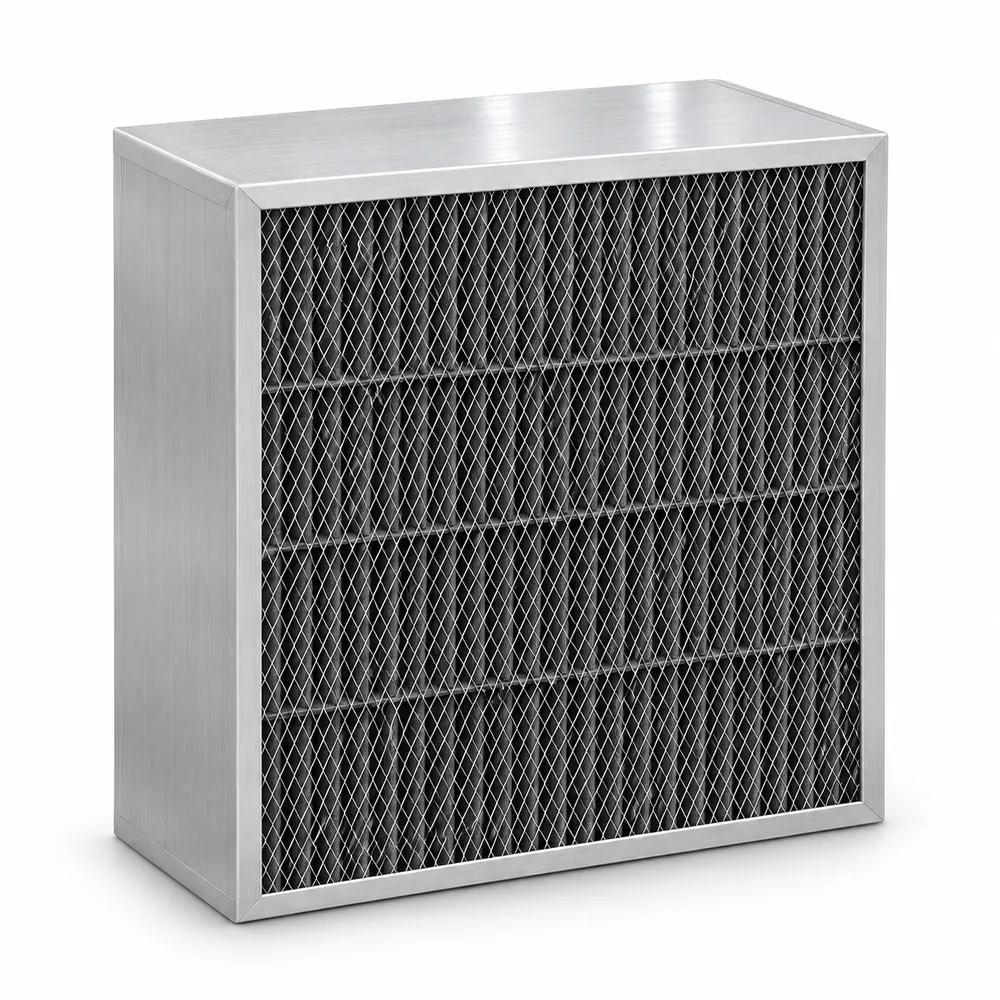
HEPA + Chemical Combination Filter (HEPA and Activated Carbon in One Frame)
Product Overview
Features & Specifications



Detailed Description
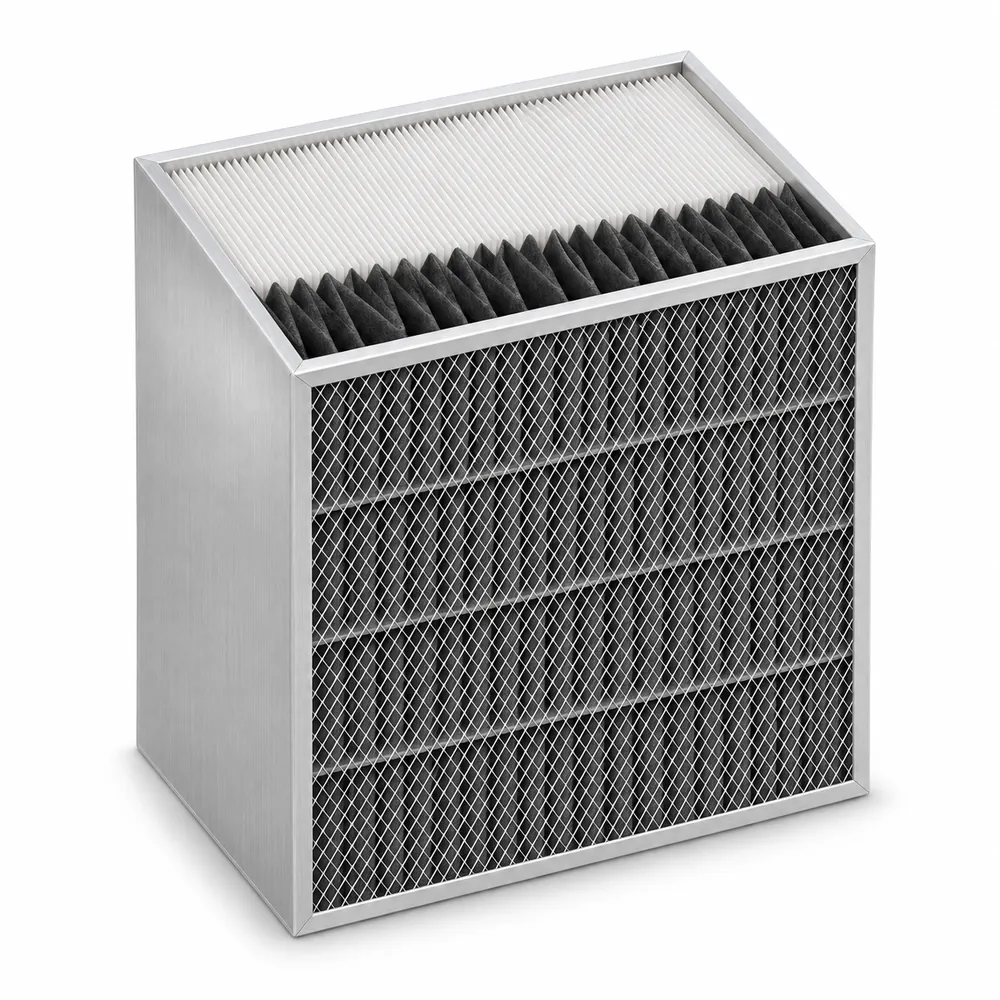
Custom depth split: how to divide the chemical block and the HEPA block
The depth split between the two blocks is made to order for each site, which is the main flexibility of a combination filter. A deeper chemical block holds more media and has more adsorption capacity; a deeper HEPA block has more media area, lower pressure drop and more dust-holding capacity. The table shows three common splits for a total depth of 290 mm; other ratios and total depths can also be made.| Model | Chemical block depth | HEPA block depth | Chemical media area | HEPA media area | Initial pressure drop (1000 m³/h) | Weight |
|---|---|---|---|---|---|---|
| BS-HCC-C1H2 (standard) | 97 mm | 193 mm | approx. 4.6 m² | approx. 30 m² | approx. 120 Pa | approx. 11 kg |
| BS-HCC-C1H1 | 145 mm | 145 mm | approx. 7.2 m² | approx. 22 m² | approx. 140 Pa | approx. 12.5 kg |
| BS-HCC-C2H1 | 193 mm | 97 mm | approx. 9.7 m² | approx. 15 m² | approx. 200 Pa | approx. 14 kg |
| Site condition | Suggested split | Why |
|---|---|---|
| Low gas concentration, mainly particle removal | BS-HCC-C1H2 | Largest HEPA media area, lowest pressure drop |
| Gases and particles both matter | BS-HCC-C1H1 | Half and half, a balance of capacity and pressure drop |
| Higher gas concentration, longer replacement interval wanted | BS-HCC-C2H1 | Most chemical media, about 2 times the adsorption capacity of the standard split |
Choosing the chemical block: acid, basic, organic gases and MOF
The media in the chemical block is chosen by target gas: acid, basic and organic gases each have matching media, and MOF (metal-organic framework) media is also available. Tell us the target gases and concentrations when you enquire and we will match the media; blended media can be used when several gases are present together.| Target gas | Typical gases | Media options |
|---|---|---|
| Acid gases | H₂S, SO₂, NOx, HCl, HF | Alkaline-impregnated activated carbon, potassium permanganate alumina, acid-removal MOF (BS-MOF-M-MA) |
| Basic gases | NH₃, amines | Ammonia-removal impregnated activated carbon, base-removal MOF (BS-MOF-M-MB) |
| Organic gases | Toluene, IPA, acetone, PGMEA | Coconut-shell activated carbon, VOC-removal MOF (BS-MOF-M-MC) |
| Mixed gases | Acid, basic and organic together | Blended media |
| Chemical block form | How it is made | Suited to |
|---|---|---|
| Wrapped pleats (standard) | Granular media wrapped in non-woven fabric and pleated, carbon loading 300 or 600 g/m² | High airflow, low pressure drop |
| Activated carbon cloth | Activated carbon cloth or MOF carbon cloth (BS-MOF-C), pleated | A thin chemical block that leaves depth for the HEPA |
| Honeycomb block | Extruded honeycomb block placed in the frame as one piece | Higher gas concentrations, longer contact time |
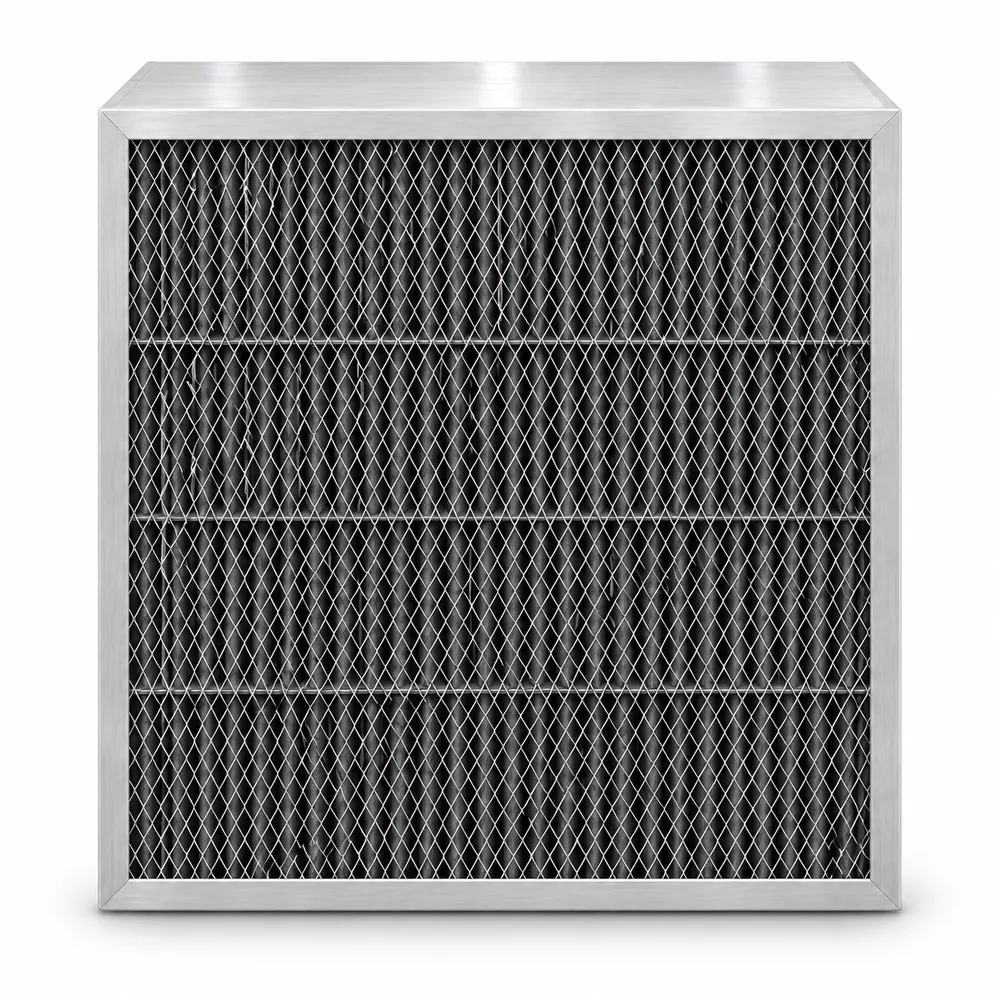
HEPA + chemical combination filter specifications: airflow, pressure drop, efficiency
The standard BS-HCC-C1H2 has a rated airflow of 1000 m³/h (face velocity 0.75 m/s) with an initial pressure drop of about 120 Pa; the recommended maximum is 1700 m³/h, where the pressure drop is about 210 Pa. The HEPA block is 99.97% or 99.99% (@0.3 μm), with ULPA optional. The chemical block has an initial removal efficiency above 90% at a face velocity of 0.35 m/s; at higher velocities the contact time is shorter and efficiency falls, so choose a deeper chemical block for high concentrations. The operating environment is 0–40°C and 30–70% relative humidity, set by the range of the chemical media; the HEPA block itself withstands up to 70°C.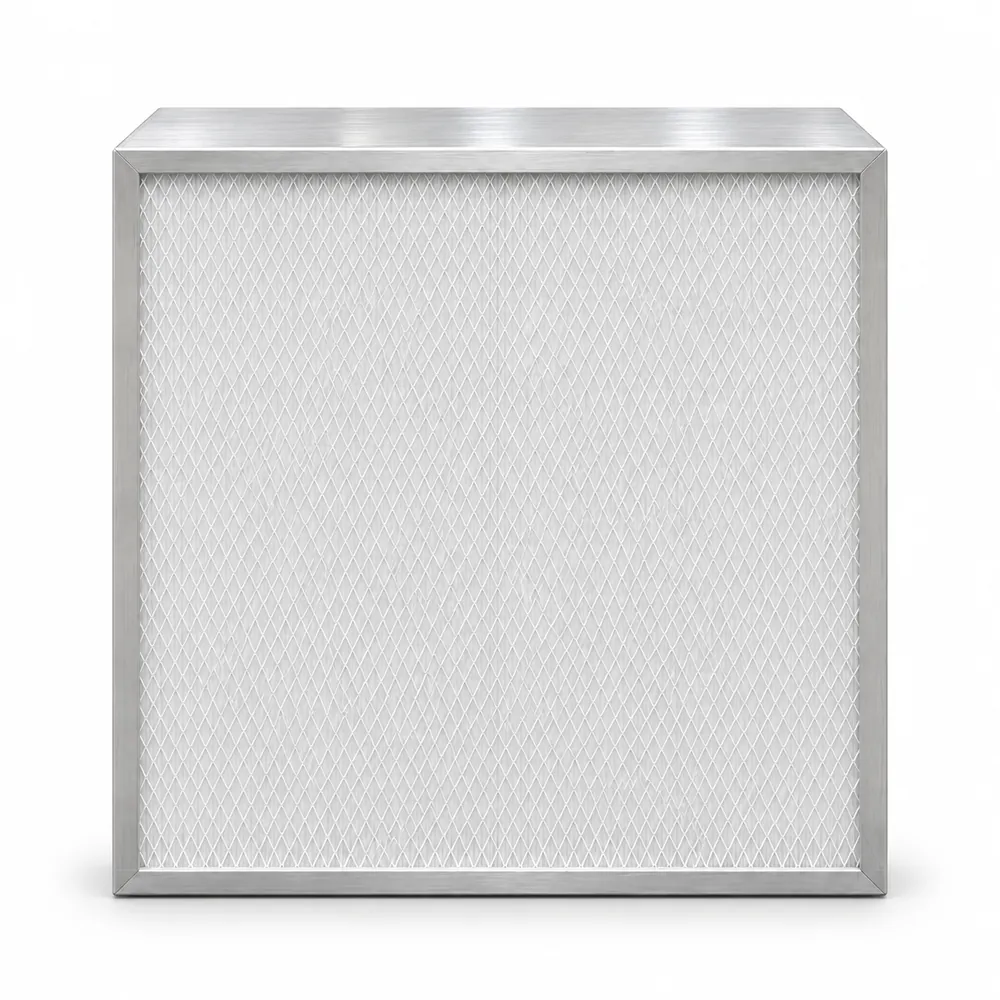
Combination filter versus a separate chemical filter and HEPA
A combination filter saves installation depth and one filter frame, while two separate stages can be replaced independently. Choose the combination filter where depth is short or the existing frame takes only one filter; choose separate stages where the chemical media is used up quickly and you want to change it on its own.| Aspect | HEPA + chemical combination filter | Separate chemical filter and HEPA |
|---|---|---|
| Installation depth | One filter, 290 mm | Two filters plus the gap between them |
| Frames and sealing faces | One set | Two sets |
| Replacement | The whole filter is replaced together | Chemical stage and HEPA stage replaced separately |
| Fines from chemical media | The chemical block is on the inlet side, so fines are caught by the HEPA in the same frame | Caught by the HEPA stage that follows |
Frequently Asked Questions
Can I specify the depth of the chemical block and the HEPA block in a combination filter?
Yes. For a total depth of 290 mm the standard split is a 97 mm chemical block plus a 193 mm HEPA block (BS-HCC-C1H2); it can also be made 145 mm each (BS-HCC-C1H1) or 193 mm chemical plus 97 mm HEPA (BS-HCC-C2H1), and other ratios, total depths and outside dimensions are made to order. Send us the inside frame dimensions, airflow and target gases.
Why is the chemical block on the inlet side and the HEPA on the outlet side?
The chemical block uses granular media, which can shed a small amount of fines in service; with the HEPA behind it, those fines are caught by the HEPA in the same frame and the outlet face stays clean. Installed the other way round, the fines would go straight downstream.
Can the chemical block use MOF media?
Yes. The chemical block can use MOF carbon cloth (BS-MOF-C) or MOF granular media (acid removal BS-MOF-M-MA, base removal BS-MOF-M-MB, VOC removal BS-MOF-M-MC), with the same frame and HEPA block. Tell us the target gases and we will confirm the suitable MOF model.
When the chemical block is spent, can I replace just the chemical block?
In the standard product both blocks are fixed in one frame, so the whole filter is replaced when the media is spent or the HEPA reaches its final pressure drop. For positions with higher gas concentrations we suggest BS-HCC-C2H1, which has the deeper chemical block, or installing a chemical filter and a HEPA as two separate stages.
Selection References
Before ordering, verify the efficiency grade, media type, and whether the operating environment fits your requirements.