Một nhà máy chip logic tiên tiến không phải toàn bộ đều cùng một cấp độ sạch. Khu quang khắc yêu cầu hạt 0.1 μm ít hơn 10 hạt/m³, trong khi khu hành lang cho phép 3,520 hạt/m³ — chênh nhau 10,000 lần.
Vì sao phải "phân vùng"? Không thể làm cả nhà máy ở mức nghiêm ngặt nhất sao?
Câu trả lời là: vấn đề tiền bạc, và cũng là vấn đề vật lý.
Nâng cả nhà máy lên ISO Class 1, chi phí xây dựng tăng 5–10 lần, tiền điện vận hành hàng năm (chủ yếu từ quạt và điều hòa) cũng tăng gấp bội. Về mặt vật lý, khu vực có người làm việc vốn dĩ sẽ sinh ra hạt (vảy da, sợi vải), muốn giữ không gian có người ổn định ở Class 1 gần như bất khả thi.
Giải pháp là thiết kế phân vùng: mỗi khu vực có mục tiêu độ sạch khác nhau.
Biểu đồ 2: Mỗi khu vực fab một cấp sạch
Không phải cả fab cùng một cấp
| Khu | Cấp sạch | Lọc | Lý do |
|---|---|---|---|
| Quang khắc | ISO Class 1–2 | U15 / U16 ULPA | Mask rất nhạy với hạt |
| Etch / màng mỏng | ISO Class 3–4 | U15 hoặc H14 | Vật tư và khí phản ứng |
| SX chính / lối đi | ISO Class 5–6 | H14 HEPA | Di chuyển người, vận chuyển |
| Hỗ trợ / văn phòng | ISO Class 7–8 | H13 hoặc trung | Khu không quy trình |
- ▸Quang khắc / EUV: ISO Class 1–2, ULPA + dòng khí tầng (laminar flow) + kiểm soát AMC độc lập
- ▸Khắc / lắng đọng màng mỏng: ISO Class 3–4, U15 hoặc H14
- ▸Sản xuất chung: ISO Class 5–6, HEPA H14
- ▸Hỗ trợ / văn phòng: ISO Class 7–8, lọc trung cấp hoặc H13
Điểm mấu chốt: phân vùng không phải cắt xén chất lượng, mà là tối ưu hóa kỹ thuật. Nơi thực sự cần Class 1 chỉ là xung quanh mặt nạ quang và một số thiết bị quy trình; những nơi khác làm đến Class 1 là lãng phí.
Ba lớp phòng tuyến phân công thế nào?
Biểu đồ 1: Ba lớp phòng thủ lọc khí của fab bán dẫn
Mỗi lớp xử lý một mức ô nhiễm khác — từ thô đến phân tử
Fab tiên tiến thêm lớp lọc hóa trên FFU cho AMC.
Mỗi lớp phòng tuyến tương ứng với mức độ ô nhiễm khác nhau:
Lớp thứ nhất: xử lý khí ngoài (MAU / OAU)
Khí ngoài trời được lọc một lần trước khi vào nhà máy. Cấu hình điển hình: lọc thô G4 + lọc trung cấp F7–F9, xử lý bụi hạt lớn, phấn hoa và một phần PM2.5. Một số nhà máy còn bổ sung màng lọc hóa học tại đây để xử lý AMC từ bên ngoài như NH₃, SO₂.
Lớp thứ hai: xử lý không khí tuần hoàn (RCU)
Lực lượng chủ lực của không khí tuần hoàn trong nhà máy. Lắp HEPA H13–H14, xử lý phần lớn hạt kích thước mịn (dưới 0.3 μm). Lớp phòng tuyến này làm tốt thì FFU phía sau đỡ vất vả.
Lớp thứ ba: lọc đầu cuối (FFU)
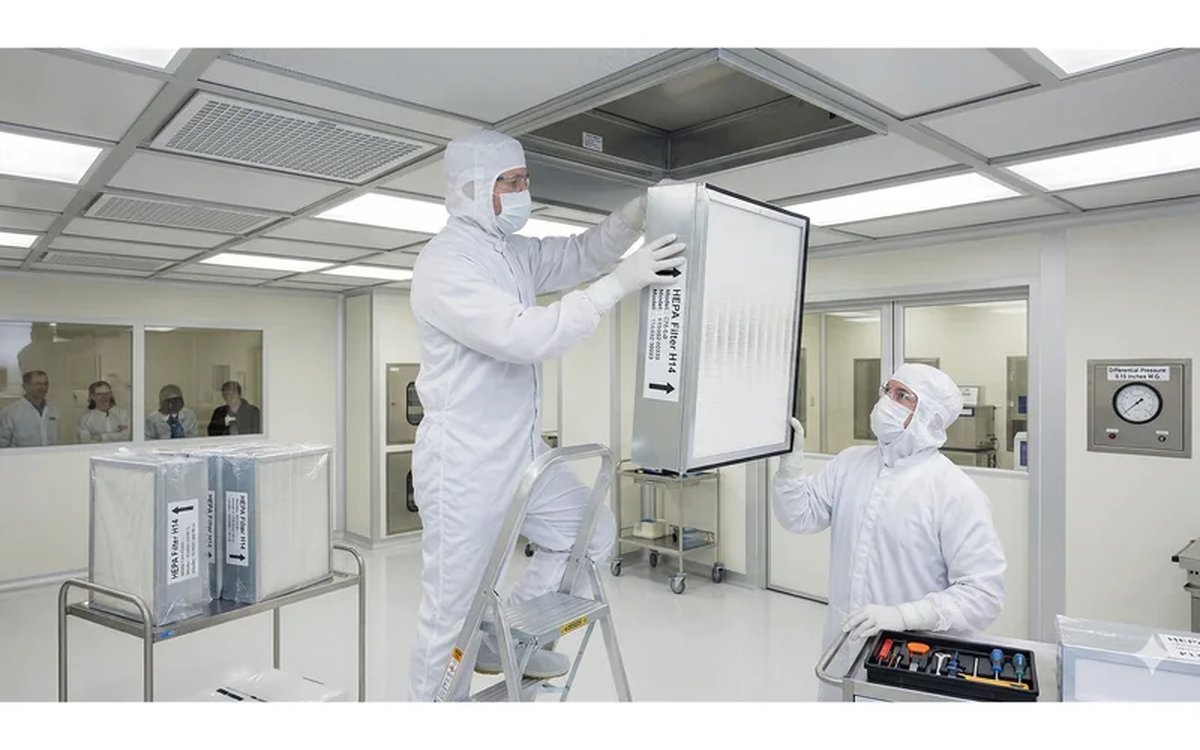
Lớp cuối cùng trên trần, cấp khí trực tiếp cho mặt phẳng làm việc của phòng sạch. HEPA H14 hoặc ULPA U15, đạt hiệu suất trên 99.995% tại MPPS (0.1–0.3 μm). Đây là lớp gần wafer nhất, bất kỳ rò rỉ cục bộ nào cũng ảnh hưởng trực tiếp đến quy trình.
Node dưới 3 nm thêm những thách thức gì?
Độ rộng đường mạch ngày càng nhỏ, lọc không khí không chỉ phải xử lý hạt mà còn cả chất ô nhiễm cấp phân tử (AMC).
Thay đổi thứ nhất: kiểm soát AMC nâng từ "có thể phát hiện" lên "không thể phát hiện". Trước đây kiểm soát NH₃ đến 10 ppb là đạt, giờ 1 ppb cũng bị coi là nhiều. Hiệu suất, tuổi thọ và giám sát của màng lọc hóa học đều phải nâng cấp.
Thay đổi thứ hai: cấp khí siêu sạch chuyên dụng cho mặt nạ quang EUV. Độ nhạy của mặt nạ quang EUV với vi hạt cao hơn DUV trên 10 lần, một tấm mặt nạ có giá hàng chục triệu USD. Bên trong hộp lưu trữ mặt nạ (POD) cần cấp khí siêu sạch độc lập + giám sát AMC theo thời gian thực, không thể dựa vào không khí tuần hoàn của nhà máy.
Thay đổi thứ ba: quản lý ô nhiễm bên trong FOUP (hộp đựng wafer). Wafer di chuyển giữa các máy nhờ FOUP, nhưng bản thân FOUP là nhựa, sẽ giải phóng AMC một cách chậm rãi. Các nhà máy tiên tiến lắp thêm màng lọc hóa học cỡ nhỏ hoặc hệ thống thổi quét liên tục bên trong FOUP.
Hai sai lầm thường gặp nhất trong thiết kế phân vùng
Sai lầm 1: chênh áp không đạt
Chìa khóa của thiết kế phân vùng không chỉ là cấp màng lọc mà còn là chênh áp. Khu độ sạch cao phải duy trì áp dương +5 đến +15 Pa so với khu độ sạch thấp, nếu không ô nhiễm từ khu cấp thấp sẽ thẩm thấu ngược qua khe cửa và việc ra vào của nhân viên.
Các sơ suất thường gặp trong thực tế: cửa mở quá thường xuyên, độ kín khí không đủ, vị trí cửa hồi gió sai — đều phá vỡ chênh áp. Kết quả là khu quang khắc trên danh nghĩa là Class 1 nhưng đo thực tế thường vọt lên Class 2 hoặc Class 3.
Sai lầm 2: chỉ nhìn màng lọc, bỏ qua lưu lượng gió và số lần trao đổi khí
Độ sạch ≠ cấp màng lọc. Một khu vực có duy trì được cấp độ hay không còn phụ thuộc số lần trao đổi khí mỗi giờ (ACH):
- ▸ISO Class 5: 400–600 ACH
- ▸ISO Class 7: 70–100 ACH
- ▸ISO Class 8: 20–40 ACH
ACH không đủ thì màng lọc tốt mấy cũng vô ích — vì tốc độ sinh ô nhiễm nhanh hơn tốc độ pha loãng. ACH quá cao lại tốn điện và thổi bay lớp cản quang. Đây là điều phải tính toán rồi mới quyết định.
Phân vùng + phân lớp + chênh áp + số lần trao đổi khí — thiết kế đồng thời cả bốn chiều mới là kiến trúc lọc không khí phòng sạch bán dẫn hoàn chỉnh.
Tối ưu hóa đơn điểm (chỉ nâng cấp một lớp lọc nào đó) thường không giải quyết được vấn đề tỷ lệ thành phẩm, vì ô nhiễm là vấn đề mang tính hệ thống.