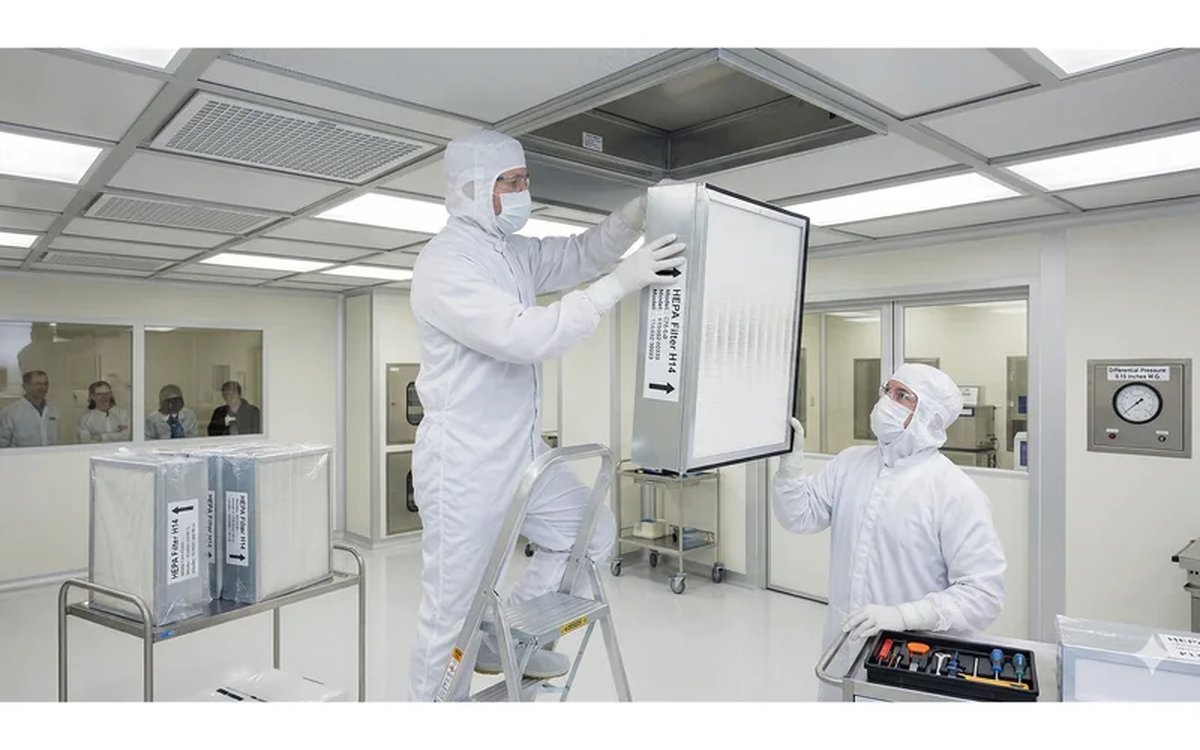
An advanced logic fab isn't uniformly clean. The litho bay must hold 0.1 μm particle count below 10 per m³, while aisles allow 3,520 per m³ — a 10,000× gap.
Why Zones at All? Why Not Just Run the Whole Fab at the Tightest Class?
Answer: cost, and physics.
Pulling the whole fab to ISO Class 1 costs 5–10× more to build and roughly doubles annual HVAC electricity. Worse, areas where humans actually work generate particles (skin cells, garment fibers). Holding a human-occupied space at Class 1 is near-physically impossible.
The solution is zone design — different cleanliness targets for different areas.
Chart 2: Zone-by-Zone Cleanliness in an Advanced Fab
Not every area is the same class — typical zoning in a logic fab
| Zone | Cleanliness | Filter | Why |
|---|---|---|---|
| Lithography bay | ISO Class 1–2 | U15 / U16 ULPA | Reticle is extremely sensitive — a particle ruins the pattern |
| Etch / thin-film | ISO Class 3–4 | U15 or H14 | Process consumables and reactive gases |
| Main production / aisle | ISO Class 5–6 | H14 HEPA | People movement and transport — baseline clean |
| Support / office | ISO Class 7–8 | H13 or medium | Non-process zones, prevent cross-contamination |
- ▸Litho / EUV — ISO Class 1–2, ULPA + laminar + dedicated AMC control
- ▸Etch / thin-film — ISO Class 3–4, U15 or H14
- ▸General production — ISO Class 5–6, H14 HEPA
- ▸Support / office — ISO Class 7–8, medium or H13
The point: zoning isn't a corner cut — it's engineering optimization. The only areas that truly need Class 1 are the reticle path and some process tool environments. Running the rest at Class 1 wastes money.
How Do the Three Lines of Defense Divide Work?
Chart 1: The Three Lines of Air-Filtration Defense in a Fab
Each tier handles a different contamination scale — from coarse to molecular
Advanced nodes (3 nm and below) add a chemical-filter layer above the FFU for AMC, plus a dedicated ultra-clean supply for EUV reticle handling.
Each line handles a different contamination scale:
Line 1: Make-up air (MAU / OAU)
Outdoor air gets filtered before entering. Typical stack: G4 pre + F7–F9 medium, catching coarse dust, pollen, and some PM2.5. Many fabs add a chemical filter here to catch NH₃, SO₂, and other external AMC.
Line 2: Recirculation (RCU)
The workhorse for the fab's internal circulation. Loads H13–H14 HEPA, handling most of the sub-0.3 μm size range. Getting this line right means the downstream FFU has a much easier job.
Line 3: Point-of-use (FFU)
The ceiling FFU directly above the cleanroom work plane. H14 HEPA or U15 ULPA, delivering ≥99.995 % efficiency at MPPS (0.1–0.3 μm). This is the line closest to the wafer — any local leak lands directly on the process.
What's Different at 3 nm and Below?
As line widths shrink, air filtration must handle not just particles but molecular contamination (AMC):
Change 1: AMC control goes from "detectable" to "undetectable." Where a decade ago NH₃ under 10 ppb was acceptable, advanced nodes now target below 1 ppb. Chemical filter efficiency, lifetime, and monitoring all need to scale up.
Change 2: Dedicated ultra-clean supply for EUV reticle handling. EUV reticles are >10× more particle-sensitive than DUV, and single reticles run into tens of millions of USD. Reticle PODs require independent ultra-clean supply + real-time AMC monitoring — they can't rely on fab recirculation.
Change 3: FOUP interior contamination management. Wafers travel between tools inside FOUPs, but the plastic FOUP itself slowly outgasses AMC. Advanced fabs now install micro chemical filters or continuous purge systems inside the FOUP.
Two Frequent Mistakes in Zone Design
Mistake 1: Pressure cascade not enforced
Zone design isn't just about filter grade — it's also about pressure differential. Clean zones must hold +5 to +15 Pa over the next-lower zone. If not, contamination from the dirtier side back-flows through door gaps and ingress points.
Common failure modes: doors opened too often, inadequate airtightness, wrongly placed returns. The litho bay is nominally Class 1 but measured reality drifts to Class 2 or 3.
Mistake 2: Watching the filter, ignoring flow and air-change rate
Cleanliness ≠ filter grade. Whether a zone actually sustains its class depends equally on air changes per hour (ACH):
- ▸ISO Class 5: 400–600 ACH
- ▸ISO Class 7: 70–100 ACH
- ▸ISO Class 8: 20–40 ACH
Insufficient ACH means the best filter is useless — contamination outpaces dilution. Excess ACH wastes energy and disrupts photoresist. This number has to be calculated, not guessed.
Zoning + layering + pressure cascade + ACH — four dimensions designed together is what makes fab air filtration actually hold.
Point-level optimization (upgrading one filter layer) rarely solves yield issues, because contamination is a system problem.