The weld seams on semiconductor gas lines are mirror-smooth, like the factory sculpted them.
>
Why go that far? Because weld roughness determines line-wide cleanliness.
Why HEPA Frames and Cleanroom Piping Require TIG
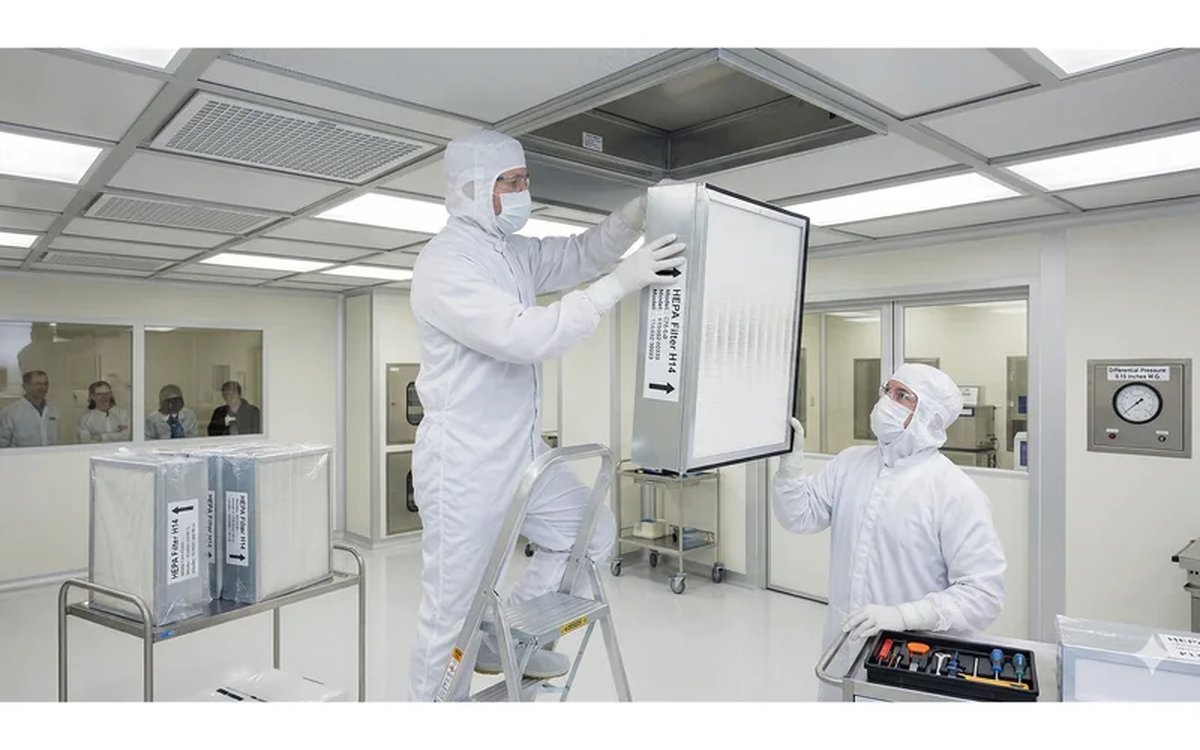
HEPA/ULPA frames, FFU housings, high-purity gas lines, pharma GMP piping — all TIG welded. Why not MIG or stick at 5–10× lower cost?
The answer is in the weld itself:
Problems with MIG / Stick
- ▸Slag — flux coatings leave slag adhering to pipe walls
- ▸Spatter — small metal balls scatter around the weld
- ▸Heat tint (oxide layer) — chromium oxides form at high temp, corrosion resistance drops
- ▸Porosity — micro-pores inside the weld that trap dust and harbor bacteria
Acceptable in general industrial. Unacceptable in cleanrooms, semi gas lines, pharma piping:
- ▸Slag → process contamination — downstream equipment swallows foreign debris
- ▸Oxide layer → degraded corrosion resistance — line lifetime slashed
- ▸Porosity → bacterial growth — mortal enemy in aseptic pharma
TIG Advantages
Chart 1: Three Mainstream Welding Methods — TIG / MIG / Stick
HEPA frames, FFU housings, cleanroom stainless piping — they're all TIG welded. Why?
| Method | Shield gas | Electrode | Bead quality | Speed | Typical use |
|---|---|---|---|---|---|
| TIG (GTAW) | Argon (Ar) / Helium (He) | Tungsten (non-consumable) | Excellent (smooth, no spatter) | Slow | Cleanroom piping, precision instruments, thin stainless |
| MIG (GMAW) | Ar + CO₂ / pure Ar | Wire (consumable) | High | Fast | General industrial, thick steel structures |
| Stick (SMAW) | None (flux-coated rod) | Rod (consumable) | Medium (spatter, slag) | Medium | Field work, outdoor, thick plate |
TIG (Gas Tungsten Arc Welding) is the industry standard for precision stainless welding. Smooth weld bead, no spatter, no contamination of process gases — exactly why semiconductor, biotech, and pharma cleanrooms demand it. Trade-off: slower and more expensive labor.
TIG = Tungsten Inert Gas welding, also GTAW.
- ▸Non-consumable tungsten electrode — no metal debris into the weld
- ▸100% argon shield — full oxygen/moisture exclusion, no oxidation, no porosity
- ▸Can weld without filler — thin stainless can fuse directly, seams so smooth they're nearly invisible
- ▸Repeatable weld quality — same welder, same machine, each seam matches spec
Cost: slower and more expensive labor. A TIG welder can complete about a third the length per day vs MIG, at 1.5–2× the hourly rate.
Alloy Selection: Not All "Stainless" Is Equal
Chart 2: Common Stainless + Nickel-Base Alloys
Not all "stainless" is equal — 304 / 316L / 321 / Hastelloy each serve distinct battlefields
| Alloy | Composition | Strength | Corrosion | Weldability | Typical use |
|---|---|---|---|---|---|
| 304 SS | Fe-18Cr-8Ni | Medium | Average (chloride weak) | Easy | General structural, HEPA frames, food equipment |
| 316L SS | Fe-17Cr-12Ni-2Mo low-C | Medium | Excellent (chloride, pitting) | Easy | Semi gas lines, pharma GMP, marine |
| 321 SS | Fe-18Cr-9Ni-Ti | Medium | Average, good high-temp | Easy | High-temp exhaust, turbines, aerospace |
| 904L SS | Fe-20Cr-25Ni-4.5Mo-Cu | Medium | Outstanding (H₂SO₄, H₃PO₄) | Medium | Acidic chemical, seawater |
| Hastelloy C-276 | Ni-16Cr-16Mo-4W | High | Outstanding (nearly anything) | Hard | Strong acids, chlorine, worst chemical |
| Inconel 625 | Ni-21Cr-9Mo-3.5Nb | Very high | Outstanding | Hard | High-temp + corrosion, aero engines, nuclear |
| Ti Gr. 2 | Pure titanium >99% | Medium | Outstanding (chloride, seawater) | Hard (full Ar shield required) | Chlorides, medical implants, chemical |
Wrong-alloy penalties: 304 in chloride environments pits and perforates; 316L in reducing acids fails; using Inconel for generic ductwork burns money. Alloy choice is tied to welding parameters — each alloy has dedicated pre-heat, shield-gas mix, and post-weld heat treatment requirements.
Engineers commonly assume "stainless is stainless." Wildly wrong.
304 vs 316L — a Mo makes the difference
304 (Fe-18Cr-8Ni) — standard stainless, lowest cost. Poor chloride resistance — coastal sites, salty environments, poolside pit in 6 months.
316L (Fe-17Cr-12Ni-2Mo + low carbon) — 2% molybdenum plus reduced carbon. Much better chloride resistance — semi fab HCl gas lines, pharma acid-wash equipment, marine environments must use 316L.
Key: "L" means Low Carbon. Lower carbon reduces grain-boundary corrosion risk, a common post-weld problem. All cleanroom piping uses 316L — don't save pennies with 316 standard.
321 — high-temp specialty
321 (Fe-18Cr-9Ni-Ti) — titanium added to stabilize high-temp carbides. Continuous 800°C without failure — aerospace engine exhaust, turbines, chemical high-temp. Chloride resistance ordinary, not for salt or acid.
Hastelloy C-276 — chemical hell scenario
Hastelloy (Ni-16Cr-16Mo-4W) — nickel base. Resists nearly anything chemical — strong acids, bases, chlorine, bromine.
Downside: 5–8× the cost of 316L, difficult to weld (requires strict heat input control). Reserved for worst-case chemical — strong acid processes, chlorine lines, fluorinated waste.
Inconel 625 — high-temp + corrosion double-edge
Inconel (Ni-21Cr-9Mo-3.5Nb) — nickel base, very strong. High-temp + corrosion resistant — aero engine hot section, nuclear reactors, power-plant boilers.
Titanium — chloride and medical
Ti Gr. 2 (pure Ti >99%) — lightweight, unparalleled chloride resistance (~100× better than 316L), biocompatible. Medical implants, seawater desalination, chlorine engineering — default choice.
Downside: weld-hard, requires full argon shielding — titanium above 500°C reacts violently with oxygen forming brittle TiO₂. Dedicated titanium weld chamber (purge box) isn't cheap.
Material × Welding — Joined at the Hip
Wrong alloy and even perfect welding fails. But right alloy with wrong welding fails the same way.
Three key parameters must match:
1. Preheat temperature
| Alloy | Preheat |
|---|---|
| 304 / 316L | Not required |
| Inconel 625 | Preheat to 150°C |
| Hastelloy C-276 | Extreme pre-weld cleanliness, usually no preheat |
| Ti Gr. 2 | No preheat, but back-side argon purge required |
2. Shield gas composition
| Alloy | Recommended shield |
|---|---|
| 304 / 316L | Pure Ar or Ar + 2% N₂ |
| Inconel | Pure Ar |
| Hastelloy | Pure Ar (high purity) |
| Ti | Pure Ar (absolutely no N₂ or O₂) |
3. Post-Weld Heat Treatment (PWHT)
| Alloy | Requirement |
|---|---|
| 304 / 316L | Usually not needed |
| 321 | 870°C stabilization anneal |
| Hastelloy C-276 | 1121°C solution anneal for thick plate |
| Ti | Stress-relief anneal for large parts |
Missing any parameter — weld corrosion resistance, strength, fatigue life can drop 50%.
Practical Recommendations
Ask three things before procurement
- 1Welding Procedure Specification (WPS) — can the vendor provide WPS for each alloy and joint type?
- 2Welder qualification (PQR) — are welders ASME or ISO 9606 certified? Certifications are not cross-alloy
- 3Acceptance testing — for cleanroom piping require helium leak test + borescope inspection + surface roughness Ra ≤ 0.4 μm after electropolish
Cost of wrong alloy
- ▸304 in chloride — pits through in 6 months
- ▸316 in reducing acid — fails in 1 year
- ▸Carbon steel at high temp — scales off in months
- ▸Carbon steel in medical — iron-ion contamination
Unit-cost difference may be tiny; rework, downtime, and contamination cleanup is 100× that.
HEPA frames, FFU housings, cleanroom piping — these "simple metal parts" rest on a precise combination of alloy selection and welding process. The right alloy with the right weld is the bedrock of any high-quality filtration system.