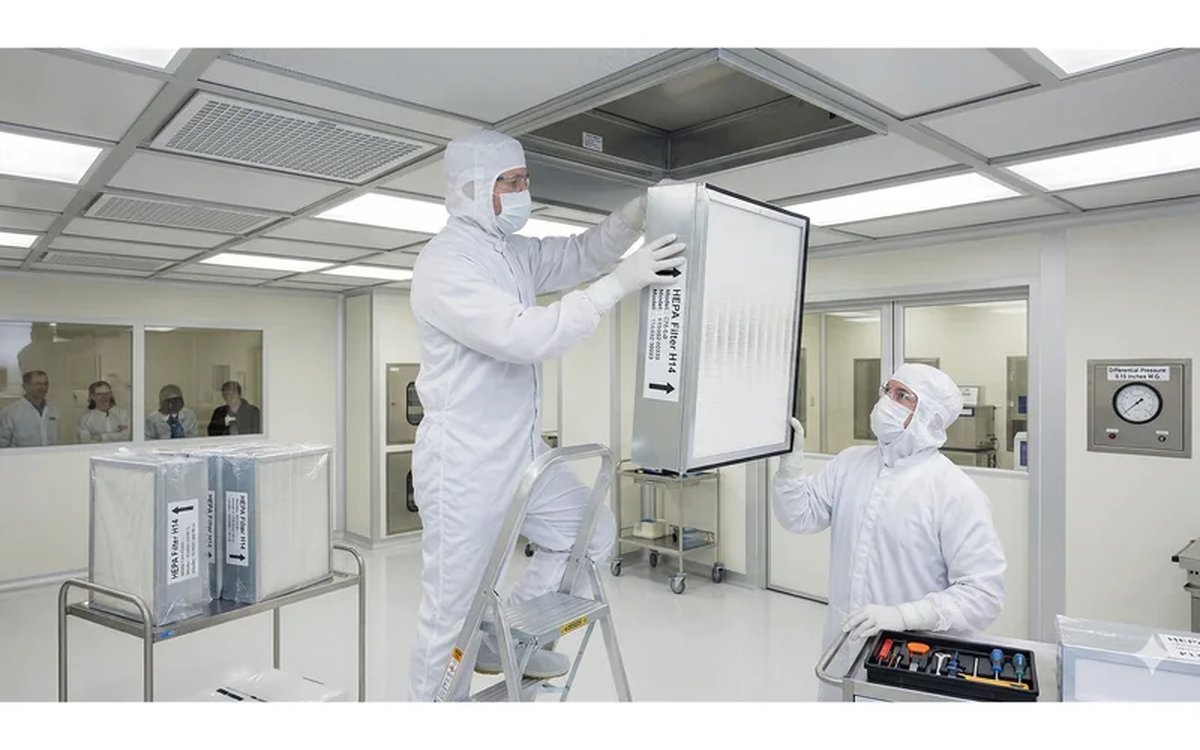
Many people shop for high-temperature filters by looking only at the media's temperature rating — then the media is fine but the sealant melts or the frame warps first. A filter's actual temperature ceiling = the lowest-rated component in the assembly.
Why the "Weakest Link" Decides Everything
A high-temperature filter has at least four components:
- ▸Filter media (glass fiber, quartz, metal, ceramic)
- ▸Sealant (bonds media to frame)
- ▸Gasket (seals the filter to the housing)
- ▸Frame (structural support)
Think of a chain: its strength equals its weakest link. If the media survives 500 °C but the sealant fails at 250 °C, the filter's real ceiling is 250 °C.
Four Sealant Materials Compared
| Sealant Type | Continuous Temp | Pros | Cons | Typical Use |
|---|---|---|---|---|
| Silicone | 250 °C | Most common, flexible, easy to apply | Lowest temp limit, carbonizes at high temp | General industrial, HVAC |
| Ceramic adhesive | 1000 °C+ | Extreme temp resistance | Zero flexibility after curing, vibration-sensitive | Kilns, incinerators |
| Metal gasket | 800 °C (SS) | Reusable, chemically resistant | Requires precision-machined flange faces | Semiconductor high-temp piping |
| Expanded graphite | 450 °C (in air) | Excellent compression recovery, chemically inert | Oxidizes above 450 °C in air | Chemical, petrochemical exhaust |
Silicone — Most Common, but Often the Bottleneck
Silicone is used in over 90% of filters. Easy to apply, affordable, flexible — but it's also the lowest-rated component in the system.
Above 250 °C, silicone carbonizes: it hardens, loses elasticity, then cracks. Once the seal fails, unfiltered hot air bypasses the media — the filter might as well not be there.
Practical tip: If continuous temperature exceeds 220 °C, seriously consider replacing silicone.
Ceramic Adhesive — Highest Temp, but Hates Vibration
Sets rock-hard like cement, exceeding 1000 °C. But it's completely rigid — any vibration or thermal cycling can crack it.
Good for stationary kiln exhaust; not for ventilation systems with fan vibration.
Metal Gaskets — The Semiconductor Choice
304 or 316 SS gaskets handle 800 °C and are reusable. Downside: they require precision-machined mating surfaces and higher installation cost.
Expanded Graphite — Great for Chemical Plants
Excellent compression recovery and chemical inertness. But above 450 °C in air it oxidizes — suitable only for sealed systems or inert-gas atmospheres.
Four Frame Materials Compared
| Frame Material | Continuous Temp | Weight | Corrosion Resistance | Notes |
|---|---|---|---|---|
| Galvanized steel | 200 °C | Medium | Poor | Cheapest; zinc vaporizes above 200 °C |
| Aluminum | 150 °C | Light | Medium | Light but softens at high temps |
| 304 Stainless | 800 °C | Heavy | Good | Standard choice for high-temp filters |
| 316 Stainless | 800 °C | Heavy | Excellent | For acid/alkali environments |
Aluminum — Never for High Temperature
Aluminum frames are light and cheap, common in room-temperature filters. But aluminum melts at 660 °C and starts softening above 150 °C. In a high-temp application? The frame warps before the media fails.
Galvanized Steel — 200 °C Hard Ceiling
Above 200 °C, the zinc coating vaporizes — losing corrosion protection and releasing zinc fumes that contaminate clean environments.
304 / 316 Stainless Steel — The Standard
304 SS handles 800 °C with good corrosion resistance and is the standard frame material for most high-temperature filters. For acid/alkali exhaust, upgrade to 316 SS (molybdenum addition improves corrosion resistance).
Recommended Combinations
| Temperature | Sealant | Frame | Notes |
|---|---|---|---|
| Room temp – 200 °C | Silicone | Galvanized or aluminum | Most economical |
| 200–350 °C | Silicone (short-term) or graphite | 304 SS | Silicone life drops sharply above 250 °C |
| 350–600 °C | Metal gasket or graphite | 304 SS | Silicone cannot be used |
| Above 600 °C | Ceramic adhesive or metal gasket | 304/316 SS | Highest-spec combination |
FAQ
Q: My filter is rated 350 °C but uses silicone sealant. How long will it really last?
If actually running above 300 °C, silicone life is roughly 3–6 months (vs. 1–2 years at normal temps). Upgrade to metal gaskets or graphite.
Q: Frame is 304 SS — anything to watch at welds?
Weld zones have reduced corrosion resistance (sensitization). If exhaust contains chlorides or acids, post-weld solution annealing or a switch to 316L is recommended. TIG welding is preferred — smallest heat-affected zone.
Q: Expanded graphite oxidizes at 450 °C in air. What about nitrogen atmosphere?
In inert gas (N2, Ar), expanded graphite handles over 2000 °C. It excels in sealed piping or inert-atmosphere furnaces — the problem is only in oxygen-containing environments.
Q: Is there a "universal" sealant that works everywhere?
No. That's why you must evaluate the entire system's temperature, chemical environment, and vibration. The most common mistake is ordering based on media spec alone, then having the sealant or frame fail first.
Q: How thick are high-temp filter frames typically?
304 SS frames are usually 0.8–1.2 mm (similar to room-temperature galvanized frames). For oversized panels (e.g., 1200 x 1200 mm), thickness increases to 1.5 mm or stiffening ribs are added.