A "high-temperature filter" sounds like one product — but the media inside falls into at least four families. Their temperature limits differ by 3x and prices by 10x. Choosing wrong doesn't just waste money; the media can shatter mid-process and contaminate your product with fiber debris.
Four High-Temperature Filter Media at a Glance
| Parameter | Glass Fiber | Quartz Fiber | Metal Fiber (SS/Ni-alloy) | Ceramic Fiber |
|---|---|---|---|---|
| Continuous use limit | 350 °C (special formulas: 400 °C) | 1000 °C | 600 °C (Ni-alloy: 800 °C) | 1200 °C |
| Peak tolerance | 400 °C | 1200 °C | 800 °C | 1400 °C |
| Filtration efficiency | Up to H14 (99.995%) | Typically E10–H12 | E10–H12 | E10–E11 |
| Initial pressure drop | Low (120–250 Pa) | Medium (200–400 Pa) | High (300–600 Pa) | High (400–800 Pa) |
| Washable / reusable | Single-use | Single-use | Pulse-jet or ultrasonic | Some types |
| Relative price | 1x | 3–5x | 5–8x | 8–12x |
| Typical service life | 6–18 months | 6–12 months | 3–5 years (washable) | 2–5 years |
Deep Dive into Each Media
Glass Fiber — "Best Value"
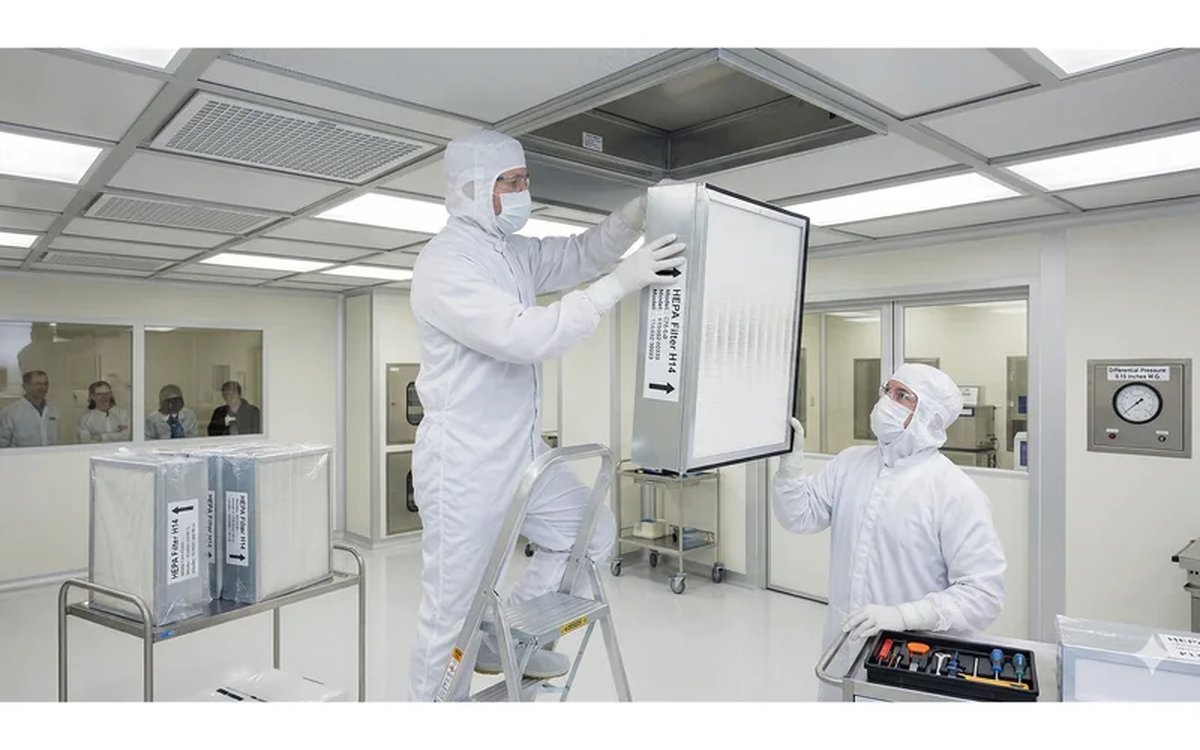
Glass fiber is the most common material in HEPA/ULPA filters. Standard borosilicate glass fiber handles about 250 °C; special boron-free formulas reach 350–400 °C.
Pros:
- ▸Highest filtration efficiency — up to ULPA grade (U15/U16)
- ▸Lowest pressure drop
- ▸Mature supply chain, most affordable
Cons:
- ▸Embrittles and shatters above its limit
- ▸Single-use, cannot be cleaned
- ▸Poor thermal-shock resistance
Best for: Semiconductor diffusion-furnace exhaust (up to 350 °C), post-CVD cooling exhaust, clean ovens
Quartz Fiber — "Highest Ceiling, Purest Material"
Quartz fiber (SiO2 purity 99.9%+) withstands up to 1000 °C — nearly 3x glass fiber.
Pros:
- ▸Extreme temperature ceiling
- ▸Chemically inert — zero metallic-ion release
- ▸Ideal where metal contamination is intolerable
Cons:
- ▸Efficiency caps around H12
- ▸Brittle — easily damaged during shipping
- ▸3–5x the price of glass fiber
Best for: High-temperature oxidation furnaces, annealing furnaces, ultra-high-purity semiconductor front-end exhaust
Metal Fiber — "The Reusable Workhorse"
316L stainless steel or nickel-alloy fibers drawn to 2–20 um and sintered. The headline feature: washable and reusable.
Pros:
- ▸Extreme mechanical strength
- ▸Pulse-jet or ultrasonic cleaning extends life to 3–5 years
- ▸Corrosion-resistant (especially 316L and Hastelloy)
Cons:
- ▸Efficiency ceiling is lower (typically H12 max)
- ▸Higher pressure drop
- ▸High upfront cost (but TCO can be lower)
Best for: Incinerators, aluminum smelters, cement kilns, high-temperature dust recovery
Ceramic Fiber — "Last Line of Defense"
Alumina or silicon-carbide filter tubes withstand up to 1200 °C — the highest of all four.
Pros:
- ▸Highest temperature ceiling
- ▸Resists strong acids and alkalis
- ▸Some designs allow pulse-jet cleaning
Cons:
- ▸Lowest filtration efficiency (typically E11 max)
- ▸Highest pressure drop
- ▸Most expensive (8–12x glass fiber)
Best for: Steel-making furnaces, glass kilns, ultra-high-temperature incinerators
Selection Decision Tree
Step 1 — Continuous operating temperature
- ▸Up to 350 °C → Glass fiber (most economical)
- ▸350–600 °C → Metal fiber
- ▸600–1000 °C → Quartz fiber or Ni-alloy metal fiber
- ▸Above 1000 °C → Ceramic
Step 2 — Required filtration efficiency
- ▸Need H13/H14 → Only glass fiber qualifies
- ▸E10–H12 is sufficient → All four are candidates
Step 3 — Total Cost of Ownership (TCO)
- ▸Downtime per filter change is expensive → Consider washable metal fiber
- ▸Filters are cheap and downtime is low → Disposable glass fiber wins
FAQ
Q: A glass-fiber HEPA is rated 350 °C. Is 300 °C safe for continuous use?
Check whether the rating is "continuous" or "peak." The former is the long-term ceiling; the latter may only survive minutes. If it's peak, running 300 °C continuously could embrittle the media within six months.
Q: Does metal-fiber efficiency drop after cleaning?
Slightly — typically less than 2%. Pulse-jet has the least impact; chemical cleaning requires checking reagent compatibility. Test efficiency with DOP or PAO after every cycle.
Q: Ceramic is much pricier than metal fiber. When is it unavoidable?
Two scenarios: temperature exceeds 800 °C, or exhaust contains strong acids/alkalis that corrode metal. Otherwise, metal fiber is usually the better pick.
Q: Can two different media be used in the same system?
Yes — commonly a metal-fiber pre-stage for coarse dust, followed by a glass-fiber HEPA for fine particles. The temperature between stages must drop to glass fiber's safe range.
Q: How do I tell if the media has embrittled?
Glass and quartz: press the surface lightly — you'll hear crackling; severe cases show white powder. Metal fiber doesn't embrittle but oxidizes and discolors. If pressure drop suddenly drops, the media has likely ruptured.