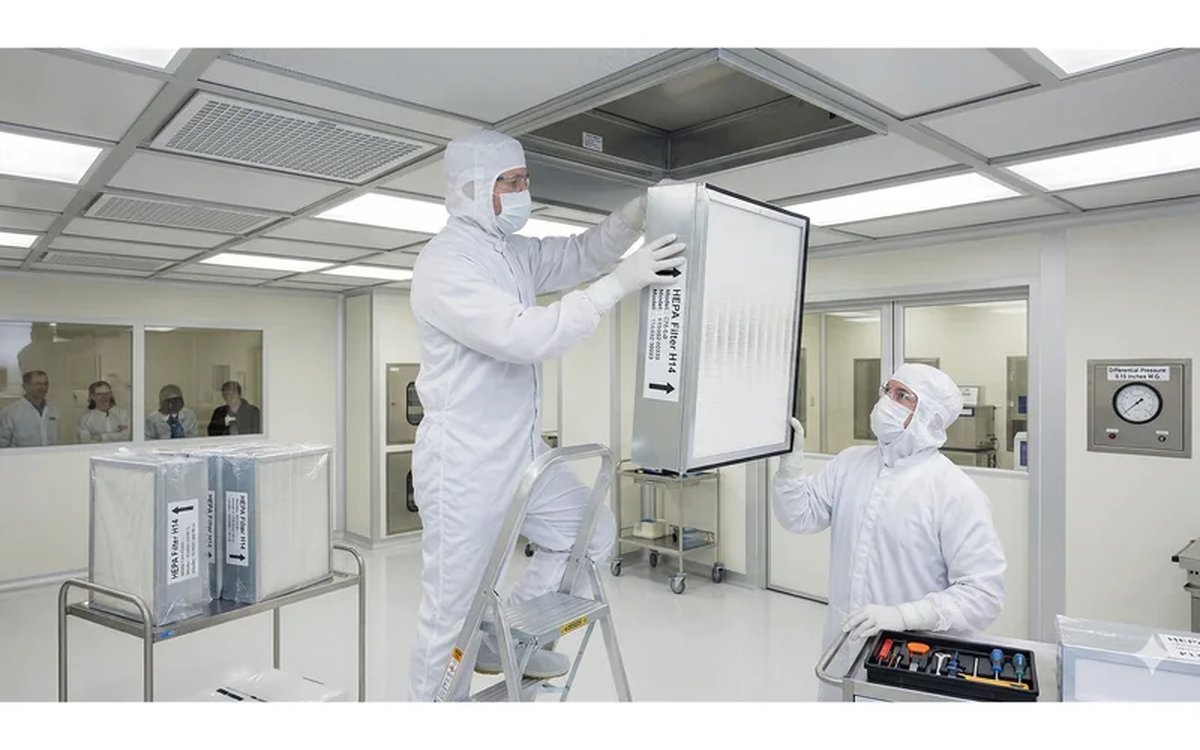
Spec says "room held at +5 Pa positive." You bring a handheld manometer and read +2 Pa.
>
Is it the instrument? HVAC design? Or — wrong position, wrong timing, wrong method all at once?
Most "ΔP wrong" problems aren't HVAC problems. They're measurement problems.
Why Is 5 Pa So Hard to Measure?
5 Pa is roughly the dynamic pressure of an A4 sheet falling 2 meters. In other words:
- ▸Someone opens a door → momentary ±20 Pa
- ▸Directly under an FFU → local jet +3 to +5 Pa
- ▸Near an exhaust → local suction −2 to −5 Pa
Your target signal (5 Pa) is the same order as the ambient noise. Without careful control, you literally cannot measure true value.
ΔP Measurement: Right vs Wrong
Chart 1: Where to Measure Pressure — Right vs Wrong
A 5 Pa error is rarely instrument noise — it's usually position
Do ✓
- 📍Room center, 1.2 m above floorRepresents the room's steady-state pressure, not local turbulence
- 🚪Wait 5 min after doors closeLet ΔP return to design value
- 🔄Average 3 readingsCancels single-reading noise
- 📏Instrument ≤ ±1 Pa precisionAny worse and a 5 Pa target is unverifiable
Don't ✗
- ⚠️Near door gaps or exhaustLocal turbulence swings readings ±3–5 Pa
- ⚠️Directly under FFU outletJet impingement fakes elevated pressure
- ⚠️Right after personnel transitDoor transit drops ΔP 10–20 Pa instantly
- ⚠️Consumer manometer (±5 Pa)Precision itself swamps the target
Target differential is typically ±5 to ±15 Pa between adjacent rooms; instrument precision must be at least ±1 Pa. Before measurement: all doors / windows closed and HVAC steady-state for ≥5 minutes.
Prerequisites before measurement
- 1All doors / windows closed ≥5 minutes — let ΔP settle to design value
- 2HVAC at steady state — readings during startup or VFD ramping are unreliable
- 3No personnel movement in the room — people disturb airflow
Position selection
Good positions:
- ▸Room geometric center, 1.2 m above floor (breathing height)
- ▸Avoid door gaps, exhaust openings, direct beneath FFUs, equipment exhaust
Bad positions:
- ▸Near doors — door transits distort
- ▸Near supply or return — local jet or suction
- ▸Behind equipment — wall eddies
Instrument selection
A handheld manometer with ±5 Pa precision is useless. To measure ±5 Pa, instrument precision should be ±1 Pa or better — otherwise the instrument reading itself falls in the ±5 Pa range and nothing can be concluded.
Recommended:
- ▸Digital micro-manometer, precision ±0.5 Pa
- ▸Real-time electronic ΔP transducer (installed on FFU, shown on central monitor)
Reading treatment
A single reading can't be trusted. Standard practice:
- ▸Log for 30 seconds continuously
- ▸Take average + standard deviation
- ▸Std. dev. > 2 Pa → conditions are unstable, find the cause (door not properly closed? HVAC not yet steady?)
Airflow Measurement: ISO 14644-3 Grid Rules
Chart 2: Airflow Velocity Measurement — Grid & Instrument
ISO 14644-3 grid: minimum √area points, evenly spaced
| Instrument | Range |
|---|---|
| Hot-wire anemometer | 0.05–30 m/s |
| Vane anemometer | 0.2–15 m/s |
| Flow hood | 40–3500 CMH |
- Hot-wire anemometer:First choice for low-speed laminar (±3 % accuracy)
- Vane anemometer:Medium-high speed outlet measurement
- Flow hood:Total FFU airflow, not point velocity
Target velocity depends on ISO class — Class 5 laminar is ~0.35–0.45 m/s; Class 7 turbulent prioritizes air changes (no point velocity target). The instrument must face into the flow during measurement.
What do different ISO classes require?
- ▸ISO Class 1–5 (laminar) → point-velocity uniformity: 0.35–0.45 m/s, deviation ≤ ±20 %
- ▸ISO Class 6–7 (turbulent) → Air Changes per Hour (ACH): 70–100 ACH
- ▸ISO Class 8–9 → ACH 20–40
Grid spacing
ISO 14644-3 formula: minimum points n ≥ √(area m²) × 10
A 10 m² room → at least 32 measurement points, evenly distributed.
Instrument selection
- ▸Hot-wire anemometer — low-speed laminar (0.05–30 m/s, ±3 % accuracy) first choice
- ▸Vane anemometer — medium-high speed outlets (0.2–15 m/s)
- ▸Flow hood — total FFU airflow (40–3500 CMH), not point velocity
Probe orientation
The probe must face into the flow — 30° off-axis reads 10–15 % low.
Common novice mistake: "wave the anemometer around" — utterly meaningless.
Beyond ΔP and Velocity — What Else to Measure
Full ISO 14644-3 qualification items:
- 1Particle concentration (OPC) — the headline, others supporting
- 2Airflow velocity ✓
- 3Pressure differential ✓
- 4Airflow visualization (smoke test) — confirm laminar is actually laminar
- 5Recovery test — how fast the room clears after a spike
- 6Leak test — filter scan test
Missing any one, qualification isn't complete.
Practical Recommendation: Standard Measurement SOP
Your facility should have a formal measurement SOP specifying:
- ▸Fixed time each quarter (remove time-of-day variation)
- ▸Fixed measurement points (marked, mapped)
- ▸Fixed instrument (annually calibrated)
- ▸Fixed operator (reduce human variation)
Same room, different values at different times — maybe the room hasn't changed, the measurement has. Holding variables constant reveals real change.
Pressure and airflow measurement isn't "grab a meter and read a number" — it's an engineering practice with standards, conditions, and instrument requirements. Done right, it reflects actual room state, catches problems early (before particle counts spike).