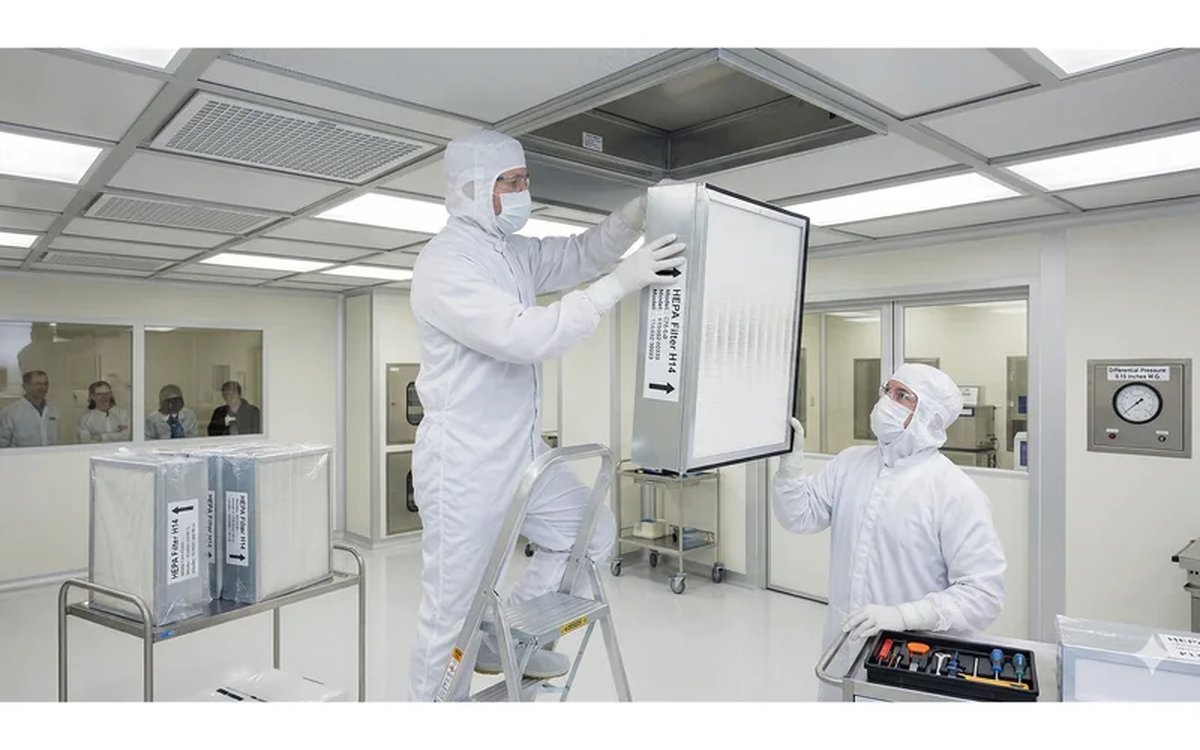
Traditional fiber filters have run for decades. But as PM2.5 becomes a public health issue and billions of filters hit landfills each year, membrane technology is emerging as the next generation.
The Dec 2025 review in Polymers (MDPI) maps the landscape systematically. Summary below.
Five Membranes, Five Battlefields
Chart 1: Five Families of Membrane-Based Air Filtration
Each family uses a different capture mechanism and fits a different use case
| Membrane type | Mechanism | Strength | Use |
|---|---|---|---|
| Nanofiber | Electrospun, tunable pore size | PM2.5 efficiency up to 99.9 % | High-eff, low ΔP |
| Microporous (PTFE / PVDF) | Precise pore control | Surface filtration, washable | Industrial, semi |
| Janus membrane | Dual-sided hydrophobicity | Particles + water management in one | Humid environments |
| Photocatalytic | TiO₂ / ZnO integrated | Decomposes VOC and hazardous gases | Indoor air + VOC |
| Hollow-fiber | Tubular geometry, high area ratio | Huge area per unit volume | Industrial-scale flow |
Synthesis from Polymers (MDPI) 2025 review. Actual selection depends on flow rate, concentration, regeneration needs, and cost.
1. Nanofiber membrane
Fabricated by electrospinning with fiber diameter tunable from tens to hundreds of nanometers. Enormous surface area.
- ▸PM2.5 capture efficiency up to 99.9 %+
- ▸Very low pressure drop at the same efficiency
- ▸Pore size tunable, broad use range
Application: high-efficiency needs with low-ΔP constraints — masks, vehicle purifiers, home air purifiers.
2. Microporous (PTFE / PVDF)
Precisely pore-controlled thin membrane. Covered in the earlier PTFE case — chemical inertness and low outgassing are its hallmarks.
- ▸Surface filtration, structurally stable
- ▸Washable and reusable
- ▸Excellent chemical resistance
Application: industrial, semiconductor acid-etch, processes needing long-term stability.
3. Janus membrane — hydrophilic on one side, hydrophobic on the other
A bi-functional membrane that performs particle filtration and water management simultaneously.
Why useful? In high humidity, water blocks conventional filter pores and collapses efficiency. A Janus membrane pushes water to the hydrophobic side while particles get captured at the hydrophilic side — the two functions don't interfere.
Application: humid environments — tropical, coastal, refrigeration perimeters.
4. Photocatalytic membrane — filter × catalyst
Integrates TiO₂ (titanium dioxide) or ZnO (zinc oxide) photocatalysts into the membrane. The same material filters particles AND decomposes VOC and hazardous gases via photocatalysis.
In short: "block only" upgraded to "block + decompose."
Application: indoor air (when UV light is available), spaces needing PM + VOC treatment.
5. Hollow-fiber membrane — tubular high-area ratio
Tubular geometry delivers huge filtration-area-per-volume — 5–10× higher than flat-sheet membranes at the same external dimensions.
Application: industrial-scale flow rates (chemical plants, power plant exhaust).
Three Forward Directions
Chart 2: Three Forward Directions for Membrane Development
From "just filtration" to multi-functional integration
Antimicrobial integration
Silver / copper-ion coatings add pathogen suppression on top of particulate filtration
Flame resistance
Meet building ventilation safety (UL / EN) without adding thickness or pressure drop
Reusable designs
Water-washable or thermally regenerable — 3–5× longer service life per unit, less landfill
All three directions feature prominently in the Polymers 2025 review and recent related research.
The paper highlights three directions:
Antimicrobial integration
Coat membrane surfaces with nano-silver, copper ions, or other antimicrobial agents. Filter and suppress pathogens simultaneously — extending useful clean life and reducing indoor microbial contamination.
Imagined applications: hospital wards, classrooms, public transit, pandemic-era public spaces.
Flame resistance
Building ventilation filters must meet fire-safety codes (UL 900, EN 13501-1). Conventional synthetic-fiber filters produce toxic fumes when they burn.
Next-gen membranes can hit higher fire ratings without adding thickness or pressure drop.
Reusable designs
Currently 90 %+ of filter media is synthetic fiber, non-biodegradable — single-use before landfill. Next-generation targets:
- ▸Washable — industrial-grade reuse 3–5 cycles
- ▸Thermally regenerable — an upgrade to activated-carbon-style regeneration
- ▸Recyclable — disassembly and material recovery into new filters
The saving is more than consumable cost — it's landfill burden.
What This Means for the Industry
Takeaways for filter makers and users:
First, no more "one best filter" world. Different scenarios, contaminants, and environments demand different membrane types. Over-committing to one family is a selection error.
Second, membrane selection isn't "look at pore size." The five families have fundamentally different mechanisms — pore size is just one dimension. Also matter: chemical resistance, humidity behavior, regeneration capability, catalytic function need.
Third, sustainability is entering purchasing criteria. Efficiency and pressure drop used to be it. Going forward, lifecycle impact, recyclability, and energy consumption will factor into procurement evaluation.
Membrane air filtration isn't replacing traditional fiber — it's providing new answers where traditional fiber is inadequate. Over the next few years expect: nanofiber dominating high-end air purifiers, Janus membranes penetrating humid markets, photocatalytic membranes claiming a share of indoor PM + VOC spaces, and hollow-fiber becoming default in large-flow industrial settings.
Traditional glass-fiber filters won't disappear, but "suitable only for certain scenarios" will become the norm.